
Gilchrist pots way to new world milestones
SINGAPORE — He is a three-time world champion and also has three South-east Asian (SEA) Games gold medals to his name.
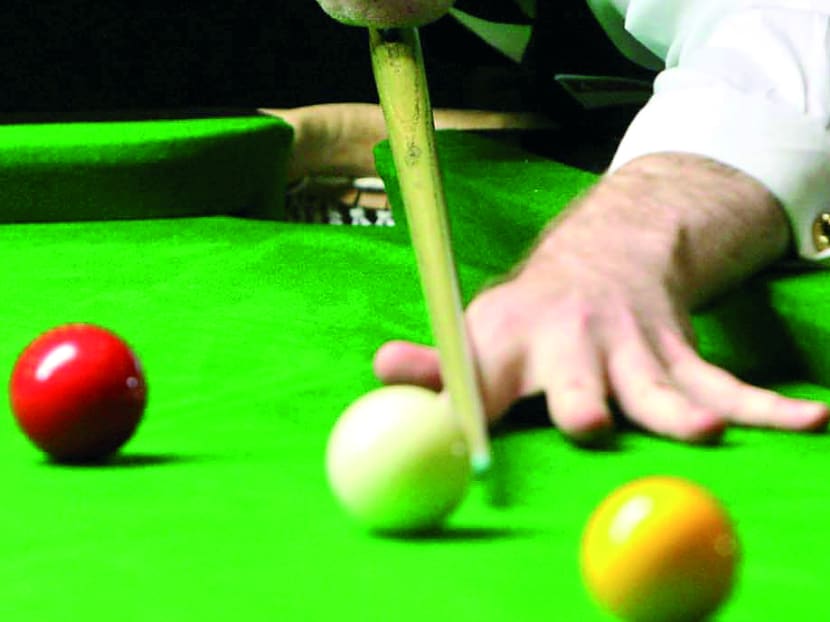
Gilchrist said trying to reach the 1,000 mark is always the most difficult part of the feat, as was the case for him at the Irish meet. TODAY FILE PHOTO
SINGAPORE — He is a three-time world champion and also has three South-east Asian (SEA) Games gold medals to his name.
And now Peter Gilchrist can add two new feathers to his sporting cap.
The 46-year-old Singapore billiards player created history last week at the Irish Open in Dublin en route to successfully defending his title. During the quarter-finals, he became the first player in the history of EBOS and WBL (English Billiards Open Series and World Billiards Limited) to record a 1,000 break when he defeated England’s Christian Kirk 1,175-130.
That, in turn, made him the first player to record two 1,000 breaks in his career.
British-born Gilchrist — who became a Singapore citizen in 2006 under the Foreign Sports Talent Scheme — recorded his first 1,000 break seven years ago when he tallied 1,346 points at the New Zealand Open, which remains the highest score to date.
Gilchrist’s achievement at the Irish Open is also only the fifth 1,000-or-more break made in competition in the modern era.
The others who have also done it include India’s Geth Seeti (1,246) and Michael Ferreira (1,149), and England’s Mike Russell (1,137).
“I never thought I could do it again (surpass the 1,000-point mark),” said Gilchrist who went on win the Irish Open title by beating England’s Dave Causier 700-322, the same player he defeated in the World Championship (long-up format) final in Leeds last October.
“Ask any billiards player and he will tell you it’s a very difficult thing to do under the 90-minute format. At the SEA Games, billiards is being played under a different format. It was a race to 100 points over the best of three frames.
“But the Irish Open and all other major championships are all played under the 90-minute format. Everything has to fall in place for a player to be able to break past the 1,000 point mark.”
Gilchrist said trying to reach the 1,000 mark is always the most difficult part of the feat, as was the case for him at the Irish meet.
“As the score got closer, I started feeling the tension. But the moment the mark was reached, it felt like a load was lifted off my shoulders. Things became much easier after that.
“Still, it was very tiring when I did the 1,175 points. I was on my feet for about an hour and 10 minutes and it took me close to 400 shots to do it,
Gilchrist received £600 (S$1,263) for winning the Irish Open, and an additional £1,500 for his 1,000 break. The achievement will be a huge confidence booster for Gilchrist as he prepares for the Asian Billiard Championship in New Delhi in April.
The event is a title that he wants to win badly simply because he has never won it before.
“The previous two championships saw me as a coach with the Singapore team and as a coach, you cannot take part,” he explained.
“But this time I am going as a player, and I want to win the title.”
BILLIARDS EXPLAINED:
* Billiards is played with three balls: Red, white and yellow.
* Each player has their own cue ball (one white, one yellow).
* There are three ways to score: In-offs, pots or cannons.
* In-offs occur when your cue ball hits one or more balls and then enters a pocket.
* A pot occurs when any ball other than your cue ball enters a pocket.
* A cannon occurs when your cue ball hits both of the other balls. Cannons are always 2 points.
* Apart from cannons, any score off the red is 3 points and off the opponent’s ball is 2 points.
* All fouls are 2 points.
Stay in the know. Anytime. Anywhere.

Subscribe to our newsletter for the top features, insights and must reads delivered straight to your inbox.
By clicking subscribe, I agree for my personal data to be used to send me TODAY newsletters, promotional offers and for research and analysis.






