
Concerns over Beijing in S China Sea stem from misconceptions
Since the tribunal ruling on the South China Sea in July, some misconceptions have been perpetuated, as evidenced by the commentary “China should heed the lessons of Pearl Harbour” (Dec 8) and the responses to it.
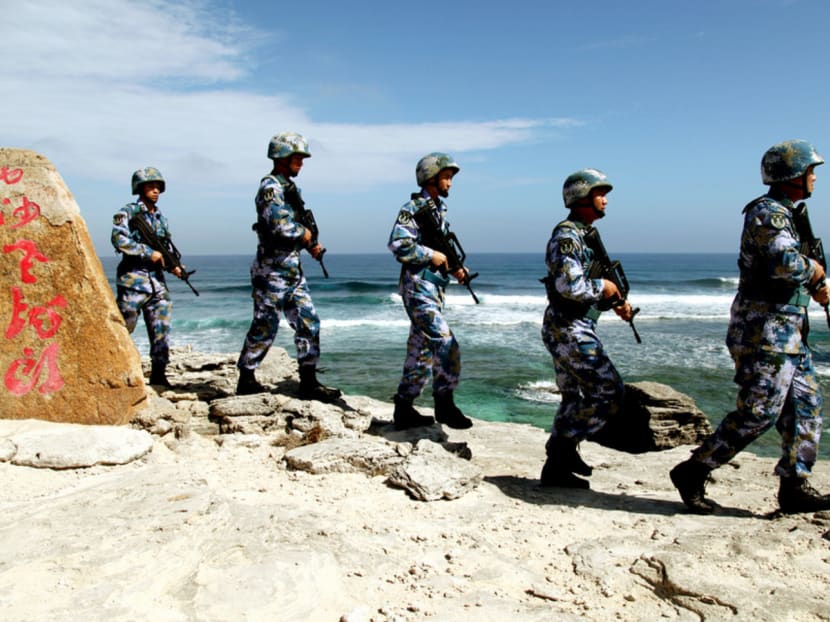
China’s heavy military garrisons in the South China Sea are mainly in the Paracel Islands, which are near China’s mainland and far from the main South China Sea navigation routes. Photo: Reuters

Since the tribunal ruling on the South China Sea in July, some misconceptions have been perpetuated, as evidenced by the commentary “China should heed the lessons of Pearl Harbour” (Dec 8) and the responses to it.
The first misconception is that the tribunal’s invalidation of the nine-dash line rejects China’s claims to the land features in the sea. In fact, the tribunal does not have the power to rule on territorial disputes.
It attempted to do so indirectly by ruling that the land features within the nine-dash line are not islands and do not have sovereign rights themselves. This ruling, however, could potentially undermine international law.
For example, Pedra Branca is smaller than some of those land features. If the tribunal’s ruling is accepted as international law, it could be used to overturn the international court’s ruling on Pedra Branca and undermine Singapore’s sovereignty.
The second misconception is that the same invalidation also rejects China’s maritime rights in the South China Sea.
China has consistently taken the position that, subject to the resolution of the territorial disputes, it is open to bilateral negotiations of the maritime delimitation.
This means China implicitly agrees that the nine-dash line can be discarded conditionally.
This is not inconsistent with the tribunal’s ruling.
Further, China’s position that maritime delimitation cannot be subjected to compulsory arbitration is consistent with international law.
The tribunal did not rule on the final maritime delimitation, as under international laws, this must be negotiated between claimants.
Thirdly, regarding freedom of navigation, which the United States appears to have taken an interest in, the key issue of contention is that China’s laws require foreign warships to seek permission to enter Chinese waters.
The US disagrees, citing international laws, and is therefore using the South China Sea to test China’s resolve in this issue, as the risks in testing this off China’s mainland coast are too high.
I believe that the US does not have an equal level of interest in freedom of navigation of commercial ships and flights through the South China Sea. It is the Chinese economy that will be strangled if this is compromised.
Fourthly, regarding militarisation of the South China Sea, China’s heavy military garrisons in the South China Sea are mainly in the Paracel Islands, which are nearer its mainland and far from the main navigation routes.
It is noteworthy that Vietnam has deployed garrisons and conducted land reclamation in the South China Sea (“Risking Beijing’s ire, Vietnam begins dredging on South China Sea reef”: Dec 9).
But the media rarely pays attention to these, while speculation is rife over China’s potential actions.
In summary, China’s position on the South China Sea does not contradict international laws substantially, while concerns over freedom of navigation and militarisation are largely hyped up.
Stay in the know. Anytime. Anywhere.

Subscribe to our newsletter for the top features, insights and must reads delivered straight to your inbox.
By clicking subscribe, I agree for my personal data to be used to send me TODAY newsletters, promotional offers and for research and analysis.






