
US Marines send F-35 stealth fighter squadron to Japan
WASHINGTON — The US Marine Corps said Tuesday (Jan 10) it has sent a squadron of F-35B fighter jets to Japan, marking the first operational overseas deployment for the controversial aircraft that is under scrutiny from President-elect Donald Trump.
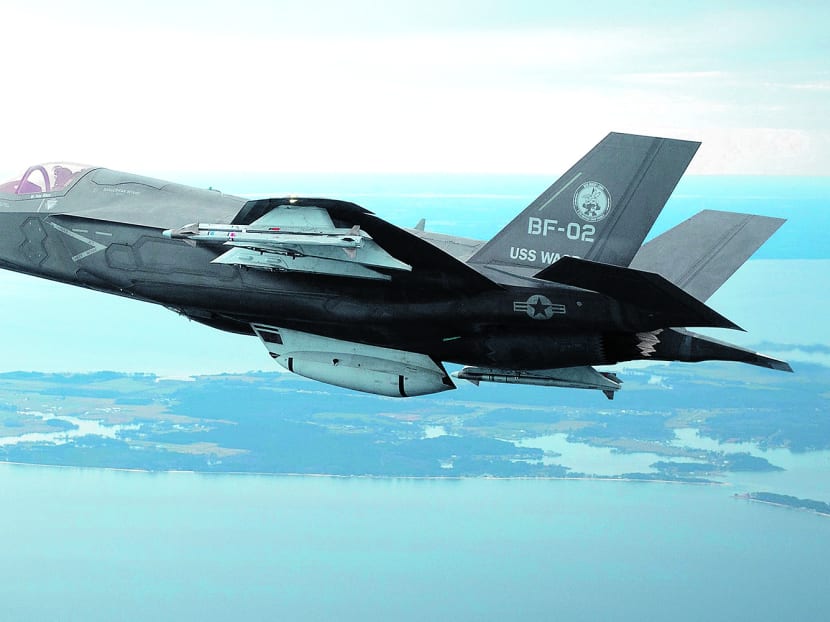
The U.S. Marine Corps version of Lockheed Martin's F35 Joint Strike Fighter, F-35B test aircraft BF-2 flies with external weapons for the first time over the Atlantic test range at Patuxent River Naval Air Systems Command in Maryland in a February 22, 2012 file photo. Photo via Reuters

WASHINGTON — The US Marine Corps said Tuesday (Jan 10) it has sent a squadron of F-35B fighter jets to Japan, marking the first operational overseas deployment for the controversial aircraft that is under scrutiny from President-elect Donald Trump.
The deployment of the 10 planes to Marine Corps Air Station Iwakuni on Honshu Island marks a major milestone for the F-35, which has been bedeviled by technical glitches and soaring cost overruns.
With a current development and acquisition price tag already at US$379 billion (S$544.5 billion) for a total of 2,443 F-35 aircraft, Lockheed Martin’s F-35 is the most expensive plane in history, and costs are set to go higher still.
The Marines’s version of the plane, known as the F-35B, is capable of conducting short takeoffs and vertical landings.
Mr Trump last month sent shockwaves through the aerospace industry when he tweeted that he wanted rival Boeing to price out a possible alternative.
“Based on the tremendous cost and cost overruns of the Lockheed Martin F-35, I have asked Boeing to price-out a comparable F-18 Super Hornet!” Mr Trump tweeted December 22.
The F/A-18 Super Hornet does not have stealth capabilities and has been in use since the late 1990s.
Once servicing, maintenance and other costs for the F-35 are factored in over the aircraft’s lifespan through 2070, overall program costs have been projected to rise to as much as US$1.5 trillion.
Proponents of the F-35 tout its speed, close air-support capabilities, airborne agility and a massive array of sensors giving pilots unparallelled access to information.
“The unique combination of stealth, cutting-edge radar and sensor technology, and electronic warfare systems bring all of the access and lethality capabilities of a fifth-generation fighter, a modern bomber, and an adverse-weather, all-threat environment air-support platform,” the Marines said in a statement.
In August, the US Air Force declared an initial squadron of F-35A stealth fighters ready for combat and said an overseas deployment for that version of the plane was likely early this year.
The US Navy’s version of the plane, the F-35C, is built to land on aircraft carriers.
In a related development, the Global Times says that the scrambling of Japanese and South Korean fighter planes in response to what China termed as a “routine training exercise” over the Tsushima Strait are raising tensions in the region.
An op-ed ran on Wednesday (Jan 11) by the influential Chinese state-run tabloid noted that the incident arose out of the three nations’ overlapping Air Defence Identification Zones (ADIZs) in the area.
Eight Chinese military aircraft, including six strategic bombers, were spotted flying over the Tsushima Strait in south-western Japan on Monday (Jan 9) prompting Japan to scramble fighters, Japan’s Defense Ministry said, adding there was no violation of Japan’s airspace.
However, the Global Times noted that China has exercised restraint during the many occasions where South Korean and Japanese warplanes entered China’s ADIZ in the East China Sea.
“If China frequently scrambles fighter jets as a response, Northeast Asia may be dragged into a hostile atmosphere,” the Global Times observed. AGENCIES
Stay in the know. Anytime. Anywhere.

Subscribe to our newsletter for the top features, insights and must reads delivered straight to your inbox.
By clicking subscribe, I agree for my personal data to be used to send me TODAY newsletters, promotional offers and for research and analysis.






