
Heeding UN ruling, India drops claim to Bay of Bengal area
NEW DELHI — If good fences make good neighbours, that may explain why much of Asia’s recent territorial tension has centred on the ocean.


NEW DELHI — If good fences make good neighbours, that may explain why much of Asia’s recent territorial tension has centred on the ocean.
India last month took a step towards tighter ties with Bangladesh in surrendering its four-decade claim to a swathe of the Bay of Bengal about 26 times the size of Singapore, opting to heed a United Nations-backed ruling. Bangladesh praised its neighbour’s move, with the head of state-run oil monopoly Petrobangla saying the newfound clarity will unlock drilling opportunities.
The decision provides a contrast to China, which has declined to acknowledge any UN jurisdiction in its dispute with the Philippines over maritime claims. The difference in approach shows why tensions are rising in the South China Sea as companies ramp up oil and gas investment in the Bay of Bengal.
“This is a showcase judgment of how countries can reach an amicable agreement,” said Dr S Chandrasekharan, New Delhi-based director of the South Asia Analysis Group, referring to India and Bangladesh. “The South China Sea is a glaring example of how one intransigent country can hold up everything.”
The Permanent Court of Arbitration on July 7 awarded about 19,500 sq km to Bangladesh, about 76 per cent of the area under dispute with India. The move followed a decision last year that clarified Bangladesh’s sea border with Myanmar.
“The award puts an end to a long-standing issue between India and Bangladesh that has impeded the ability of both countries to fully exploit the resources in that part of the Bay of Bengal,” Junior Minister VK Singh of India’s Ministry of External Affairs told lawmakers on Wednesday.
“The peaceful settlement of this issue on the basis of international law symbolises friendship, mutual understanding and goodwill between the two countries.”
The cooperation has opened up access to energy exploration for India and Bangladesh, which account for less than 1 per cent of the world’s proven gas reserves, based on estimates by BP. By the end of this year, Bangladesh plans to auction 18 oil and gas blocks in the Bay of Bengal, including 10 previously claimed by India, said Dr Hossain Mansur, Petroblanga chairman.
Oil and Natural Gas Corporation, India’s biggest energy explorer, will study the blocks and may make a bid, said its New Delhi-based chairman Dinesh Sarraf.
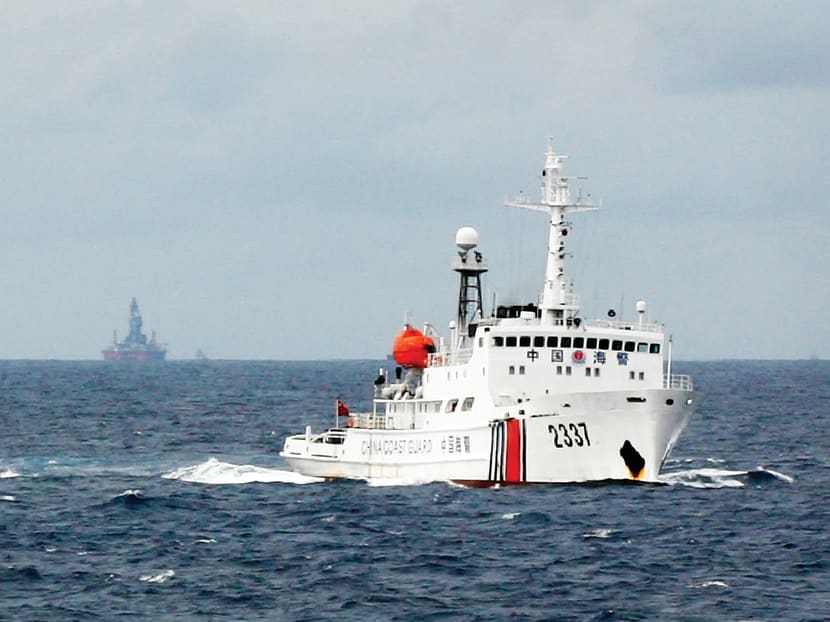
In the South China Sea, oil and gas exploration has been contentious. Chinese ships have cut the cables of survey vessels working for Vietnam and the Philippines, while state-run China National Petroleum Corporation this year moved a deepwater rig into a disputed area despite objections from its neighbours.
Mr Paul Reichler, a Washington-based lawyer who represented Bangladesh in its case against India, is also working for the Philippines as it seeks a ruling from the same court on China’s claims. Beijing has declined to participate, telling the court last year it “does not accept the arbitration initiated by the Philippines”.
“The fact India has accepted this judgment without question puts a little pressure on China,” Mr Reichler said, adding that Beijing was the first country to refuse to participate in arbitration under the UN Convention on the Law of the Sea.
The South China Sea is estimated to have as much as 30 billion metric tonnes of oil and 16 trillion cubic metres of gas, which would account for about one-third of China’s oil and gas resources, said the official Xinhua news agency. Hanoi and Manila have rejected Beijing’s “nine-dash map” of the waters as a basis for joint oil-and-gas development.
“India, Bangladesh and Myanmar have all demonstrated that countries can successfully settle their disputes through impartial third-party arbitration,” Philippine Foreign Secretary Albert del Rosario said in a text message.
Vietnam has prepared evidence and is waiting for the “appropriate timing” to take legal action against China, Prime Minister Nguyen Tan Dung told Bloomberg on May 30.
Without some sort of international settlement, tensions between the two countries will flare again, said Mr Le Hong Hiep, a lecturer at Vietnam National University in Ho Chi Minh City.
Indian Prime Minister Narendra Modi and Chinese President Xi Jinping pledged to resolve a land border dispute when they met in Brazil last month. Mr Xi said the two countries should work together to give developing countries a stronger voice in setting global rules, Xinhua said.
“The Chinese leadership around Xi Jinping is ready to get into difficulties with its neighbours to consolidate its pre-eminence in the region and rebalance its power vis-a-vis other players, including the United States,” said Professor Jean-Pierre Cabestan, director of government and international studies at Hong Kong Baptist University.
“If you’re a big power and know you’re more powerful, you don’t want to be constrained by international law,” said Dr Li Mingjiang, associate professor and coordinator of the China programme at the S Rajaratnam School of International Studies in Singapore. “You want to use political and other means to resolve the dispute.” BLOOMBERG
Stay in the know. Anytime. Anywhere.

Subscribe to our newsletter for the top features, insights and must reads delivered straight to your inbox.
By clicking subscribe, I agree for my personal data to be used to send me TODAY newsletters, promotional offers and for research and analysis.






