
Carnage spreads on social media as attackers focus on soft targets
JAKARTA — A “Paris-style” suicide strike on the Indonesian capital today (Jan 14) confirmed South-east Asian governments’ worst fears — that citizens returning from fighting alongside the Islamic State group in the Middle East could launch attacks at home.
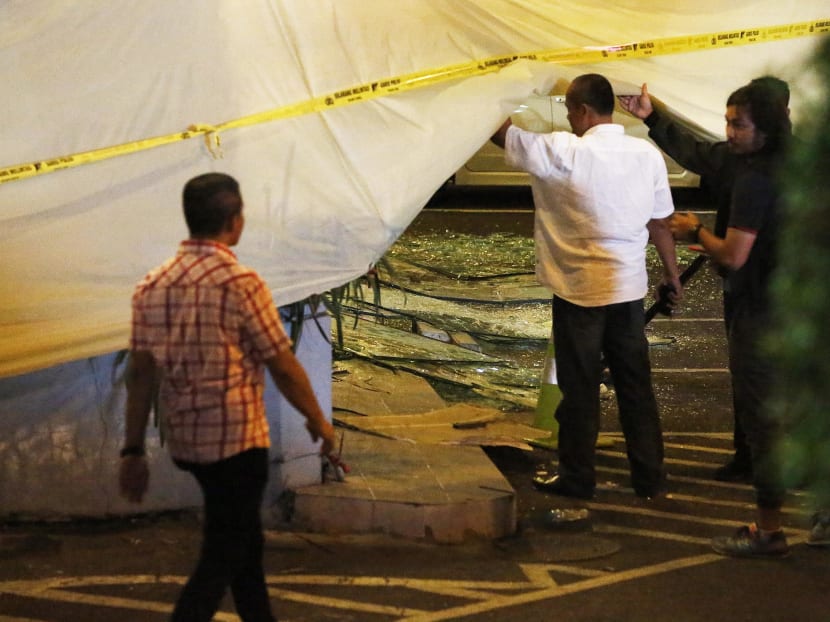
Forensics team examining the scene at the Starbucks along Jalan Thamrin on Jan 15, 2016, where the first bomb was detonated. Photo: Nadarajan Rajendran/TODAY

JAKARTA — A “Paris-style” suicide strike on the Indonesian capital today (Jan 14) confirmed South-east Asian governments’ worst fears — that citizens returning from fighting alongside the Islamic State group in the Middle East could launch attacks at home.
Regional nations have been warning for months about the possibility of an attack, mirroring concerns expressed by the European authorities fearful of the intentions of people returning home from conflict.
The blasts and gunfire that rocked Jakarta came after six years of relative calm, following a government crackdown that weakened the country’s most dangerous home-grown Islamic networks.
“We know that (ISIS) has the desire to declare a province in this region and there are groups in this region ... that have pledged allegiance to (ISIS),” said Associate Professor Kumar Ramakrishna, an expert on South-east Asian militant groups at the S Rajaratnam School of International Studies (RSIS).
“The threat of returning South-east Asian fighters radicalised in the Iraq/Syria region (is) also another factor of concern, together with the possibility of self-radicalised lone wolves appearing in the scene.”
National police spokesman Anton Charliyan said today that an ISIS-linked group carried out the assault and that it was designed to replicate the November strike on Paris that claimed 130 lives.
Although the death toll from the raid was much lower than the Paris attacks, the selection of soft targets in the heart of Indonesia’s capital terrified citizens, and social media erupted with disturbing images and video footage, and the hashtag #KamiTidat Takut (We are not afraid).
The latest attack came just weeks after Indonesia issued a heightened alert and arrested several suspected militants, some of them from ISIS-linked cells.
The Soufan Group, a New York-based security consultancy, says that of the 500 to 700 Indonesians who travelled abroad to join ISIS’ self-proclaimed caliphate across swathes of Syria and Iraq, scores have since returned.
The involvement of Indonesian fighters in Syria became more prominent after an extremist from Borneo named Riza Fardi was killed there last year, according to the Institute for Policy Analysis of Conflict.
The threat posed by returning foreign fighters is not a new one for Indonesia. Indonesian extremists are known to have trained and fought in Afghanistan in the 1980s and 1990s, in the southern Philippines and possibly in Bosnia. The country’s counter-terror chief has recalled that Indonesians who trained with Islamic militants in Afghanistan in the 1990s came back and launched terror attacks, including the 2002 Bali bombings.
Mr Ken Conboy, who works for an Indonesian security company and wrote a book about the one-time South-east Asian branch of Al Qaeda, Jemaah Islamiyah, speculated that the attacks were connected to recent arrests of terrorism suspects on Java, the Indonesian island that includes Jakarta. “All the people arrested in recent weeks were all linked to each other. The arrests kept on snowballing,” said Mr Conboy.
“They were supposedly planning attacks on police stations, Shia Muslim communities, and maybe the national Police Headquarters (in Jakarta).”
Mr Conboy said there was no indication that the suspects recently arrested during a crackdown by Indonesian authorities were connected to ISIS — also known as ISIS or ISIL.
“The police are extra vigilant about saying ISIS these days, but there was no indication that the people picked up were linked to ISIS or had allegiance to ISIS,” he said.
More recently, the country has banned support for ISIS and its ideology, but experts worry that Indonesian laws are not adequate.
Mr Yohanes Sulaiman, an Indonesian political analyst, said the Indonesian government had not done enough to contain Islamist radicals in recent years. He said the police had “done a good job in preventing such attacks, considering that Indonesia is kind of a messy place. What the government hasn’t been doing is to stop the radicalism.”
RSIS regional terrorism expert Professor Rohan Gunaratna urged regional governments to work together to prevent the creation of a satellite of the ISIS caliphate.
“If such a satellite is declared, the threat in South-east Asia will grow,” he warned. “There are groups based both in Indonesia and the Philippines that have pledged allegiance to ISIS and those groups must be dismantled.”
Indonesia and South-east Asia have also been a target for Al Qaeda, with the terror network’s chief, Ayman Zawahiri, calling for a regional “battle” in remarks released this week.
Addressing Muslims in Indonesia, the Philippines, Malaysia and neighbouring countries, Zawahiri said the region’s Muslims were “leading an ideological and political battle against the seculars and the enemies of the religion”.
One strategy being deployed by Indonesia’s counter-terror chiefs is to leverage a handful of former ISIS members who have returned from the Middle East disenchanted with their experiences.
They are looking to publicise their stories of misery and disappointment — at the hands of a jihadist leadership which gave them little respect or responsibility — in a bid to deter potential recruits.
But the threat is unlikely to dissipate. AGENCIES
Stay in the know. Anytime. Anywhere.

Subscribe to our newsletter for the top features, insights and must reads delivered straight to your inbox.
By clicking subscribe, I agree for my personal data to be used to send me TODAY newsletters, promotional offers and for research and analysis.






