
More than 300 slave fishermen rescued from Indonesian island
TUAL (Indonesia) — The same trawlers that had enslaved countless migrant fishermen for years carried more than 300 of them to freedom on Saturday, following a dramatic rescue from a remote Indonesian island that many men believed would probably be their final resting place.
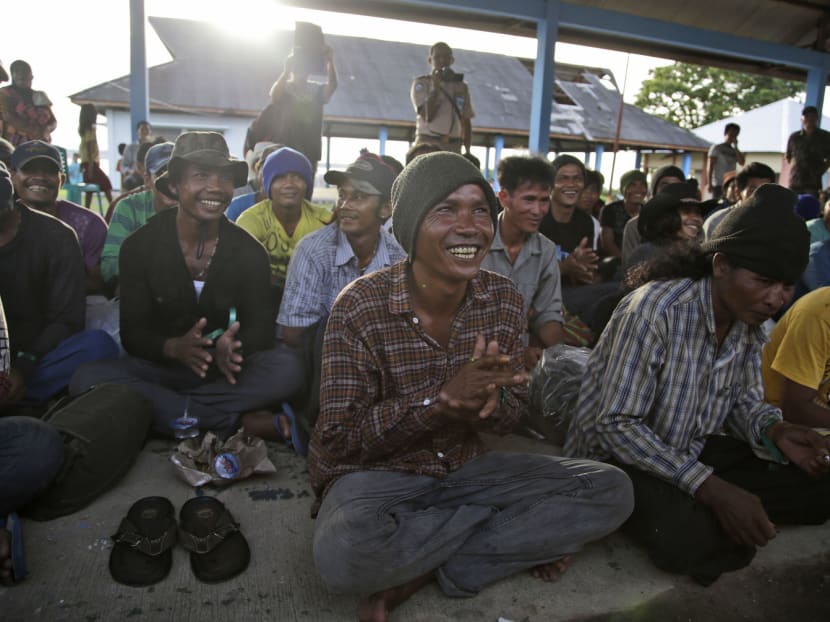
Recently rescued Cambodian fishermen clap their hands while singing after their arrival in Tual, Indonesia, on Saturday, April 4, 2015. Photo: AP

TUAL (Indonesia) — The same trawlers that had enslaved countless migrant fishermen for years carried more than 300 of them to freedom on Saturday, following a dramatic rescue from a remote Indonesian island that many men believed would probably be their final resting place.
Three-quarters of the more than 320 migrant workers who left the island were from Myanmar. Others were from Cambodia and Laos, and a few Thais were allowed to board the boats. However, the Indonesians said most Thai nationals could stay on Benjina more safely, since Thai captains were less likely to abuse them.
After 17 hours overnight at sea, the men, mostly from Myanmar, took their first steps of freedom. They filed off the boats and walked to the site of their new temporary home, where they were finally safe.
“I’m so happy. I wanted to go home for so long,” said Mr Aung Aung, 26, who lifted his hair on the left side of his head to show a fat, jagged scar stretching from his lip to the back of his neck — the result of a machete attack by his captain’s son. “I missed home and especially after I was cut ... I was afraid I would die there.”
The men from Myanmar were among hundreds of migrant workers revealed in an Associated Press investigation to have been lured or tricked into leaving their countries to go to Thailand, where they were put on boats and taken to Indonesia. From there, they were forced to catch seafood that was shipped back to Thailand and exported to consumers around the world, including the United States. In response to AP’s findings, an Indonesian delegation visited the island village of Benjina on Friday and offered immediate evacuation after finding brutal conditions.
The officials from the Fisheries Ministry offered the men a chance to leave, fearing they would not be safe if they stayed on the island after speaking out about the horrendous labour abuses they endured.
About 320 men took up the offer. Even as a downpour started, some dashed through the rain. They sprinted back to their boats, jumped over the rails and threw themselves through windows. They stuffed their meagre belongings into plastic bags, small suitcases and day packs, and rushed back to the dock, not wanting to be left behind.
Friday’s unexpected rescue came after a round of interviews Indonesian officials held with the fishermen, where they confirmed the abuse reported in the AP story, which included video footage of eight migrants locked in a cage and a slave graveyard. The men talked of how they were beaten and shocked with taser-like devices at sea, forced to work almost non-stop without clean water or proper food, paid little or nothing and prevented from going home.
The findings documented by Indonesian officials and AP came in stark contrast to what a Thai delegation reported from a visit to Benjina earlier this week when it searched for trafficked Thai nationals. It denied mistreatment on the boats and said the crews were all Thai, even though AP found many migrant workers from other countries were issued fake documents with Thai names and addresses.
Thailand, the world’s third-largest seafood exporter, has been under further pressure to clean up the industry since AP tracked a boat of slave-caught seafood by satellite from Benjina to a port outside Bangkok. Records then linked it to the supply chains of some of America’s largest supermarkets and retailers and among the most popular brands of pet food. AP
Stay in the know. Anytime. Anywhere.

Subscribe to our newsletter for the top features, insights and must reads delivered straight to your inbox.
By clicking subscribe, I agree for my personal data to be used to send me TODAY newsletters, promotional offers and for research and analysis.






