
China slams US for ‘deliberate provocation’ in South China Sea
WASHINGTON/BEIJING — China yesterday accused the United States of committing a “deliberate provocation” by sending a navy destroyer into waters claimed by Beijing, adding defiantly that such actions would force China to speed up its building of artificial islands and installations in the South China Sea.
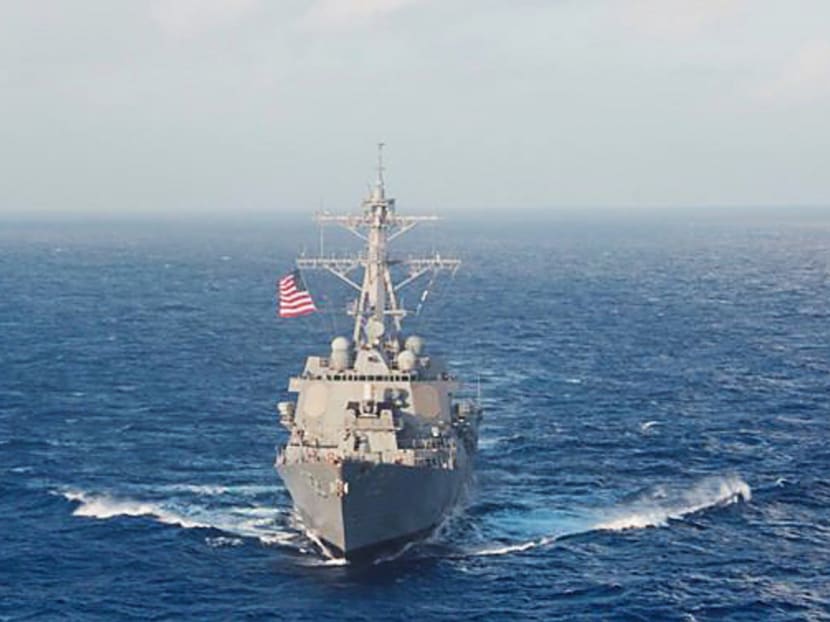
An image posted on the USS Lassen’s Facebook page showing the ship sailing through the South China Sea yesterday. Photo: USS Lassen (DDG 82) Facebook page

WASHINGTON/BEIJING — China yesterday accused the United States of committing a “deliberate provocation” by sending a navy destroyer into waters claimed by Beijing, adding defiantly that such actions would force China to speed up its building of artificial islands and installations in the South China Sea.
“China will firmly react to this deliberate provocation,” Mr Lu Kang, a spokesman for the Chinese Foreign Ministry, said at a regularly scheduled news conference. “China will not condone any action that undermines China’s security.” He said if the US continued to “create tensions in the region”, China might conclude it has to “increase and strengthen the building up of our relevant abilities”.
In an earlier statement, the ministry had said the US warship “illegally” entered Chinese waters and was tracked, monitored and warned off by the Chinese warships.
China’s Defence Ministry last night described the US patrol as an attempt to militarise the South China Sea, adding that the Chinese military would take all necessary steps to protect the country’s interests.
The strong Chinese rebuke came after the USS Lassen, a guided missile destroyer homeported in Yokosuka of Japan, sailed within 12 nautical miles of Subi Reef, one of several artificial islands that China has built in the disputed Spratly Islands chain. The US had signalled for weeks that it would undertake the mission, which it called an exercise of the right to freedom of navigation in international waters.
Washington informed nations in South-east Asia this month it would soon send naval vessels into the disputed archipelago, according to diplomats. “You don’t need to consult with any nation when you are exercising the right of freedom of navigation in international waters,” Mr John Kirby, the US State Department spokesman, said at a news conference yesterday.
Mr Kirby said that such a challenge to what he called a questionable sovereignty claim was “one of the reasons you have a navy — to be able to exert influence and defend freedom of navigation on international waters.”
The move, however, has clearly angered Beijing and could sour Sino-American ties.
Chinese Vice-Foreign Minister Zhang Yesui yesterday summoned American Ambassador Max Baucus to protest against the patrol.
Mr Zhang called the move “extremely irresponsible” and urged the US to cease actions that harm China’s sovereignty and security interests.
China claims most of the South China Sea, through which more than US$5 trillion (S$7 trillion) of world trade passes every year. Vietnam, Malaysia, Brunei, the Philippines and Taiwan have rival claims.
Beijing has been reclaiming land and placing military equipment in the South China and East China Seas for several years. The projects in the vicinity of the Spratlys have come under increasing criticism from the US and its regional allies who dispute the legitimacy of the newly built islands.
A US defence official said the mission, which lasted a few hours, also included Mischief Reef and would be the first in a series of freedom-of-navigation exercises aimed at testing China’s territorial claims.
Both Subi and Mischief Reefs were submerged at high tide before China began a dredging project to turn them into islands last year.
Under the United Nations Convention on the Law of the Sea, 12-nautical mile limits cannot be set around man-made islands built on previously submerged reefs.
The defence official said additional patrols would follow in coming weeks and could be conducted around features that Vietnam and the Philippines have built up in the Spratlys.
“This is something that will be a regular occurrence, not a one-off event,” said the official. “It’s not something that’s unique to China.”
The Philippines, a vocal critic of Chinese activities in the South China Sea, yesterday welcomed the US action. “The American passage through these contentious waters is meant precisely to say that there are norms as to what freedom-of-navigation entails and they intend to exercise so there is no de facto changing of the reality on the ground,” said Filipino President Benigno Aquino.
Australia also weighed in on the issue, with Defence Minister Marise Payne issuing a statement backing the US’ right to sail through the region.
“It is important to recognise that all states have a right under international law to freedom of navigation and freedom of overflight, including in the South China Sea,” she said. “Australia strongly supports these rights.”
In Tokyo, Japan’s top government spokesman Yoshihide Suga told a press conference that he will not comment on “each operation” of the US forces, while adding, “We are closely exchanging information.”
Beijing’s angry rebuke was echoed in various state-owned media. A commentary carried by state-run news Xinhua stated that the sailing “constitutes a blatant provocation to China’s territorial sovereignty and puts on a show of force under the excuse of testing freedom of navigation and over-flight in the waters.”
Meanwhile, the Global Times — an official political tabloid — published a commentary deriding the US move as “harassment” and a “political show” since Washington is unable to stop Beijing’s legitimate construction activities. “In face of the US harassment, Beijing should deal with Washington tactfully and prepare for the worst. This can convince the White House that China, despite its unwillingness, is not frightened to fight a war with the US in the region, and is determined to safeguard its national interests and dignity,” said the commentary.
But many Chinese social media users were critical of what they saw as a weak response to the American patrol. “If you can’t even safeguard sovereignty, what else you can do to win the trust of the people?” read one of about 100 comments, most of them critical of China’s response, under an article by Xinhua. AGENCIES
Stay in the know. Anytime. Anywhere.

Subscribe to our newsletter for the top features, insights and must reads delivered straight to your inbox.
By clicking subscribe, I agree for my personal data to be used to send me TODAY newsletters, promotional offers and for research and analysis.






