
Germany’s Merkel starts third term in new coalition
BERLIN — Germany’s Parliament elected Chancellor Angela Merkel to a third term as the leader of Europe’s biggest economic power today (Dec 17), nearly three months after an awkward election result forced her to put together a new governing coalition.
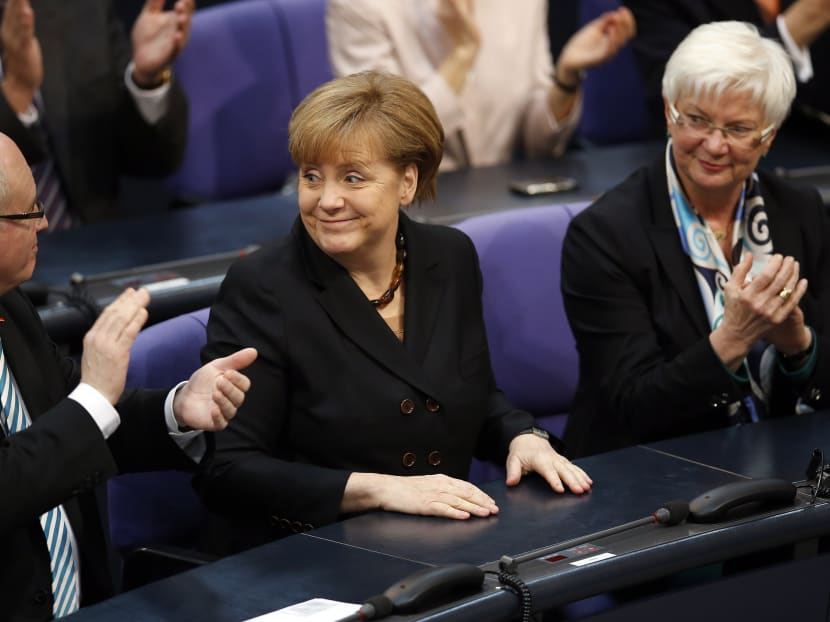
Members of the parliament applaud after German Chancellor Angela Merkel was re-elected during a meeting of the German federal parliament. Photo: AP

BERLIN — Germany’s Parliament elected Chancellor Angela Merkel to a third term as the leader of Europe’s biggest economic power today (Dec 17), nearly three months after an awkward election result forced her to put together a new governing coalition.
Ms Merkel now heads a “grand coalition” of Germany’s biggest parties — her conservative Union bloc and the centre-left Social Democrats, which are traditional rivals. Parliament’s lower house elected her as chancellor by 462 votes to 150, with nine abstentions
The new government will move Germany somewhat leftward, for example introducing a national minimum wage, but will take a largely unchanged approach to Europe’s debt crisis.
It features Germany’s first female defence minister, conservative Ursula von der Leyen, and sees former Foreign Minister Frank-Walter Steinmeier, a Social Democrat, return to his old job. Finance Minister Wolfgang Schaeuble, a powerful figure in Europe’s debt crisis, is staying on.
The parties’ effort to form a government after Sept 22 national elections, in which Ms Merkel’s conservatives came close to a parliamentary majority but saw their previous coalition partners lose all their seats, has been the longest in post-World War II Germany.
It was extended by the Social Democrats’ decision to put the coalition deal to a ballot of all their members. They won approval last weekend but some remain wary because the party emerged weakened from a previous grand coalition in Ms Merkel’s first term, from 2005 to 2009.
At least 42 government lawmakers did not vote for the chancellor today but, given the new coalition’s enormous majority, that is unlikely to worry her.
Conservatives and Social Democrats hold 504 of the 631 seats. Germany’s best-known ex-communist, Gregor Gysi, becomes the opposition leader; his hardline Left Party is the bigger of two left-leaning opposition groups.
Germany’s biggest-selling newspaper, Bild, declared on today’s front page: “Dear grand coalition, we are your extraparliamentary opposition now!” Editor Kai Diekmann wrote that “this parliament is too weak; its opposition too small and too left-wing”. AP
Stay in the know. Anytime. Anywhere.

Subscribe to our newsletter for the top features, insights and must reads delivered straight to your inbox.
By clicking subscribe, I agree for my personal data to be used to send me TODAY newsletters, promotional offers and for research and analysis.






