
North Korean submarine missile threat prompts U.S.-led military drills
TOKYO — Amid fears that North Korea is rapidly developing its submarine-launched ballistic missile technology, the United States, Japan and South Korea teamed up on Monday (Dec 11) for a drill to track such hard-to-detect missiles, military officials said.
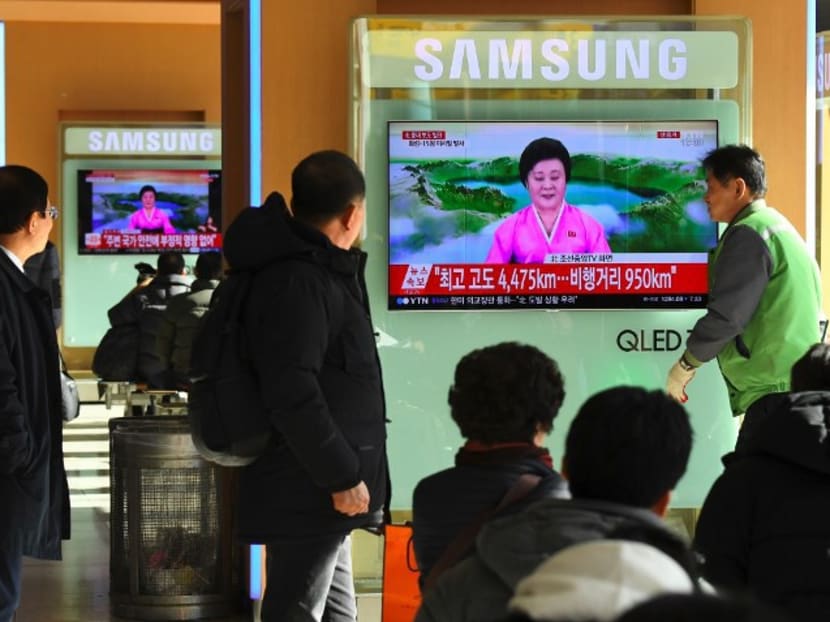
People watch a television news screen showing a North Korean announcer reading a statement on the country’s new ICBM test late last month. The United States, Japan and South Korea started joint exercises on Monday (Dec 11) as tensions rise in the region over North Korea’s fast-developing weapons programmes. Photo: AFP

TOKYO — Amid fears that North Korea is rapidly developing its submarine-launched ballistic missile technology, the United States, Japan and South Korea teamed up on Monday (Dec 11) for a drill to track such hard-to-detect missiles, military officials said.
The drill is taking place over two days in waters between Japan and the Korean Peninsula, said South Korea’s Joint Chiefs of Staff, and will involve destroyers from the three nations doing computer-simulated training to track submarine missile launchings by North Korea.
“During the drill, Aegis warships from each country will simulate detecting and tracking down potential ballistic missiles from the North and sharing information,” it said in a statement.
Two US ships are taking part, with one each from the two Asian countries.
This week’s exercises will be the sixth drills sharing information in tracking ballistic missiles among the three nations, the Japan’s Maritime Self-Defence Force said.
The drills come in the wake of news reports that North Korea is making progress developing submarine-launched ballistic missiles, or SLBMs.
The website 38 North, based at the US-Korea Institute at Johns Hopkins University, obtained images of cylindrical objects, evidence that “suggests construction of a new submarine” at a facility on North Korea’s east coast.
Any North Korean capability to field submarine-launched ballistic missiles in open waters would be particularly worrying for the US and its allies, since such missiles are hard to detect before launching.
In August 2016, North Korea successfully tested such a missile from near its submarine base in Sinpo, sending it 500km toward Japan in a launch that came after several failed tests.
Monday’s military manoeuvres come a week after the US and South Korea began holding joint drills that included flyovers of advanced stealth fighters and B1-B Lancer bombers over the Korean Peninsula, exercises that led North Korea to accuse the US of pushing the region “to the brink of nuclear war.”
To step up pressure, South Korea on Monday imposed a new round of sanctions on 20 North Korean groups and 12 individuals.
“This unilateral sanction will prevent illegal funds flowing to North Korea and contribute to reinforce international communities’ sanctions against North Korea,” South Korea’s finance ministry said in a statement.
The move is largely symbolic as trade and financial exchanges between the two Koreas have been barred since May 2010 following the torpedoing of a South Korean warship, which the North denied.
Still, the sanctions, an effort to curtail North Korea’s missile and nuclear weapons programmes, were imposed in retaliation for the North’s launching of a missile in late November that experts said was capable of hitting much of the continental US.
Also, Japanese Defence Minister Itsunori Onodera said the ministry plans to include 730 million yen (S$8.7 million) to help build a new missile interceptor system, the Aegis Ashore, in its next fiscal year budget request, public broadcaster NHK reported. AGENCIES
Stay in the know. Anytime. Anywhere.

Subscribe to our newsletter for the top features, insights and must reads delivered straight to your inbox.
By clicking subscribe, I agree for my personal data to be used to send me TODAY newsletters, promotional offers and for research and analysis.






