
Restoring North Korea to terrorism blacklist dims hopes for talks
SEOUL — United States President Donald Trump’s re-designation of North Korea as a state sponsor of terrorism may have dashed cautious hopes in the region that talks and diplomacy would replace escalating tensions and bellicose threats, analysts said.
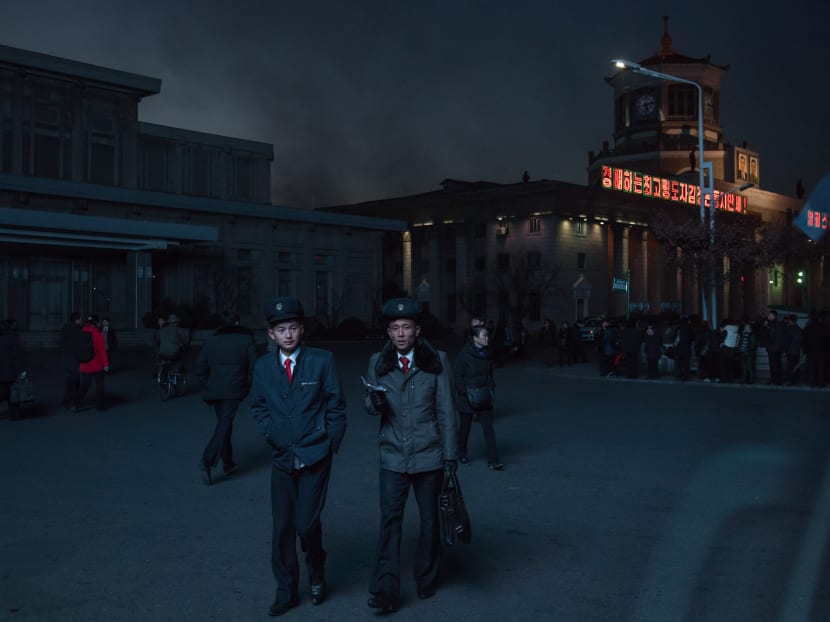
North Korean students illuminated by a public television screen walk past the central station in Pyongyang. Analysts say United States President Donald Trump’s re-designation of North Korea as a state sponsor of terrorism may have dashed cautious hopes in the region that talks and diplomacy would replace escalating tensions and bellicose threats. Photo: AFP

SEOUL — United States President Donald Trump’s re-designation of North Korea as a state sponsor of terrorism may have dashed cautious hopes in the region that talks and diplomacy would replace escalating tensions and bellicose threats, analysts said.
Despite a two-month hiatus in North Korea’s weapons tests, Mr Trump has held to his policy of “maximum pressure,” restoring North Korea on Monday (Nov 20) to Washington’s list of terrorism-sponsoring states, along with Iran, Sudan and Syria.
The move, he said, would be followed by “the highest level of sanctions.”
On Tuesday, Treasury Department officials announced a new round of sanctions aimed at disrupting the North’s nuclear and ballistic missile programme.
They were levied against Chinese trading companies and several North Korean shipping vessels and companies, freezing their assets and prohibiting Americans from engaging in transactions with them.
Secretary of State Rex Tillerson had described the sanctions as extensions of existing prohibitions. “It may, though, disrupt and dissuade some third parties,” he said. “This will close a few additional loopholes off.”
Analysts said they doubted that new sanctions would make any real difference on the already heavily penalised country. If anything, they said, the designation will make diplomacy more difficult without increasing Washington’s leverage, warning that Pyongyang will probably take the naming and shaming as another reason to stick to its hardline policy of developing and testing nuclear weapons and intercontinental ballistic missiles (ICBMs).
“It’s hard to see any real impact on North Korea, which has lived through all manners of sanctions for seven decades,” said Mr Paik Hak-soon, a senior analyst at the Sejong Institute, a South Korean research organisation.
“What it does instead is to send a clear message to North Korea that Trump is not interested in talks, another sign and reconfirmation that the Americans remain a hostile force.”
North Korea has yet to respond to Mr Trump’s move.
But its leader, Mr Kim Jong-un, has been notoriously sensitive to outside attacks on his regime. He called Mr Trump a “mentally deranged US dotard” in September after the president threatened to “totally destroy” North Korea if it endangered the US.
His government has also said it would launch more ballistic missiles in the Pacific, and could conduct an atmospheric hydrogen bomb test there, depending on Washington’s behaviour.
“As long as it is technically ready, North Korea will test missiles again anytime,” said Mr Yun Duk-min, a former chancellor of South Korea’s Korea National Diplomatic Academy who now teaches at Hankuk University of Foreign Studies in Seoul.
“It is following its own schedule in weapons development, regardless of whether it is redesignated as a terrorism-sponsoring country.”
But Mr Trump’s announcement gives the country an excuse to justify a new weapons test and “deflect blame onto the US,” said Mr Lee Sung-yoon, a Korea expert at the Fletcher School of Law and Diplomacy at Tufts University.
Such prospects do not bode well for the policy of South Korea President Moon Jae-in, who has sought to ease tensions as the country prepares to host the Winter Olympics in February.
Many of Mr Moon’s progressive supporters believe Trump’s provocative style and focus on military options have heightened the risk of war on the Korean Peninsula.
On Tuesday, Mr Moon’s government stressed cooperation with Washington, deflecting any suggestion that there is a disconnect between the allies on policy.
Meanwhile, conservative South Koreans welcomed Washington’s re-listing of the North as a sponsor of terrorism, and in Tokyo, the support from Shinzo Abe, the hawkish prime minister of Japan, was straightforward.
“We welcome and support the act, as it is expected to increase pressure on North Korea,” he told reporters Tuesday.
The Trump administration says it will keep pressuring North Korea until it agrees to talks on negotiating away its nuclear programs.
But the North insists those weapons are not for bargaining.
President Xi Jinping of China, who has been under pressure from Mr Trump to do more to rein in its Communist neighbor, sent a special envoy to Pyongyang over the weekend in what Trump called a “big move” to persuade the North to change course.
The envoy, Mr Song Tao, returned home Monday, apparently empty-handed. Neither China nor North Korea has indicated that Mr Song met Mr Kim.
“North Korea knew that its re-designation as a terrorism-sponsoring state was coming, and it needed to show that it will not bend under pressure from neither the US nor China,” said Mr Kim Yong-hyun, a North Korea specialist at Dongguk University in Seoul. “I think North Korea is ready to launch another long-range or medium-range missile or a satellite rocket.” THE NEW YORK TIMES
Stay in the know. Anytime. Anywhere.

Subscribe to our newsletter for the top features, insights and must reads delivered straight to your inbox.
By clicking subscribe, I agree for my personal data to be used to send me TODAY newsletters, promotional offers and for research and analysis.






