
Thailand faces long fight against a hidden killer
BANGKOK — The conflict may be over, but the danger lives on. Landmines left by insurgents and government forces have contaminated Thailand for more than four decades. Buried just beneath the surface, these weapons are designed to kill and injure those who misstep. They hide just off of well-worn paths, in fields, forests and sometimes dangerously close to places people call home.
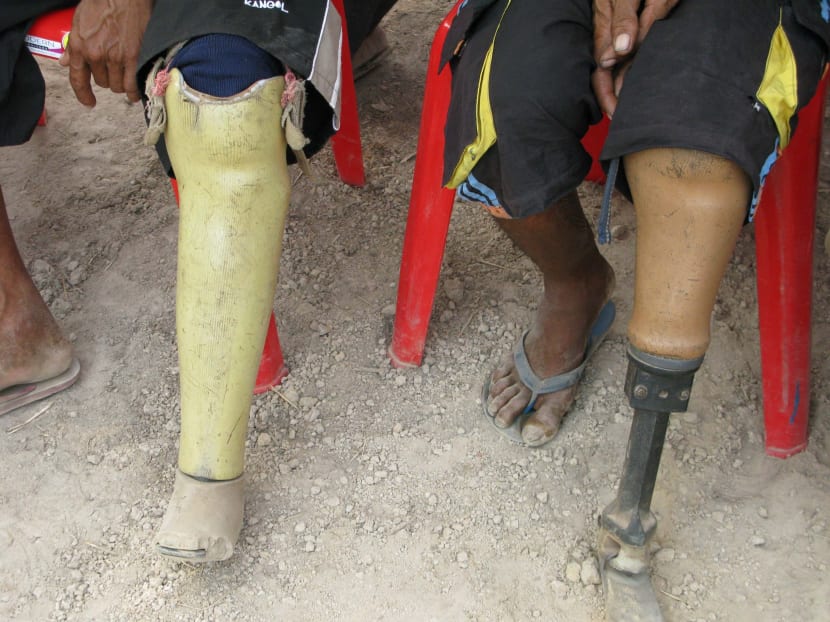
Nineteen people were killed, and many more injured, in the past year alone by landmines in Thailand. Photo: Bangkok Post

BANGKOK — The conflict may be over, but the danger lives on. Landmines left by insurgents and government forces have contaminated Thailand for more than four decades. Buried just beneath the surface, these weapons are designed to kill and injure those who misstep. They hide just off of well-worn paths, in fields, forests and sometimes dangerously close to places people call home.
Finding these weapons scattered across the countryside has been a challenge -- perhaps a bigger challenge than the country realised when it committed to being landmine-free nearly 20 years ago.
The latest deadline is set for this November. With 11 months remaining and 409sq km of contaminated area still spread around the country, Thailand will miss that deadline.
Almost 4,000 people have been hurt or killed by landmines in Thailand -- 19 in the past year. For many who’ve survived a run-in with these weapons, a landmine-free Thailand cannot happen soon enough.
PAST THREAT CONTINUES
In the 1970s, ‘80s and ‘90s, insurgents and government forces planted millions of landmines along Thailand’s borders with Cambodia, Laos, Malaysia and Myanmar.
According to a survey conducted almost two decades ago, 27 of Thailand’s provinces were affected by landmine contamination, impacting more than 530 communities and some 500,000 people.
The majority of the contaminated area was and continues to be along the Thai-Cambodian border, where some estimate that the largest landmine field in the world was planted.
Wiboonrat Chanchoo lives not far from this border, in Sa Keao province. A young mushroom and luffa gourd farmer, Ms Wiboonrat was scouring the forest near her village for bamboo trees to build a lattice when she stepped on a landmine.
“Suddenly I heard a click, immediately followed by a big boom sound,” she said. “I wasn’t sure what that was since it happened so fast. Next thing I knew, I saw my boot and my left leg flying in the air.”
She was 29, the year was 1996. She had help from friends and family, but her husband physically abused her after the accident. Ms Wiboonrat considered ending her life but told herself that she needed to stand tall and move forward. After recovering in a local hospital, she left her husband and learned how to walk with a prosthetic leg.
Others in her village have not been so lucky.
“There are approximately 124 people injured by landmines in my village,” she said. “There are also more than 100 of them that didn’t make it out alive.
“It’s still is a big problem in our village. We had another case just last year.”
AN INTERNATIONAL PROBLEM
Landmines are not just a problem in Thailand; many countries around the world are plagued by these weapons. In 1997 Thailand and several other countries signed the Mine Ban Treaty, an international agreement prohibiting landmines.
It sets deadlines for countries to become landmine-free and outlines methods for destroying old weapon stockpiles. Countries who sign the treaty agree to provide mine risk education and assistance to landmine victims.
It’s one of the world’s most widely-accepted treaties. As of 2015, 28 countries with mine contamination had successfully removed all landmines in their territory. Fifty-nine countries, including Thailand, have yet to become landmine-free.
BUMPS IN THE ROAD
Thailand has not purged its landmines as quickly as it planned to when it signed the Mine Ban Treaty 20 years ago. At the time, the country was given 10 years to clear all landmines, and when it missed that deadline, was granted 10 more.
But with this latest deadline less than a year away, Thailand is not on track to make it -- not even close.
Thailand still has approximately 409sq km of contaminated area to clear scattered around the country. With an average clearance rate of about 1sq km per year between 2011 and 2015, it will be a long time before Thailand is mine-free if it continues at that rate.
And while it would be great if clearing landmines was as simple as digging them up and hauling them away, the process is much more complicated. The first step is figuring out where to look.
SURVEY SLIP
In 2001, a survey attempted to measure the impact of landmines in Thailand. It concluded that 2,500sq km of the country was contaminated by the weapons.
But according to the Norwegian People’s Aid (NPA), an NGO dedicated to helping countries with landmine contamination, that number was hugely overestimated.
The survey looked at the number of people and communities affected by the threat of landmines, not how much area was actually contaminated by landmines.
“The difference is that if you live in a village where you cannot use a certain area, for livelihood or recreation, because of landmines, you are impacted … but it’s not the whole village that is actually covered by landmines, just a certain portion of the village,” says Aksel Steen-Nilsen, country director of NPA in both Thailand and Cambodia.
He says these discrepancies slowed down the landmine clearance process, which is run by the Thailand Mine Action Centre (TMAC).
“[TMAC de-miners] have been spending a lot of time clearing areas with few or no landmines. So, they’ve been working in the wrong places, not all the time, but some of the time,” says Mr Steen-Nilsen.
Bangkok Post reached out to TMAC for comment, but did not receive a response.
NPA has been working in Thailand since 2000. Its primary role is to accurately map mine-contaminated areas through evidence-based surveying.
“[We] try to verify if the areas that have been previously recorded are actually contaminated or not,” says Mr Steen-Nilsen. To do this, they study maps, consult past surveys and talk to people who know the area.
“This we do by speaking with local population, military, police, that are in the area. By doing this we are actually also getting some new information so we are able to identify new areas that previously had not been recorded.”
With the help of these surveys, the Thai government is able to pinpoint large areas that were wrongly labeled as “contaminated”. Between 2000 and 2008, almost 2,000sq km were found to have been mislabeled.
This greatly reduced the original estimation that 2,500sq km of Thailand was contaminated by landmines. Now, more resources can be spent on actually digging up and destroying landmines.
But TMAC needs more resources.
The government has gradually decreased the funding it gives TMAC each year. The centre’s budget fell by about 10 per cent between 2013 and 2014 to 72.65 million baht (S$3.02 million), and then by another 3 per cent to 68.27 million baht by 2016.
Geographical constraints have also slowed the mine clearing process. De-miners are faced with challenging terrain that can severely delay their de-mining efforts.
For example, some areas are difficult to access along the Laos border because of extremely dense, mountainous forests. Heavy rains during monsoon season are an issue. Mudslides can cause landmine’s positions to change.
The Thai government is already in the process of requesting an additional five-year extension, which they will present at an annual meeting of the state parties in Vienna, Austria, this month.
In a draft of its request submitted last year, it addresses some of the challenges it faces and suggests a few solutions.
For example, it plans on training civilian de-miners to tackle clearance in areas where military personnel are at risk. The report also outlines a few ways that the clearance and survey teams can be more efficient while out in the field.
In order to clear all landmines by 2023, Thailand plans to clear about 30sq km in 2018, and about 70sq km each year after that. In total, the report states that the budget for the extension period will be a little over 1.2 billion baht, some of which Thailand is hoping to secure from “sources other than the government”, such as NGOs.
As for survivors like Ms Wiboonrat, she looks forward to the day Thailand is officially landmine free.
Since her accident more than 20 years ago, she has become a strong and vocal advocate for landmine survivors. With the help of local officials, Ms Wiboonrat helped start a support group in her village, which expanded across her province and throughout Thailand.
She says she wants to empower landmine survivors and help them get their lives back on track.
“I’m sure there are still a lot more cases that can happen in the future but at least we know we will be taken care of,” she said. “No matter what happens, I’m here to support everyone, and that gives new purpose to my life.” BANGKOK POST
Stay in the know. Anytime. Anywhere.

Subscribe to our newsletter for the top features, insights and must reads delivered straight to your inbox.
By clicking subscribe, I agree for my personal data to be used to send me TODAY newsletters, promotional offers and for research and analysis.






