
The Big Read in short: Making home hospitalisations a norm
Each week, TODAY’s long-running Big Read series delves into the trends and issues that matter. This week, we look at the move to make home hospitalisation a mainstream service in public healthcare. This is a shortened version of the full feature, which can be found here.
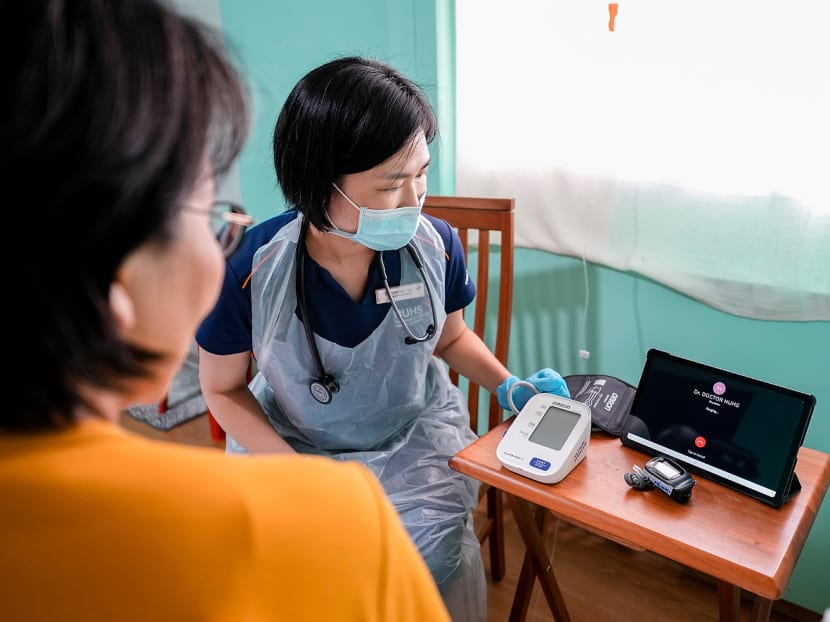
Come April 1, a pilot scheme where patients are hospitalised at home will become a “mainstream” service in public hospitals


This audio is AI-generated.
Each week, TODAY’s long-running Big Read series delves into the trends and issues that matter. This week, we look at the move to make home hospitalisation a mainstream service in public healthcare. This is a shortened version of the full feature, which can be found here.
- Come April 1, a pilot scheme where patients are hospitalised at home will become a “mainstream” service in public hospitals
- This means patients with certain medical conditions will recover at home while being fully monitored by doctors and nurses remotely
- Patients who have gone through it told TODAY of the upsides of being in a virtual ward in the comfort of their homes
- Medical professionals largely welcome the initiative as it can help patients recover better and also frees up hospital beds for those who need them more
- Still, some people remain sceptical about such a scheme and experts said a mindset shift is needed before it is more acceptable publicly


SINGAPORE — Ever since the stringent no-visitor rule in hospitals was temporarily imposed at the height of the Covid-19 pandemic, Mr Paul Osmond George, 46, who has ischemic heart disease and cardiomyopathy, has had a phobia of being hospitalised.
In January, when an upper respiratory tract infection caused a huge fluid build-up in Mr George's body, leading to coughing and vomiting, his cardiologist at Sengkang General Hospital (SKH) advised hospitalisation for a more effective diuretic medication treatment.
However, given Mr George’s aversion to hospitals, he immediately took up his doctor’s offer — with “no second thoughts or worries” — to recover at home under the Mobile Inpatient Care-at-Home (MIC@Home) pilot, aimed at making “virtual wards” a viable alternative to traditional hospital care.
While virtual wards may still be a novelty for many Singaporeans, they are not new — similar models have been widely adopted overseas.
Virtual wards were first piloted in England in 2005 and have since been further scaled up by the country's National Health Service, with more than 10,000 virtual beds available.
In Australia, the concept has been taken further with the setting up of a standalone virtual hospital in Adelaide.
WHY IT MATTERS
Speaking in Parliament on March 6 during a debate on his ministry's budget, Minister for Health Ong Ye Kung announced that from April 1, the MIC@Home service will become "mainstream" and be offered as part of public hospitals’ regular services.
This follows a successful two-year MIC@Home pilot the Ministry of Health launched in April 2022 as part of ongoing efforts to future-proof the healthcare system in a rapidly ageing Singapore.
The pilot was an extension of the Covid-19 Virtual Ward programme launched in September 2021 to free up bed capacity in Singapore's Covid-19 wards for the more seriously ill when Singapore experienced a spike in coronavirus cases.
Mr Ong said the rationale behind making MIC@Home mainstream is so that Singapore is not trapped in the mindset of “building hospitals” when thinking about expanding healthcare capacity.
“There is potential to better anchor care outside of hospitals and in the community,” said Mr Ong, adding that not all patients require “high-acuity care” and constant monitoring in a hospital throughout their treatment course.
In his parliamentary speech, Mr Ong also said that MIC@Home is not set to cost more than a regular hospital stay, and might be projected to cost the same or less.
MIC@Home offers eligible patients with certain conditions — such as skin infections, urinary tract infections, and congestive heart failure with fluid overload — the option of being cared for in the comfort of their own homes instead of a hospital ward.
Other hospitals that currently offer MIC@Home are Changi General Hospital (CGH), Singapore General Hospital (SGH), Khoo Teck Puat Hospital, Tan Tock Seng Hospital, KK Women’s and Children’s Hospital (KKH), and hospitals under National University Health System (NUHS).
Currently, there are 104 MIC@Home virtual beds across all these hospitals.
In response to TODAY's queries, MOH said it aims to provide up to 300 MIC@Home virtual beds this year in light of the move to make it a mainstream service.
In turn, public hospitals here told TODAY they are in the process of ramping up resources, though they all declined to provide specific figures.
Patients under MIC@Home are generally loaned monitoring devices, namely blood pressure monitoring sets, thermometers, and pulse oximeters.
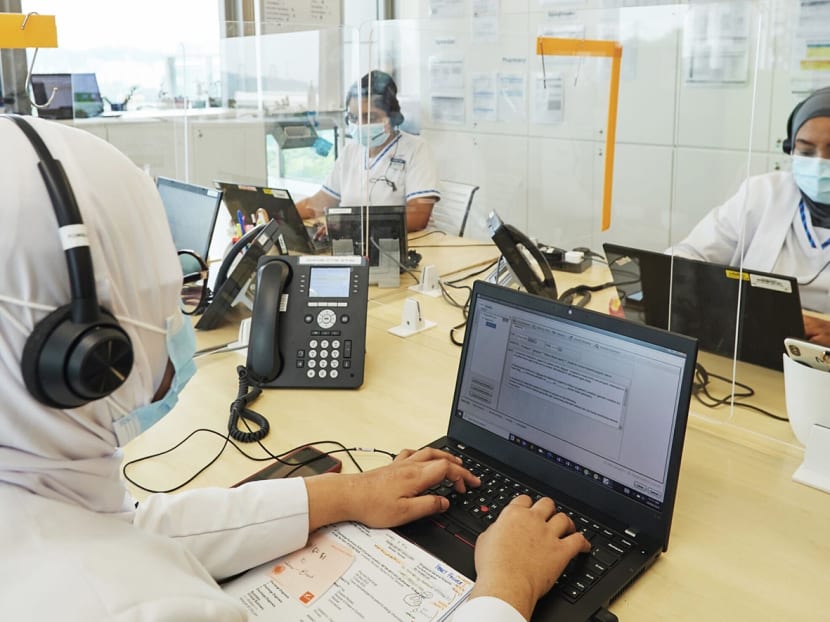
Healthcare workers can monitor patients via a dashboard that contains all the pertinent information on their conditions.
Just like a normal hospital ward, a specialist consultant is in charge of every patient admitted to the programme.
The consultants work with a team of junior doctors, nurses, therapists, and administrative staff to ensure each patient gets the care and support they need round the clock.
Doctors and nurses on the MIC@Home teams do not have any duties in the ward and are solely focused on teleconsultations and home visits.
They communicate with patients and their families using messaging platforms such as Telegram, WhatsApp, and phone calls.
THE BIG PICTURE
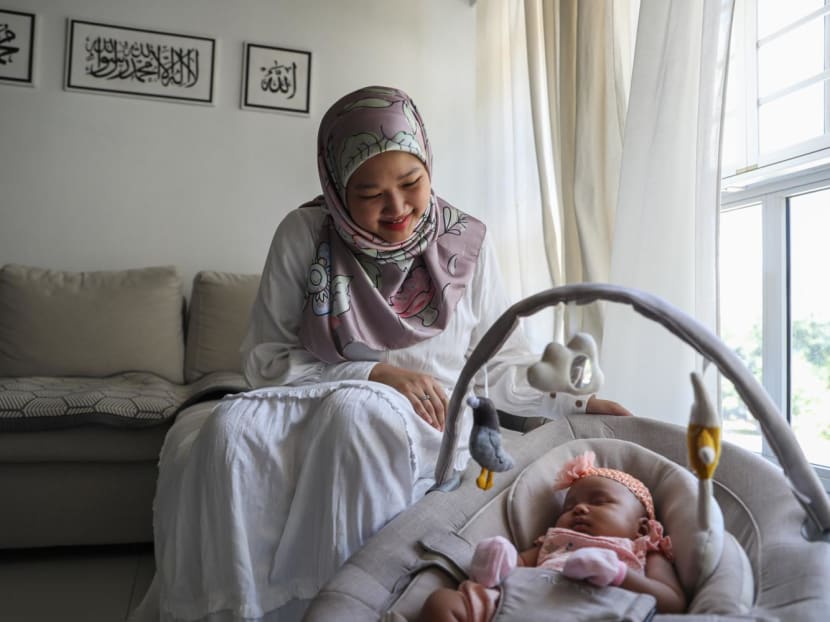
New mum Fatin Farzana Miswan, 31, decided to make use of the MIC@Home scheme after her baby had jaundice just five days after birth in February.
As a first-time parent, the geologist was fraught with anxiety, given her baby’s tender age and the arrangements she and her husband would have to make to visit the child in hospital.
“I'll be thinking and worrying about what is happening to my daughter,” said Ms Farzana, “We also don't have a car, so I think it'd be quite difficult for us to commute back and forth to the hospital.”
Setting up a “virtual ward” in her home was a seamless process for Ms Farzana.
The phototherapy machine was delivered to her flat, before KKH nurses came to advise her on how long to administer phototherapy treatment, and how to take her baby's vital signs and record them on an app.
Being connected to the nurses through a WhatsApp group also eased her worries, especially when she had questions about her daughter's care.
While the MIC@Home programme allows patients to recover in the comfort of their homes, the knock-on effect of this arrangement is also keenly felt by their caregivers.
Mr Adrian Tiam, a 53-year-old private hire driver, felt reassured having his daughter Charlotte recuperate at home in February after she was diagnosed with dengue fever and required hospitalisation due to a dangerously low platelet count of 50,000 per ml.
Platelets help to clot a person’s blood and prevent excessive bleeding. When the platelet count is low, one may have trouble stopping bleeding.
Since normal platelet counts are between 150,000 and 450,000 per ml.
When Charlotte, 16, and Mr Tiam went to CGH, they had to wait 12 hours before she finally got a bed close to midnight and was warded for one night.
“I felt nervous and uneasy in a new environment as I had to sleep in the hospital overnight,” said Charlotte.
The student was “quite happy” to be told by the CGH@Home team later that while her platelet count was still low, she would be eligible for the pilot programme to recover from home.
“I definitely felt well taken care of, as the nurses and doctor would call me if I didn’t take my blood pressure readings at my normal times,” said Charlotte.
Mr Tiam said having Charlotte recover at home meant he and his wife could watch over her “24 hours a day”, and did not have to make special arrangements with their work to accommodate the hospital’s visiting hours.
THE BOTTOM LINE
Doctors and healthcare professionals say that there are many benefits to making the MIC@Home service mainstream, besides freeing up healthcare capacity in hospitals.
For one thing, patients recover better at home, where a familiar environment results in them eating and sleeping better, which aids in their recovery.
While patients are recommended to take up MIC@Home, it is still presented as an option and they can decline it at any time.
SGH@Home's lead, Dr Michelle Tan, said that some patients have declined to be part of MIC@Home as they are more familiar with receiving medical treatment in the hospital.
“This will require a mindset change in patients and their caregivers to accept this new model,” Dr Tan said.
Other reasons patients do not take up MIC@Home include the lack of caregiving support at home or if if their home environment is not suitable for the service.
Indeed, while patients and their caregivers who participated in MIC@Home have praised the initiative, some people remain sceptical.
One of them is Mr Hayden Ng, 33, who has not been hospitalised in recent months. But he would still not choose to recover at home if given the option even though he believes MIC@Home is a good initiative to lessen the load for hospitals.
The social media manager said that since he is single and lives with his elderly mother, having him recover at home “doesn’t seem like a good idea”.
He is not sure that she can cope with the “extra stress and responsibilities needed” for being his caregiver if he chooses MIC@Home.
“At the same time, I’d prefer to be near the healthcare staff in case my condition suddenly worsens,” said Mr Ng. “This would give me more peace of mind.”
Experts said that in order for MIC@Home to achieve mainstream success, public perceptions of traditional care need to change.
Assistant Professor Ian Ang, from Saw Swee Hock School of Public Health at the National University of Singapore, said: “The public has to be convinced with data and evidence that such a new care model will not compromise their recovery, and also have an open mindset for this paradigm shift in the evolving forms of healthcare in Singapore with the times.”
Still, some doctors are more sanguine about the move to make home hospitalisations a norm.
“People usually think you have to be in a hospital to get treatments like intravenous drips under a doctor's watchful eye,” said Dr Stephanie Ko, a consultant at the division of advanced internal medicine at NUHS and lead of NUHS@Home.
“But we have shown that it is not only possible but that it is also safe and works well, changing how people think about home-based care.”
Related topics
Hospital Ong Ye Kung Ministry of HealthStay in the know. Anytime. Anywhere.

Subscribe to our newsletter for the top features, insights and must reads delivered straight to your inbox.
By clicking subscribe, I agree for my personal data to be used to send me TODAY newsletters, promotional offers and for research and analysis.





