
The Big Read in short: Investigating the root cause of Singapore's traffic accident woes
SINGAPORE — Just two weeks ago, a driver who decided to ignore the directional signs in a multi-storey car park in Choa Chu Kang almost collided into the vehicle that digital marketing manager Marcus Khoo was driving.
Experts and motorists TODAY spoke to believe a mix of stricter penalties, utilisation of speed-limiting technology in vehicles and continued education is the right way forward for safer roads.


This audio is AI-generated.
Each week, TODAY’s long-running Big Read series delves into the trends and issues that matter. This week, we look at why Singapore's road safety culture appears to be regressing amid a rise in fatalities and injuries from road accidents. This is a shortened version of the full feature, which can be found here.
- Several high-profile traffic accidents in recent months have shone a spotlight on Singapore’s road safety and driving culture
- Official statistics show that the number of traffic accidents resulting in fatalities and injuries has increased for three straight years, even though the roads are safer now than they were before Covid-19
- International studies suggest that Covid-19, the entry of ride-hailing services and the popularity of car-sharing can have a tangible impact on the number of road accidents and driver behaviour
- However, a lack of local studies means their influence in Singapore is debatable
- Experts and motorists TODAY spoke to believe a mix of stricter penalties, utilisation of speed-limiting technology in vehicles and continued education is the right way forward for safer roads


SINGAPORE — Just two weeks ago, a driver who decided to ignore the directional signs in a multi-storey car park in Chua Chu Kang almost collided into the vehicle that digital marketing manager Marcus Khoo was driving.
This near-miss, alongside his increasing observations of drivers who hog lanes, display road rage and blatantly flout the rules, has led Mr Khoo, 29, to believe that the behaviour of motorists on the road has regressed — “more so than ever” since the easing of Covid-19 restrictions.
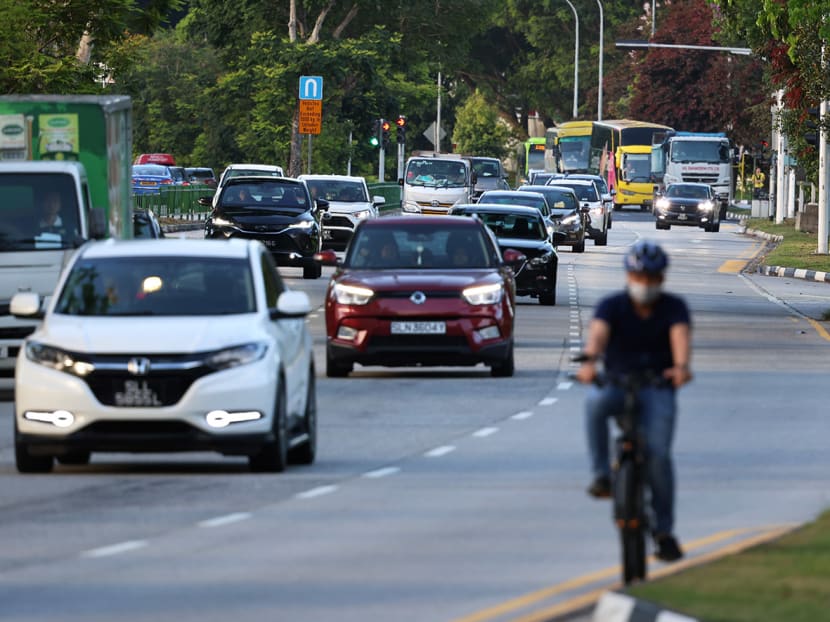
In TODAY’s conversations with seven motorists who have driven for at least five years, the sentiment is near-unanimous: Drivers' behaviours have been getting worse.
In recent months, Singapore has been gripped by several high-profile traffic accidents that have shone a spotlight on the country’s traffic safety measures, and by extension its road culture.
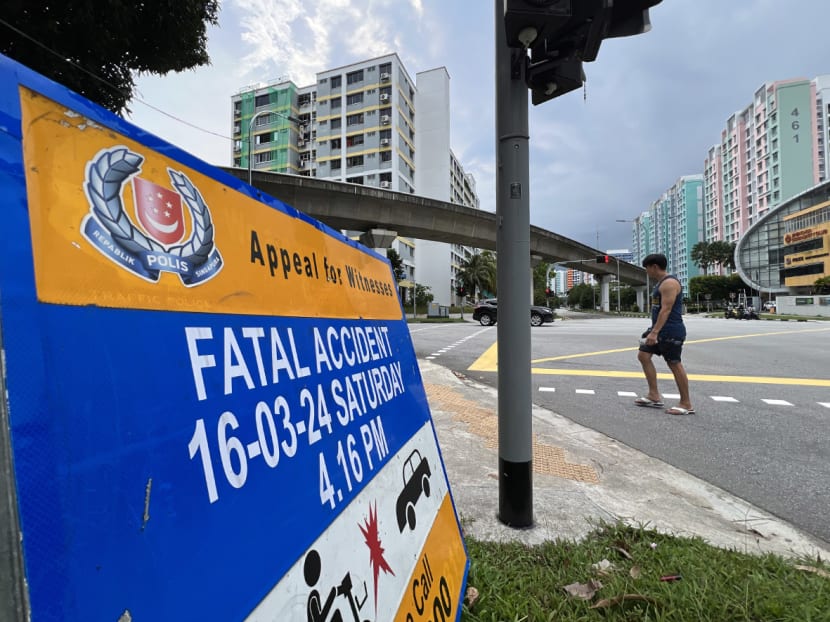
On Jan 23, a four-year-old was walking home from her preschool in River Valley when a car turned a bend and hit her. Barely a week later, a 12-year-old girl was on her way home from school in Taman Jurong when a van hit her.
Both children died in the accidents.
Last month, a multi-vehicle crash at the junction of Tampines Avenue 1 and Tampines Avenue 4 injured eight people and took the lives of 17-year-old student Afifah Munirah Muhammad Azril, and 57-year-old Norzihan Juwahib, who worked at a pest control company.
What could be behind Singapore’s apparent recent regression in road safety? TODAY looks at the potential causes and what can be done to improve the situation on the roads.
WHY IT MATTERS
With traffic safety matters prevalent in Singaporeans’ collective consciousness of late, the issue was raised in Parliament this week, after several Members of Parliament (MPs) filed questions on what measures can be taken to improve road safety for users and whether the Ministry of Home Affairs would consider implementing mandatory speed limiters on all motor vehicles.
MPs also asked whether existing penalties under the Road Traffic Act 1961 should be reviewed.
In response to these questions on Tuesday (May 7), Minister of State for Home Affairs Muhammad Faishal Ibrahim stated that the penalties under the Road Traffic Act — which had been raised significantly in July 2019 — “are already quite stiff” and adequate to deter dangerous driving.
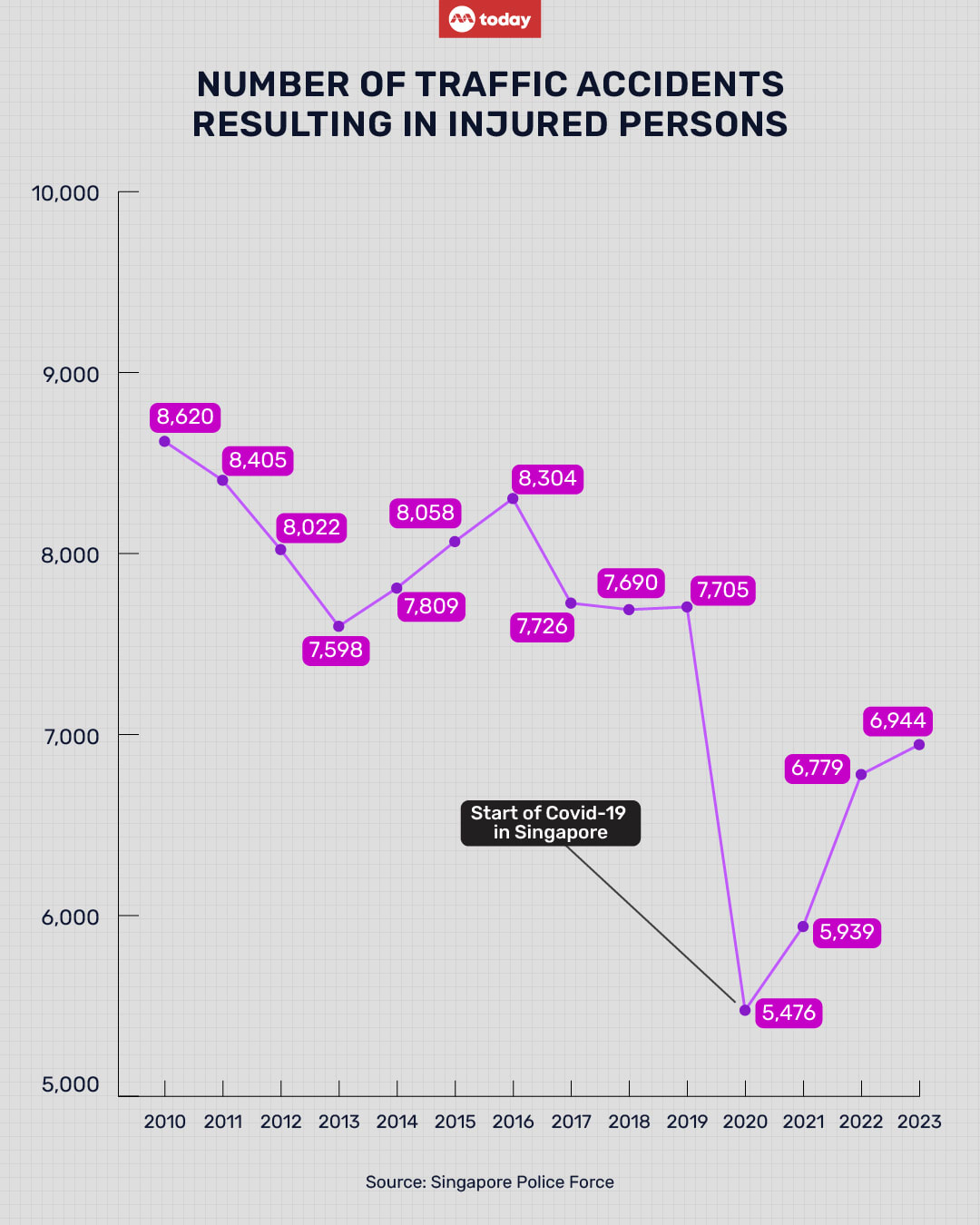
Associate Professor Faishal said that Singapore’s roads “have become safer” too, as the number of accidents resulting in injuries or fatalities had fallen by about 10 per cent from 7,822 in 2019 to 7,075 in 2023.
Indeed, according to data gleaned from the Annual Road Traffic Situation reports published by the Singapore Police Force, there had been a consistent decrease in the number of traffic accidents resulting in fatalities in Singapore from 2011 to 2019.
These 117 accidents reported in 2019 represented a 39.1 per cent decrease from the 192 reported eight years ago in 2011.
This number dropped further to 80 in 2020 — when lockdown measures were implemented due to the Covid-19 pandemic.
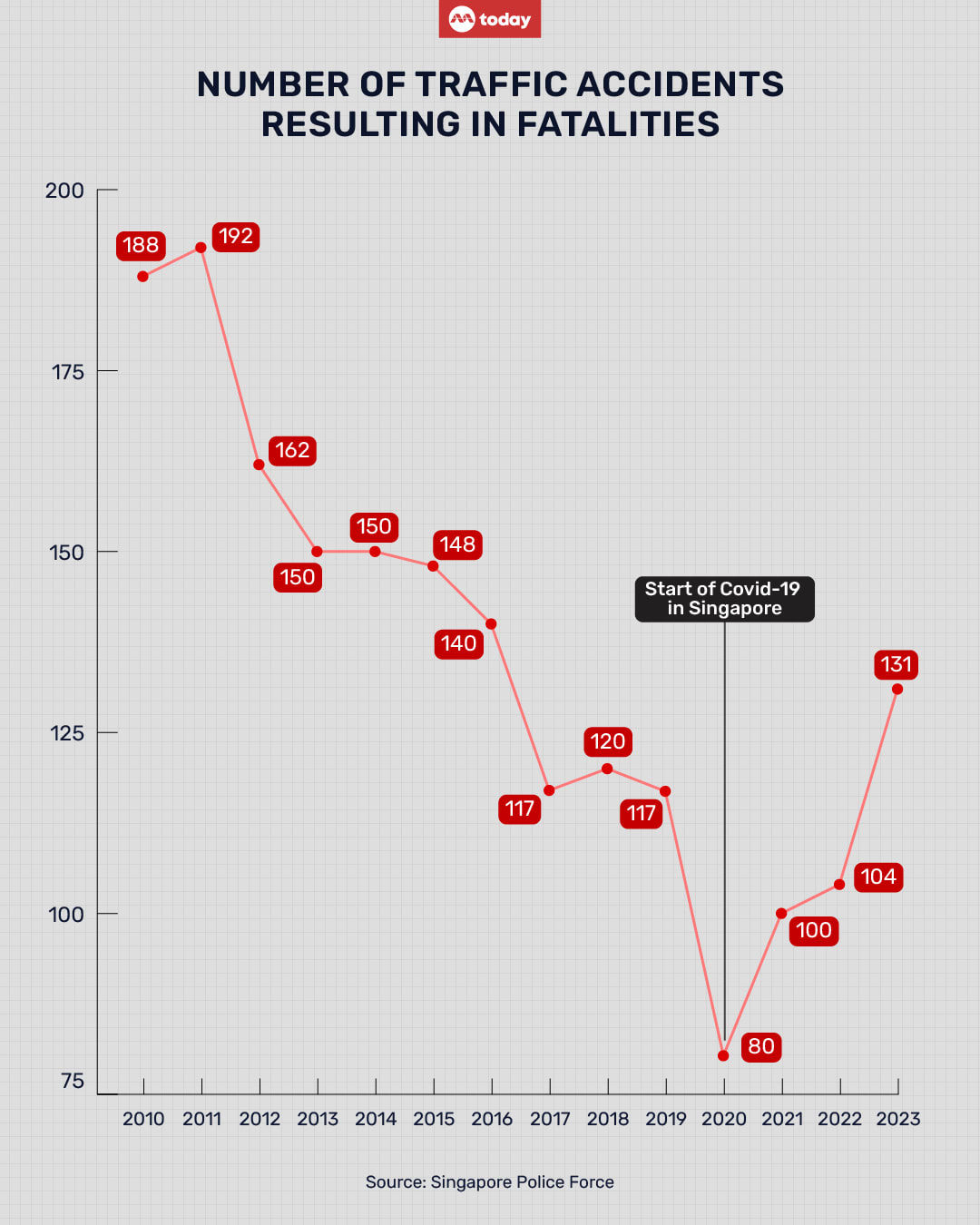

According to transport engineering consultant Gopinath Menon, this fall in fatality-causing accidents is indicative of Singapore “moving in the right direction on road safety”.
But that’s not to say that the motorists’ views shared earlier are completely unfounded.
Since the start of the pandemic in 2020, the number of traffic accidents resulting in both fatalities and injuries has increased year-on-year.
From 2020 to 2023, the number of fatality-causing accidents jumped by 63 per cent from 80 to 131, while accidents resulting in injuries went up by 26.8 per cent from 5,476 to 6,944.
While it is not surprising that 2020’s numbers were lower, should the rise in fatality- and injury-causing accidents for three consecutive years be a cause for concern?
Law lecturer at Singapore University of Social Sciences (SUSS) Ben Chester Cheong thinks so, calling the increase a “worrying trend that should not be taken lightly”.
“Road safety is a critical issue that affects everyone, and any regression in this area can have severe consequences for individuals, families, and society,” he said.
THE BIG PICTURE
Being forced to stay at home more often at the onset of the pandemic may have caused a deterioration in safety standards on the roads, according to Mr Khoo, Mr Gopinath and several other motorists TODAY spoke to.
With fewer vehicles on the roads back in 2020, “some drivers might have developed a habit of speeding or driving less cautiously due to the perceived lack of traffic”, said Mr Cheong of SUSS.
He added that the significant stress, anxiety, and mental health challenges that the pandemic had caused for many people may have also led to more distracted and aggressive driving.
Indeed, there have been multiple studies in the region and beyond that have lent credence to Mr Cheong's perspectives, indicating that Covid-19 has had a profound impact on road accidents and driver behaviour.
For instance, a Spanish study conducted in 2021 with 30 participants compared their driving styles to that before the pandemic.
The findings indicated that drivers had adopted a more aggressive driving style than they did before the pandemic, particularly those who had experienced anxiety because of Covid-19.
The Australian Road Safety Foundation’s annual research report in 2020 also showed that one in four drivers admitted to taking increased road risks since the implementation of Covid-19 lockdowns.
The foundation said this is likely driven by complacency and the fact that two thirds of Australians believe the roads were safer with lower traffic volumes and congestion.
While there have not been studies examining the impact of the Covid-19 pandemic on motorists’ behaviours on roads in Singapore, Mr Menon said it is possible that these findings apply to the local context too.
“Many drivers may have resorted to going at high speeds because they were able to do so.
“Impatience and general frustration because of the severe restrictions on the quality of life may have led to more red light running and reckless driving,” he said.
In fact, from 2020 to 2022, the number of speeding related accidents here did increase by 50 per cent (from 757 to 1,138) though that figure dropped sharply by 45 per cent to 624 cases in 2023.
It is also interesting to note that despite fatalities and injuries from traffic accidents rising for three straight years, red light and speeding violations recorded have simultaneously and consistently fallen over the same time period.
From 2020 to 2023, the number of red-light violations decreased by 38.2 per cent (51,459 to 31,815), with speeding violations dropping by 29.4 per cent (163,823 to 115,705).
However, statistics on such violations are more correlated to enforcement action than statistics on accidents.
Pandemic aside, the past decade has seen several key changes in the way Singaporean motorists commute — specifically the emergence of ride-hailing applications like Uber and Grab in 2013, and the more recent popularity of car-sharing services.
Studies abroad have indicated that both ride-hailing and car-sharing have an impact on road safety figures, though they point in opposing directions.
One 2019 study in South Korea found a causal relationship between the presence of a car-sharing service in an urban area and the number of car accidents there.
The more users a car-sharing service had in a market, the more accidents were recorded — particularly among experienced drivers, which the study defined as someone who has had a driver’s licence for at least three years.
But car-sharing’s impact on Singapore specifically is harder to quantify, as the Traffic Police does not track whether vehicles involved in accidents are car-sharing vehicles or not.
On the flip side, multiple studies overseas have shown that the presence of ride-hailing options in a city tends to decrease fatal vehicular crashes.
A United States nationwide study in 2018 found that once Uber has operated in a county for four or more years, fatal crashes decline by 17 to 40 per cent.
This is consistent with Singapore’s trend of declining fatality figures resulting from traffic accidents since ride-hailing apps entered the market in 2013.
THE BOTTOMLINE
Experts and motorists TODAY spoke to said a mix of stricter penalties, utilisation of speed-limiting technology in vehicles and continued education is the right way forward for safer roads in Singapore.
Mr Cheong, the SUSS law lecturer, said that introducing harsher penalties can lead to increased deterrence for reckless driving and raise more public awareness about the seriousness of road safety issues.
“In the past, it may not be practical or fair to impose severe penalties for traffic offences because of the difficulty in evidence collection and the difficulty in ascribing culpability (or blame) for an accident,” Mr Cheong said.
Now, however, the technology exists to identify those culpable clearly, and more severe punishments are justified, he added.
In a TODAY commentary earlier this week, SUSS senior lecturer Nicholas Netto suggested equipping all vehicles with Intelligent Speed Assistance technology, where traffic signs can automatically ensure vehicles comply with corresponding speed limits through an onboard communication system.
Mr Benjamin Leow, 31, who is self-employed and has driven for almost 10 years, said the country’s focus should be on cultivating what he calls “road intelligence” — like knowing which lanes to stick to at various speeds and when to use one’s hazard lights, for instance.
“It’s unfortunate we have to stoop to such measures, but given we’re a country that advocates lifelong learning, this is a small way to decrease incidents on the road,” he said.
For 28-year-old data analyst Prashanth Sutty, who owns both a Class 2B and Class 3 licence, the errant behaviours on the road boils down to the fact that “many of us are concerned about our own needs and convenience, resulting in a feeling of entitlement”.
In a similar vein, several MPs also brought up their own personal anecdotes of their encounters on Singapore’s roads in Parliament this week and questioned whether the nation’s road culture is one characterised by impatience.
MP for Hougang Single Member Constituency Dennis Tan said, for instance, that it is common for Singaporeans to honk at a stationary car “as soon as the (traffic) light turns green”.
Assoc Prof Faishal said in response to Mr Tan and other MPs that every person has a part to play in improving road safety.
“At the end of the day, we need to internalise this whole element within each of us that there are people around us who also are using the road,” he said.
“When you know that these road users have families… I think more care will be applied in the way we use our devices on the road.”
He also emphasised that while the Government will do all it can to keep Singapore’s roads safe, “road safety is necessarily a shared responsibility”.
While some motorists agree with that sentiment, they still believe that heavier punishments need to be meted out as those who subscribe to the above philosophy tend not to be the people causing accidents in the first place.
Mr Khoo, the digital marketing manager, said: “Until the Government takes more steps to enforce and remind (motorists), I honestly think the situation won’t improve and the cycle (of increasing accidents) will just keep repeating.”
Related topics
road safety traffic accidentsStay in the know. Anytime. Anywhere.

Subscribe to our newsletter for the top features, insights and must reads delivered straight to your inbox.
By clicking subscribe, I agree for my personal data to be used to send me TODAY newsletters, promotional offers and for research and analysis.





