
S’pore Writers Fest: So are S’poreans illiterate robots?
SINGAPORE — “And your point is?” Those were the words printed on the shirt of Makansutra founder KF Seetoh, which was perfect for the Closing Debate that wrapped up the Singapore Writers Festival yesterday (Oct 10). It was lively, witty, and quite heated — so you should get ready for a long post.
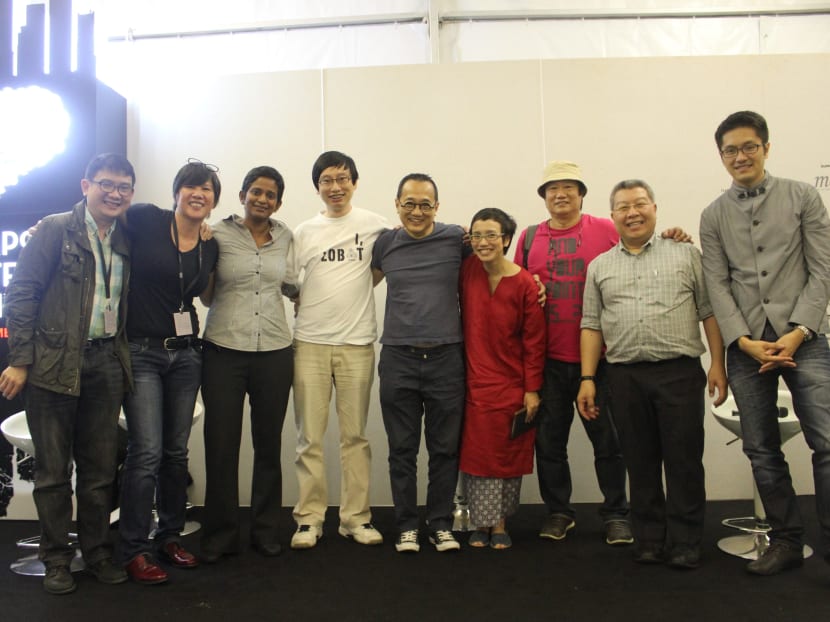
If there's one thing everyone can agree on, is that nobody present the SWF Closing Debate are illiterate or robots. Photo: Mysara Bte Mohamad Aljaru

SINGAPORE — “And your point is?”
Those were the words printed on the shirt of Makansutra founder KF Seetoh, which was perfect for the Closing Debate that wrapped up the Singapore Writers Festival yesterday (Oct 10). It was lively, witty, and quite heated — so you should get ready for a long post.
This year’s debate, chaired by Eleanor Wong, had the proposition (Gwee Li Sui, Edmund Wee and Shamini Flint) and the opposition (Oniatta Effendi, KF Seetoh and Kevin Tan) teams debate the motion: This House Computes That Singaporeans Are Illiterate Robots.
It kicked off with the first speaker of the proposition team, poet/critic Gwee Li Sui warning the opposition: “All I will say to Seetoh and his Motley Crew is this — prepare not to fry, but to get fried!”
Gwee then proceeded to define certain keywords in the motion, starting off with defining Singaporeans. Hearing the audience burst into laughter was a reminder that Singaporeans do have a sense of humour and we are able to poke fun at ourselves (most of the time at least).
“They don’t make babies because they don’t have sex, let alone commit adultery. They love work so much that they don’t need work-life balance. They worship money and food, and hence the holy book Makansutra. They always vote PAP — because Singaporeans don’t want to rock Sampan 2.0. I don’t know what sank Sampan 1.0,” said Gwee.
“For this one ah, I had to look at the dictionary,” he continued, this time in trying to define the meaning of illiterate. “I tried but I couldn’t find the word — under the letter ‘e’. I asked a minister and he said, ‘What do you think?’”
The meaning was eventually defined by actress and educator Oniatta, who opened up the opposition’s case.
“But this year, we have students reading and burning textbooks, allocated time for them to read in school — storybooks. Our children are certainly not short of lovely picture books. And us, you and I, we are reading Facebook!”
Jokes aside, Oniatta brought up the point about how the word literacy now encompasses a much broader context and that it must be also been seen as a set of skills that “enables us to have access, knowledge and information”.
A debate wouldn’t be a debate without statistics. Edmund Wee, publisher and founder of Epigram Books, brought up the rather alarming decreasing number of O-Levels candidates sitting for the Literature paper.
“In 2001, 7,000 students took Literature for O Levels. This year, 3,000 students will take Literature — that’s exactly nine per cent of the cohort,” claimed Wee.
Personally, I wondered if the statistics meant anything. I bet there are students like me, who wanted to take Literature as an O-Level subject but was never offered it in secondary school (sigh). Besides, even if we don’t study Literature, we read — and that has to count for something right?
“You cannot count all those books that have many colours between black and grey, all the different shades between black and grey — not counted. You do not count horror stories written by an Australian with a Chinese name,” said Wee. (We all know what he’s referring to.)
Just when I thought Wee was done, he continued: “You do not count books about where to find the best hawker food.” (Cue a priceless expression from Seetoh.)
Seetoh was quick to retort: “By the way, you sell 1,000 of your very clever books right? My Makansutra sells 20,000.” (Ooh, burn.)
Seetoh also talked about a hawker, laksa and satay. Honestly, I didn’t totally understand his point, but it had something to do with proving that Singaporeans are not robotic and stupid. (And, as always, he made me hungry).
Despite it being a debate about Singaporeans, it was, in my opinion, Flint who stole the show. After instructing the audience to put their hands in their pockets, she said: “I have a confession and I don’t want you to throw stones — I’m a Malaysian.”
Flint brought up a point that everyone has to admit is true. “I’ve been on the MRT but you’re not reading. First, you’re all listening to music, then playing on your smartphone — and don’t tell me you’re reading on your smartphones, unless you’re pointing to the sentences you really like!” she said animatedly (imitating someone playing Candy Crush).
What about Singaporeans who actually do read?
“Everything is a religious book! And if it’s not a religious book, it’s a self-help book. How to make money while you sleep? How to make money using spoons?” she said and added cheekily: “How to make money writing about hawker food?”
On the topic of Singaporeans being robots, Flint talked about the education system. The Singapore-based corporate lawyer-turned-writer had just transferred her children to a local school from an international school.
“I can’t stand the international schools and you know why? They want your child to be happy! I’m like what s**t is that? I want them to know science; I want them to know Maths! I want them to be illiterate robots!” she quipped.
“I promise you, they have not been happy since,” she added, which made some teenagers in front of me clap loudly.
Lawyer Kevin Tan, author and editor of over 30 books, rebutted the proposition’s points in true lawyer style.
“The fact that you are all here at the literary festival, the fact that you are reading books, the fact that you are thinking — you laugh at the points (when) you think something is funny — shows that you are not illiterate; neither are you robots. With that, I rest my case,” said Tan.
Tan and Flint also rounded up their case for their teams.
“There could be Singaporeans who are literate, but they are not robots. There could be Singaporeans, who are robots, but they are not illiterate — I’m thinking of certain people in high places. But if you are illiterate, you are (a) robot, you cannot be Singaporean,” mentioned Tan.
He may have had the applause, but Flint had the final say.
“You see something at this Writers Festival, where you are all so energetic and all so enthusiastic — and we know it’s changing. But in the meantime, too many people are too uninterested in books, too uninterested in words, too uninterested in the experience of reading and discovering through books,” she said.
The word “fail” was something Tan also used to highlight the proposition’s points — it reminded me of classes in primary school, and I was glad that Flint pointed it out.
“And him, him!” she said as she pointed excitedly to Tan. “You know what he said? He said something, something, something fail! That is the language of a robot. Pass, fail — that is the PSLE language.”
While the winning team was judged based on audience support — the proposition team won — a question from the audience (very briefly) brought both teams together: If Singaporean literature always revolved around Singaporean spaces and Singaporean identity, and not on more universal topics that can be universally applicable, then what the hell is the value of Singaporean literature?
Oniatta broke the short silence (and said what was on everyone’s mind): “I just want to say, relax ah, brother.”
Said Wee: “I only publish Singapore literature. I publish stories written mainly by Singaporeans, set in Singapore, about Singapore society. I don’t want to publish stories with universal values because these values are in all the other books.”
To which Flint highlighted the importance of having an identity through these books. “I do think that for us to feel comfortable in a society, we need to see our lives reflected in books. And so, it’s not good enough to read the next Harry Potter. We also need to read the next Singaporean writer and find ourselves as the people.”
Despite being a “hardcore” Potterhead who grew up reading the Harry Potter series, I had to agree with her.
Stay in the know. Anytime. Anywhere.

Subscribe to our newsletter for the top features, insights and must reads delivered straight to your inbox.
By clicking subscribe, I agree for my personal data to be used to send me TODAY newsletters, promotional offers and for research and analysis.






