
‘Father of the Internet’ Vint Cerf says we should reach for the stars
SINGAPORE — Think big, and out of this world. That’s the advice from Internet pioneer Mr Vinton Gray Cerf, who is often referred to as the “Father of the Internet” for his role in co-developing the first Internet protocol suite which is the basis of online end-to-end data communications.
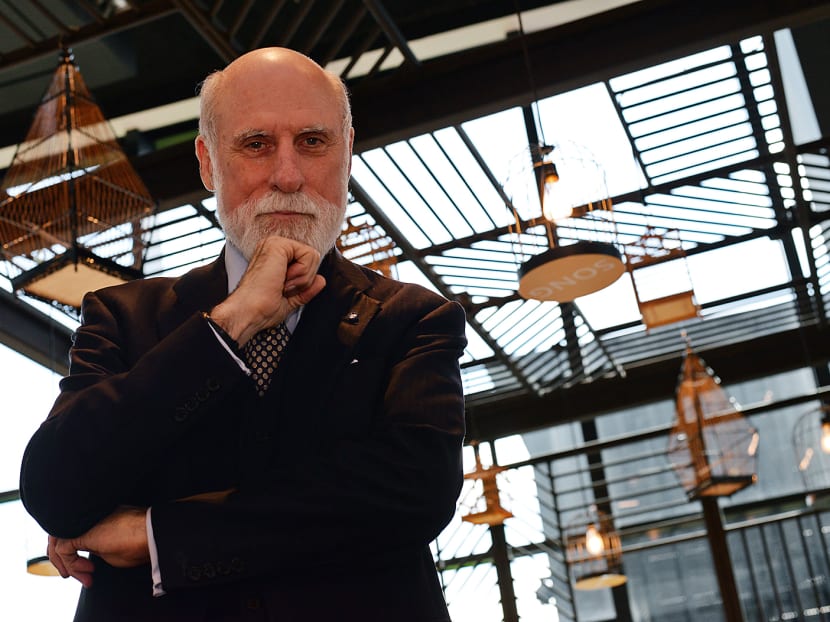
Vinton Cerf, known as the Father of the Internet as well as vice president and Chief Internet Evangelist for Google, on May 16, 2017. Photo: Robin Choo/TODAY
SINGAPORE – Think big, and out of this world. That’s the advice from Internet pioneer Mr Vinton Gray Cerf, who is often referred to as one of the “Fathers of the Internet” for his role in co-developing the Internet protocol suite and the architecture of the Internet.
With the Internet firmly entrenched in our daily lives – affecting how we interact with each other, how we conduct business, and how we perceive the world – how much further can the Internet go?
An intragalactic network, or an Internet for our galaxy, is the vision by Mr Cerf, who bears the title of Google vice president and Chief Internet Evangelist.
The future of the Internet is going to get “bigger, faster... and integrated into our lives far more than it is today,” Mr Cerf said in an interview with TODAY.
In the not so distant future, Internet-enabled devices will dominate the new wave. The widely-touted ‘Internet of Things’, or the connectivity of everyday objects, will be prevalent, together with machine learning and interactive artificial intelligence, said Mr Cerf.
“I think the Internet will simply surround us in the future. It will be built into our offices, homes, vehicles, and maybe in our persons. It will just be there to serve us in the same way that electrical power is expected to come out of the wall at need.”
MAKING THE INTERNET MORE SECURE
The Internet has certainly ignited a new economic growth engine for the world, creating enormous amounts of wealth and business for people with the applications that sit on top of it, said Mr Cerf, citing the case of Google.
Mr Cerf added he is “pretty happy” with the results of the Internet.
The advent of the smartphone boom has further aided the growth of the Internet community, he said. Today about 3.5 billion people are online. Mr Cerf forecasts that another 2 to 3 billion people will go online by 2020.
As benefits and economic gains are generated by the Internet, the future of the Internet also requires safety and security. “There’s no trivial cure for this,” said Mr Cerf.
To work towards a safer and more secure Internet environment, the technical community has to minimise the mistakes they make when they write operating systems software and applications software, he said. Individuals need to be more aware about Internet security and avoid unsecured products.
“We have to recognise that if we are going to build devices for the net, we have to take extra steps to make sure we can protect ourselves from being invaded or controlled by people who are not authorised to do that,” said Mr Cerf.
Digital signatures, or other kinds of cryptographic methods can help, but “improving our ability to write software with fewer bugs in it and improving our ability to update software when we discover there are bugs, is a very important part of making the network safer for everyone to use.”
As individual users, we can also play a part in practising Internet security, such as adopting two-factor authentication, not clicking on potential phishing messages as well as not buying equipment and gadgets that are unsafe, Mr Cerf said.
VISION FOR THE FUTURE
Having worked on developing the system since its early days, Mr Cerf says the Internet was planned to be a global system since 1973.
The power of the Internet is far from its saturation point. The design of the Internet allows it to adapt to new technologies and support new applications pretty much without an end in sight, shared Mr Cerf.
The Internet was “designed to be expandable,” he said. The idea was “to allow new kinds of applications to be built on top of it.”
He explained that the Internet can support an arbitrarily large number of new applications, whether it is “voice or video or a piece of the webpage or a document or something else.”
“That was a very, very deliberate design choice on our part, in order to permit that kind of exploration and growth… so there isn’t really any limitation to what you can do with software except your imagination and what you can programme.”
Hence, the limitless boundaries of the Internet – even beyond our world.
There is “real incentive” to develop intragalactic networking, due to the solar systems that have been found in space, said Mr Cerf. However, some barriers to the technology include communicating faster than the speed of light which is still a mystery to be solved.
Currently, there are already developments to deliver scientific data back to researchers on Earth using a prototype interplanetary network between Earth, Mars and the International Space Station.
“That’s functional, that’s real, that’s running. As new missions get launched we will continue to grow the interplanetary backbone. So from my point of view we have an architecture that we are pretty confident will work for solar system scale.”
“Right now the hard part is doing it between here and Alpha Centauri (the closest star system to the solar system) or Beta Centauri. The Centauri system, that’s 4.3 light years away. That’s going to be harder to do,” Mr Cerf said.
Much as his sights are on the future, this “Father of the Internet” insists we do not forget history.
Mr Cerf is currently working on solving the problem of preserving digital content – photos, movies, documents, programmes, databases, application and operating system software.
“We need technologies to run old software on emulated old hardware so we can see (in future) what our ancestors wrote, Tweeted, Facebooked or YouTubed about… Fortunately, it looks as if there may be some long-term solutions to this problem. But there is still a lot of work to be done to make this feasible.”
Stay in the know. Anytime. Anywhere.

Subscribe to our newsletter for the top features, insights and must reads delivered straight to your inbox.
By clicking subscribe, I agree for my personal data to be used to send me TODAY newsletters, promotional offers and for research and analysis.