
OCBC tables S$6.23 billion bid for Wing Hang
SINGAPORE — After months of negotiations, OCBC has formalised its offer to acquire Hong Kong’s Wing Hang Bank (WHB) for about S$6.23 billion, in a bold move to substantially increase its presence in the fast-growing Greater China region.
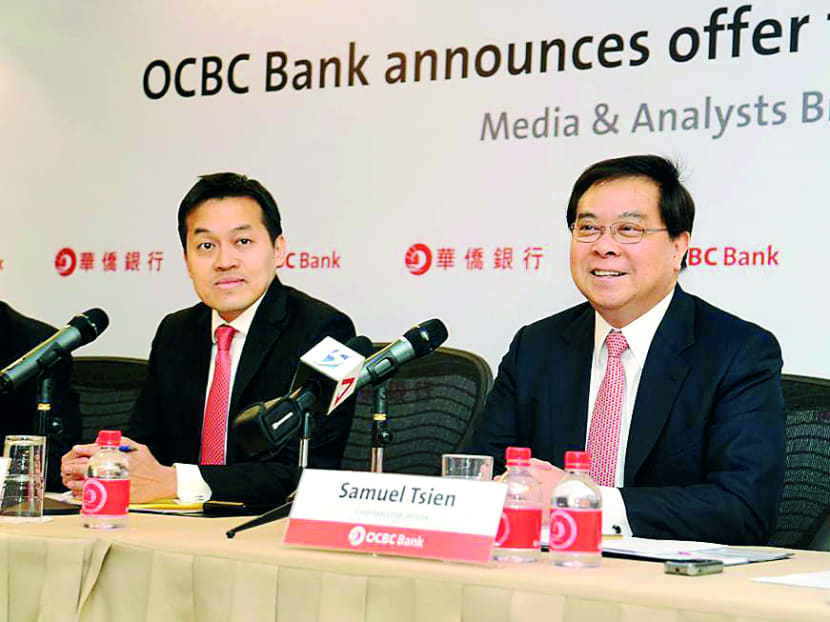
By acquiring Wing Hang, OCBC hopes to realise its overseas ambitions, said its Chief Financial Officer Darren Tan (left) and Chief Executive Officer Samuel Tsien. Photo: OCBC
SINGAPORE — After months of negotiations, OCBC has formalised its offer to acquire Hong Kong’s Wing Hang Bank (WHB) for about S$6.23 billion, in a bold move to substantially increase its presence in the fast-growing Greater China region.
Announcing the offer yesterday, OCBC Chief Executive Samuel Tsien hailed it as the next breakthrough for the Singapore bank in realising its overseas ambitions.
The deal “helps deepen our presence in Greater China, positions us to capture the new business opportunities from the growing economic connections between North and Southeast Asia (and) broadens our product capabilities”, including a much wider yuan product range, he said.
OCBC is offering about 1.77 times WHB’s net book value as of December last year, but the price is “fair” to both buyers and sellers because of the franchise value it will be able to create, as well as the additional investment it will make in WHB, Mr Tsien added.
Analysts said that while the dollar value of the deal is eye-catching, it will be a positive investment for OCBC.
“It’s a hefty sum to be sure, but I believe it’s a good deal. Initially, the price was expected to be around 1.9 times the book value — OCBC could’ve ended up paying much more,” CMC Markets analyst Kenny Kan told TODAY.
Investors seemed to share that view, pushing OCBC’s share price up by 0.53 per cent in the wake of yesterday’s announcement to close at S$9.56.
Nonetheless, the acquisition — which is still pending formal regulatory approval — will see OCBC’s total capital adequacy ratio dropping from 16.3 per cent to 12.5 per cent, closer to the minimum 10 per cent required.
The group plans to raise capital to return the ratios to prudent levels, Chief Financial Officer Darren Tan said, but details will only be announced later.
The acquisition will be accretive to the group’s earnings per share and return on equity by 2017, he added.
Looking beyond the financials, the strategic value of the deal is unmistakable, Mr Kan said.
“The deal is compelling because without Wing Hang, OCBC may take much longer to expand in Greater China,” he said.
“Now, with Wing Hang, OCBC can expect a much bigger exposure to offshore yuan trading, which should bring double-digit growth to the group’s treasury income.”
Hong Kong, where OCBC currently has only one branch focusing on corporate banking, is the world’s biggest offshore yuan hub with deposits reaching more than 800 billion yuan (S$163 billion).
Acquiring WHB will create access to a broader and more stable yuan funding base, while strengthening OCBC’s yuan product capabilities in areas including trade finance, offshore bonds and wealth management, Mr Tsien said.
WHB’s 2013 annual report published last month said it planned to remain strategically focused on offshore and onshore yuan businesses, although it did not specify its current market share. Nevertheless, its presence in the biggest offshore yuan market will give OCBC a platform from which it can further expand a part of the banking business seen to have massive growth potential.
With a network of 70 outlets mainly in Hong Kong, Macau and Guangdong province, WHB offers OCBC an instant gateway to the Pearl River Delta region, a vibrant business hub and a key driver for China’s colossal economy.
OCBC also expects WHB to have a strong geographic and product synergy with its existing franchise in China, where the bank has 16 branches via a local subsidiary.
“(On top of the offshore yuan business), we will also have access to other capabilities including SME banking, speciality financing and car-financing in markets where WHB is in,” Mr Tsien said, noting that the acquisition will help the Singapore bank further diversify its earnings.
Post-acquisition, Greater China’s contribution to the group’s profit before tax will increase from 6 per cent to 16 per cent, he said.
Stay in the know. Anytime. Anywhere.

Subscribe to our newsletter for the top features, insights and must reads delivered straight to your inbox.
By clicking subscribe, I agree for my personal data to be used to send me TODAY newsletters, promotional offers and for research and analysis.






