
Sembcorp Marine opens integrated shipyard at Tuas
SINGAPORE — The Government is stepping up its efforts to help the marine and offshore industry upgrade its capabilities and manpower in a bid to ensure that the sector remains competitive despite the land and labour constraints in Singapore.
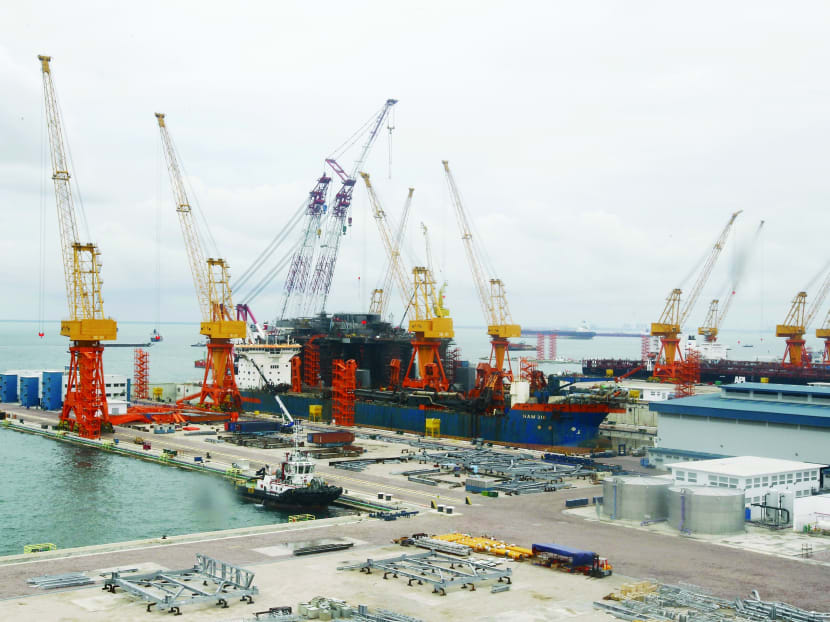
SembMarine Integrated Yard at Tuas will be capable of servicing a wide range of vessels and rigs. Photo: Ernest Chua
SINGAPORE — The Government is stepping up its efforts to help the marine and offshore industry upgrade its capabilities and manpower in a bid to ensure that the sector remains competitive despite the land and labour constraints in Singapore.
The plans include enhancing institutional collaboration in research and development, and building an ocean-basin test facility for innovation-intensive activities, Prime Minister Lee Hsien Loong said yesterday.
“We will also build a pipeline of talent and skilled manpower. We will establish industry-relevant specialised training programmes … and work with companies to improve the quality of jobs and raise the income of workers in this sector,” Mr Lee added.
Similar attention will also be given to other manufacturing and services sectors.
“For instance, there is potential for raising productivity in the construction sector, and our target is a 20 to 30 per cent improvement by 2020,” said Mr Lee. “For precision engineering, we will also focus on raising value-add per worker to the levels of advanced economies ... and we will attract higher value-add activities to Singapore.”
The Prime Minister made these comments yesterday at a ceremony marking the launch of Sembcorp Marine’s integrated shipyard at Tuas, which will be capable of servicing a wide range of vessels and rigs, including very-long-range and mega carriers.
The 206-hectare facility, the largest of its kind in Singapore, will be completed in three phases, and Sembcorp Marine plans to consolidate all its yards in Singapore — which include Jurong Shipyard and Sembawang Shipyard — by 2024.
“This is to create a shipyard for the future, which will significantly increase our productivity,” Mr Lee said. “Sembcorp Marine can optimise its layout and facilities, while freeing up the lands they currently occupy for other developments.”
Sembcorp Marine Chairman Goh Geok Ling said the integrated yard, the first phase of which is already complete, incorporates innovative design and advanced automation.
“These will maximise work efficiency and operational synergy, enabling us to utilise our workforce and resources more effectively to achieve higher productivity,” he said.
Meanwhile, Mr Lee urged the rest of the industry to follow SembMarine’s lead, saying: “As the Singapore economy matures, we’re reducing the inflow of foreign workers … and land is becoming scarce and expensive. So, the challenge is for the industry to stay viable while optimising land use and reducing reliance on foreign manpower.”
Overcoming these domestic constraints will be crucial for the future growth of the marine and offshore sector, which accounts for 1.6 per cent of Singapore’s gross domestic product and employs about 20,000 locals.
The industry also makes up around 10 per cent of Singapore’s manufacturing output, making the Republic the largest jack-up rig manufacturer in the world, CIMB economist Song Seng Wun said.
“But we are also facing increased competition from China and Korea. Integrated facilities like the SembMarine Integrated Yard will be a boost to Singapore against this competition, giving the industry added efficiency to deliver projects ahead of schedule and at a lower cost,” he told TODAY.
“As long as Singapore keeps investing in the industry, it should have no problem maintaining its lead in the marine and offshore business,” Mr Song added.
Stay in the know. Anytime. Anywhere.

Subscribe to our newsletter for the top features, insights and must reads delivered straight to your inbox.
By clicking subscribe, I agree for my personal data to be used to send me TODAY newsletters, promotional offers and for research and analysis.






