
SIA chief sees new A350 plane as a game-changer
SINGAPORE — Nearly 10 years after placing its first order for the Airbus A350, flag carrier Singapore Airlines (SIA) finally took delivery of the fuel-efficient aircraft, in a move that could help it reinstate its foothold on long-haul routes amid strong competition from Middle Eastern carriers.
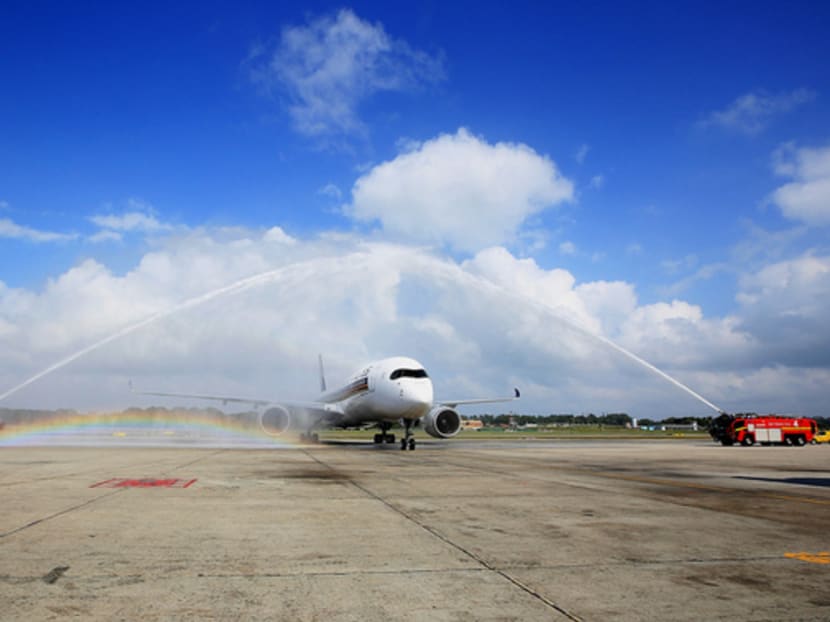
Singapore Airlines’ new A350 receiving a water cannon salute when it arrived at Changi Airport yesterday. Photo: Koh Mui Fong
SINGAPORE — Nearly 10 years after placing its first order for the Airbus A350, flag carrier Singapore Airlines (SIA) finally took delivery of the fuel-efficient aircraft, in a move that could help it reinstate its foothold on long-haul routes amid strong competition from Middle Eastern carriers.
The plane, which is the first of SIA’s 67 orders, will be a “game-changer” for the airline, said chief executive officer Goh Choon Phong.
Amid slow demand growth led by a weak economic outlook and crowded skies putting pressure on yields, the A350 fleet, Mr Goh said, is a key element of the flag carrier’s overall strategy for capacity growth and fleet renewal. The aircraft, according to its maker Airbus, consumes 25 per cent less fuel than its long-range competitors, and the improved operational efficiency could allow SIA to open up more new routes.
“The A350 will be a game-changer for us, allowing for flights to more long-haul destinations on a non-stop basis, which will help us boost our network competitiveness and further develop the important Singapore hub,” Mr Goh said after the aircraft arrived in Singapore.
The aircraft was received with a water cannon salute at Changi Airport in the presence of Singapore’s Coordinating Minister for Infrastructure and Minister for Transport, Mr Khaw Boon Wan.
Some analysts, however, expressed concern that even with the new A350 fleet, SIA could find itself facing challenges fending off the competition.
“SIA has been a little late waking up to competition from Middle Eastern carriers ... ,” said Mr Ellis Taylor, Asia finance editor at Flightglobal. “However, it is a step in the right direction given that these planes are more fuel efficient, and SIA will now be at an advantage when it comes to connecting South-east Asia non-stop to secondary cities in Europe, and later, the United States.
“But, on routes from the South Pacific and East Asia, most passengers travelling to Europe go for cheap fares, and Middle Eastern carriers have been really aggressive on their strategy to grab market share with premium services at lower fares. For most passengers in these markets it doesn’t matter whether they stop over in Singapore, Dubai or Doha.”
SIA will deploy the A350s on long-haul services to Amsterdam from May 9 this year. It will also operate all-new services between Singapore and Dusseldorf from July, as well as “many more destinations in the SIA network”, details of which, the airline said, will be announced through the course of this year.
From 2018, an ultra-long-range variant of the A350 known as the A350-900ULR will be added to SIA’s fleet for the re-launch of the world’s longest non-stop flights: Between Singapore and both Los Angeles and New York, as well as a third destination in the US.
“From SIA’s perspective, the new aircraft is expected to generate cost efficiencies as well as improve yields compared to the aircraft they replace. The issue about competition from Middle Eastern carriers is something altogether different as it is based on geographical positioning as well as capacity expansion,” said UOB Kay Hian analyst K Ajith.
SIA ordered the first batch of A350s in July 2006. The initial fleet will be fitted with 253 seats across three classes: 42 in business, 24 in premium economy and 187 in economy.
“At this point we are not seeing a weaker demand in business class. There is pressure on pricing and yields. But with the kind of outlook we are seeing in the world economy, we do expect that it will affect business demand,” Mr Goh told reporters at the sidelines of event.
SIA has prided itself on having a young and modern fleet of aircraft, which the A350 will add to. As of Jan 1, the average age of SIA’s fleet stood at seven years and three months, making it one of the world’s youngest and most fuel efficient.
The new aircraft will feature higher ceilings, larger windows, an extra-wide body and lighting designed to reduce jet lag, as well as a more advanced in-flight entertainment system.
Stay in the know. Anytime. Anywhere.

Subscribe to our newsletter for the top features, insights and must reads delivered straight to your inbox.
By clicking subscribe, I agree for my personal data to be used to send me TODAY newsletters, promotional offers and for research and analysis.






