
Finding the right fit
SINGAPORE — When Mr Joseph Tan secured the sole distributorship for a brand of ergonomic chairs from Germany, his plan was to sell them in dedicated spaces within department stores. But his proposal was rejected repeatedly because his products were deemed too niche for a mass-market retail space.
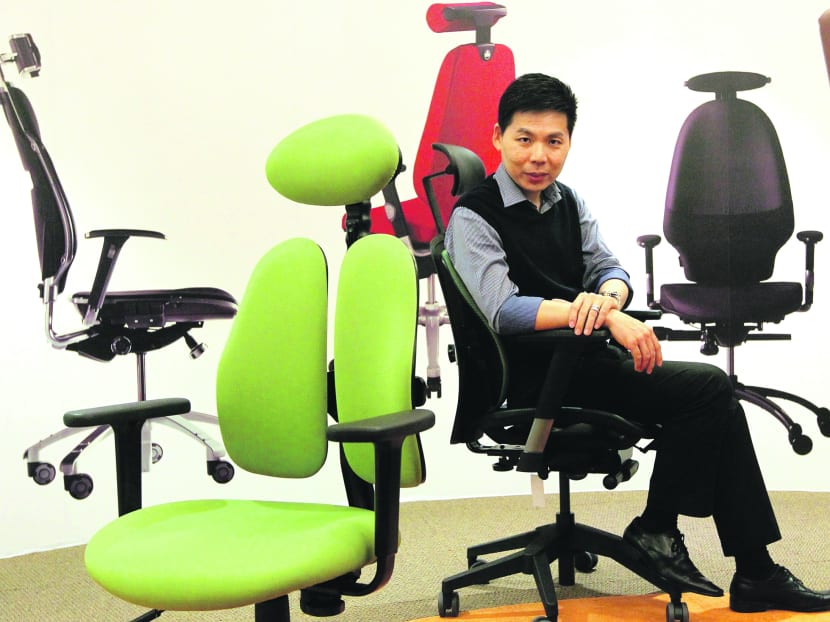
In 2006, Mr Joseph Tan and his wife started Ergoworks and began to distribute ergonomic furniture made by brands in Europe. Photo: Don Wong
SINGAPORE — When Mr Joseph Tan secured the sole distributorship for a brand of ergonomic chairs from Germany, his plan was to sell them in dedicated spaces within department stores. But his proposal was rejected repeatedly because his products were deemed too niche for a mass-market retail space.
“Our original plan was to open concept corners in major department stores, but when we presented our proposal, they found that their customers might not be able to afford our products,” said Mr Tan, co-founder of Impact Lifestyle, a company that sells a range of ergonomic products, including school bags, chairs and workstations.
Backed into a corner, he took a gamble on buying a 1,200 sq ft showroom at Marina Square in 2006 to showcase the firm’s flagship Duorest range of products. It was a heavy investment for the small company, but one that has paid off handsomely, considering how retail rents have skyrocketed in recent years.
The company, which markets its various products under the umbrella brand of Ergoworks, has since added two more showrooms, at Centrepoint along Orchard Road and Causeway Point in Woodlands, and has grown from three staff to over 20.
“In a way, we were forced to open the showrooms. We had signed the distributorship for Duorest but didn’t have a space. The downside was that the initial set-up cost was high, but it also gave us a lot of flexibility to market our products,” said Mr Tan.
The 42-year-old and his wife Rennie Pan, 40, had set up Impact Lifestyle in 2001 to market children’s school bags and other school essentials such as water bottles and stationery.
The business was born after Mr Tan’s family business of making luggage and school bags closed due to a lack of skilled needleworkers. He then looked for new business opportunities that could leverage on his experience in manufacturing bags, and stumbled on the burgeoning field of ergonomics — or the study of designing equipment and devices that fit the human body.
After hearing complaints from friends about their children having to lug around overloaded school bags, they developed “spinal-protection” bags designed to provide proper support for a child’s back.
In 2006, they established Ergoworks and began to distribute ergonomic furniture made by brands in Europe, including the company’s flagship Duorest chairs.
“My wife and I have sat in chairs that have given us back pain, and I even fell off a chair when the base cracked,” he recalled with a chuckle.
The pair researched the market and found that high-end ergonomic chairs from brands like Herman Miller tended to cater to big projects and offices, with very few options for retail buyers.
While they initially targeted customers who bought their products for use at home, favourable word of mouth soon saw more of their wares being used in offices. “Towkays would come to buy a chair for their homes, but after using it, they want the chairs for their companies as well,” revealed Mr Tan. The company now supplies its products to offices and government agencies as well.
The price of an Ergoworks chair ranges from around S$500 to S$3,000. According to Mr Tan, the furniture brand is the first to be certified and recommended by The Chiropractic Association (Singapore) and the Singapore Physiotherapy Association.
Outside of the Republic, Impact Lifestyle distributes its brands to neighbouring places, including Malaysia, Thailand, Hong Kong, Taiwan and Indonesia.
In the next five years, the company aims to expand its presence in other countries in Asia, which have generally lagged Singapore in terms of accepting ergonomics. This might include operating its own showrooms abroad or franchising its concepts.
“We are looking at places like China, Hong Kong, Korea and Japan. But there are obstacles like IP (intellectual property) protection. So we are talking with lawyers to see how we can roll this out smoothly,” he said.
Closer to home, the company has plans to design its own ergonomic furniture and is planning to open another outlet here.
“We are looking at other locations for a showroom. But after so many years, we are still at the mercy of the landlord, because we are still seen as selling a niche product.”
Stay in the know. Anytime. Anywhere.

Subscribe to our newsletter for the top features, insights and must reads delivered straight to your inbox.
By clicking subscribe, I agree for my personal data to be used to send me TODAY newsletters, promotional offers and for research and analysis.






