
Texas Instruments unveils automated warehouse
SINGAPORE — It spans 7,500 sq m and is plied by 36 battery-powered robots that will move and store products in a process controlled by a computer, allowing semiconductor giant Texas Instruments (TI) to increase productivity by 40 per cent at its product distribution centre at DHL’s Changi supply chain hub.
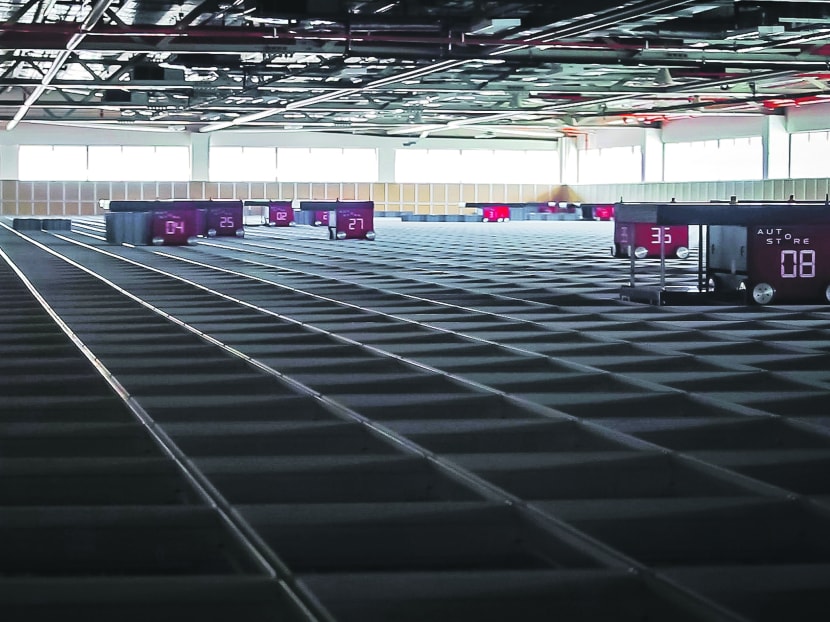
The warehouse management system, called Autostore, involves 36 robots plying the top of the grid to store and extract products. Photo: DHL
SINGAPORE — It spans 7,500 sq m and is plied by 36 battery-powered robots that will move and store products in a process controlled by a computer, allowing semiconductor giant Texas Instruments (TI) to increase productivity by 40 per cent at its product distribution centre at DHL’s Changi supply chain hub.
Opened yesterday, this warehouse management system, called Autostore, is TI’s S$12.8-million answer to the challenge of boosting productivity in Singapore’s high-cost environment as the Government seeks to restructure the economy and tighten manpower policies.
Instead of a typical arrangement of shelves and aisles, the system features a grid designed to save space, with 63,000 bins stacked 108 rows wide, 38 rows deep and 16 bins high, allowing TI to quadruple its capacity at Changi. A 800-metre conveyor system connects the grid to receiving and shipping areas, allowing for swift movement of goods. A warehouse management software acts as the nerve centre, controlling the entire inventory flow.
“Within a space that previously stored 500 million semiconductor units, we will ramp up to two billion units this year,” TI President for Asia Larry Tan said at the opening yesterday.
“The integrated design enables TI to support its customers’ growth well into the future by improving efficiency and reliability of shipments.”
TI’s distribution centre in Singapore, which employs 250 people, is the group’s largest globally, managing inventory from 20 inbound countries while shipping to 54 countries.
Significant volume growth over the past few years pushed TI to look for a solution that optimised existing space and increased productivity through automation, the company said.
The logistics and warehousing sector is growing at a compound annual rate of 6 per cent and currently contributes to about 8 per cent of Singapore’s economy, while employing more than 200,000 workers.
“This investment in state-of-the-art warehousing solutions exemplifies how the logistics industry in Singapore can achieve growth and competitiveness through operational excellence and productivity gains,” said Mr Quek Swee Kuan, Deputy Managing Director of the Economic Development Board.
DHL Supply Chain’s South and South-east Asia Chief Executive, Mr Oscar de Bok, who was present at the event yesterday, said: “Looking at Singapore, I see a lot of opportunities to go more towards automation here, because the cost drivers in terms of labour and land do stimulate you towards business optimisation. Automation is a crucial part of that,” he said.
Mr Koh Seng Teck, Head for South-east Asia at Swisslog — which developed the system — pointed out that not all upgrades have to come at a hefty price.
“There are many different technologies catering to the different business needs and the modern solutions have the flexibility and scalability for that … So it all depends on the business model of an operator,” he said.
“Companies should first focus on upgrading the parts of operations where benefits outweigh costs — which aren’t necessarily high. At Swisslog, for example, we’ve done systems that cost less than S$3 million in Singapore.”
Stay in the know. Anytime. Anywhere.

Subscribe to our newsletter for the top features, insights and must reads delivered straight to your inbox.
By clicking subscribe, I agree for my personal data to be used to send me TODAY newsletters, promotional offers and for research and analysis.