
Beijing does not have a population problem, say experts
BEIJING — The Beijing city government has taken several steps lately to rein in its population growth, a problem authorities blame for foul air, worsening traffic, and other woes.
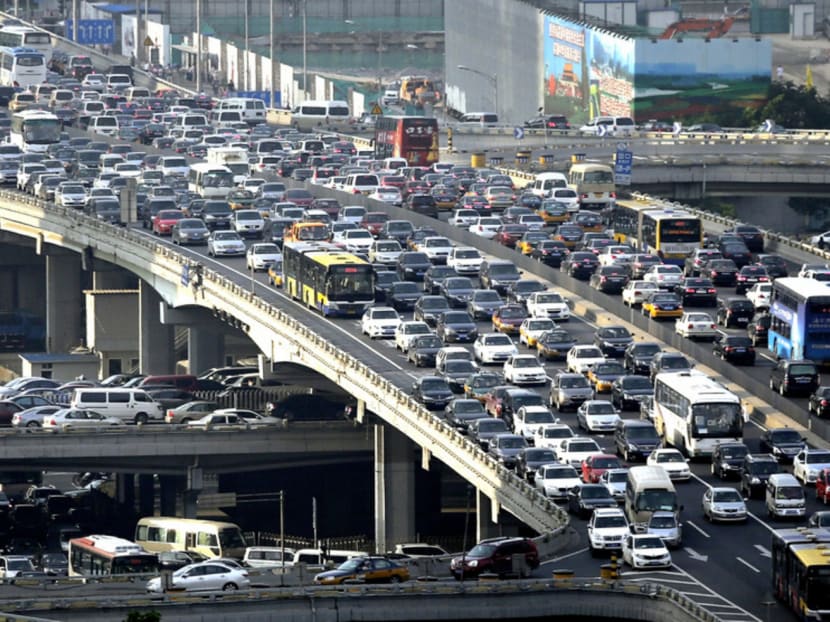
Rush-hour traffic on Guomao Bridge in Beijing in July 2013. In the past two years, city authorities have tried to curb the growing number of migrant workers to Beijing, also moving factories and major wholesale markets to the city’s outskirts or neighbouring Tianjin and Hebei. Photo: Reuters
BEIJING — The Beijing city government has taken several steps lately to rein in its population growth, a problem authorities blame for foul air, worsening traffic, and other woes.
However, academics said much of the government’s argument for the curbs is flawed, and some are also asking whether the latest moves will work considering previous attempts to slow population growth in the capital failed.
The city government said in July that it planned to move the bulk of its agencies to the less populated eastern Tongzhou district over the next several years, a move authorities hope will shift one million people out of crowded downtown areas.
The authorities have also been moving factories and major wholesale markets to the city’s outskirts or to neighbouring Tianjin and Hebei province to comply with a central government order for Beijing to shed some functions that do not match its status as the capital.
In a more controversial move, city authorities have in the past two years tightened requirements for children from migrant families to enrol in public schools, in an apparent effort to curb the growing number of migrant workers in Beijing. The capital had 8.82 million migrant workers — 38 per cent of the total population — at the end of 2014.
Slowing Beijing’s population growth features prominently in the plans of the 25-member Politburo, one of the ruling Communist Party’s top decision-making bodies, that were announced in April for better integrating Beijing, Tianjin and Hebei. The ideas, which were only made public recently, require the capital to limit its population to 23 million people in 2020. This level “must not be exceeded”, Beijing’s party boss Guo Jinlong said at a city legislature meeting in July.
Several experts said the cap has factored in land and water resources available to Beijing, and the potential impact of population on the environment and public transport.
A government-backed study in March 2013 showed that Beijing residents have an average of 119 cubic metres of water available to them, while the United Nations says a country or region is heavily short of water if the figure is as low as 1,000.
The study also found that Beijing’s population density soared by more than 60 per cent from 1999 to 2011 to 1,300 people per square kilometre, a level described as unsustainable. The dense population weighs heavily on the city’s roads and public transport systems, the report said.
But some academics say Beijing may not have the population problem that officials think it does.
Dr Huang Wenzheng, a demographer at Johns Hopkins University, wrote in an article that the city’s population density ranked only 138 out of 224 cities around the world with a population of at least 2 million people.
The Chinese capital is more crowded than big cities in most developed countries, such as Tokyo, Paris and New York, but less cramped than cities in developing countries, including Brazil’s Sao Paulo and Ankara in Turkey.
“From a global perspective, it’s untenable to claim Beijing has too many people,” Dr Huang wrote.
Many major cities have much less water than Beijing, he said. Singaporeans have an average of 113 cubic metres of water available to them and Los Angeles can only meet 15 per cent of its water demand, relying heavily on supplies from other areas.
Mr Zheng Xinye, a professor of economics at Renmin University, said that based on official statistics, Beijing’s water reserves had more than doubled from 1.92 billion cubic metres in 2001 to 3.95 billion.
Residents of the capital each had access to 193.3 cubic metres of water in 2012, up from 139.7 in 2001, largely due to an increase in recycled water.
A desalination project in Hebei’s Caofeidian development zone can provide the capital with 1 million cubic metres of water per day, the official Beijing Daily newspaper reported in March 2013. This works out to one-third of the city’s needs.
Many experts argue that if Beijing can devise an effective conservation strategy, water should not be a problem. They also contend that poor urban planning is responsible for Beijing’s other big problems, such as air pollution and overcrowding.
Official data indicates that some of the capital’s traffic woes could be blamed on a lack of roads.
The city’s streets accounted for only 7 per cent of its total space, while the figure in New York’s urban areas is 25 per cent. Meanwhile, many roads in Beijing are off-limits because they are reserved for government agencies and the military.
Mr Yang Ming, a senior urban planner at state-run Beijing Municipal Institute of City Planning and Design, said that at the core of Beijing’s problems is the inability of officials to run a big city.
He said that greater Tokyo was more developed when its population hit 30 million than when it had 20 million inhabitants, proof that a city can be better planned even as its population grows.
“Take Shijiazhuang, the capital of Hebei province, as another example,” Mr Yang said. “It’s more polluted than Beijing even though its population is only one-sixth the population of the capital.”
He pointed out that officials would be better served by focusing on urban planning than setting population targets, especially given that goals set in 1983, 1993 and 2004 were all missed. CAIXIN ONLINE
Stay in the know. Anytime. Anywhere.

Subscribe to our newsletter for the top features, insights and must reads delivered straight to your inbox.
By clicking subscribe, I agree for my personal data to be used to send me TODAY newsletters, promotional offers and for research and analysis.






