
China’s dyslexic children lacking support at school
BEIJING — Over 10 million children in elementary schools across China have dyslexia, researchers have found, and they do not get timely support because their troubles are ignored or misunderstood.
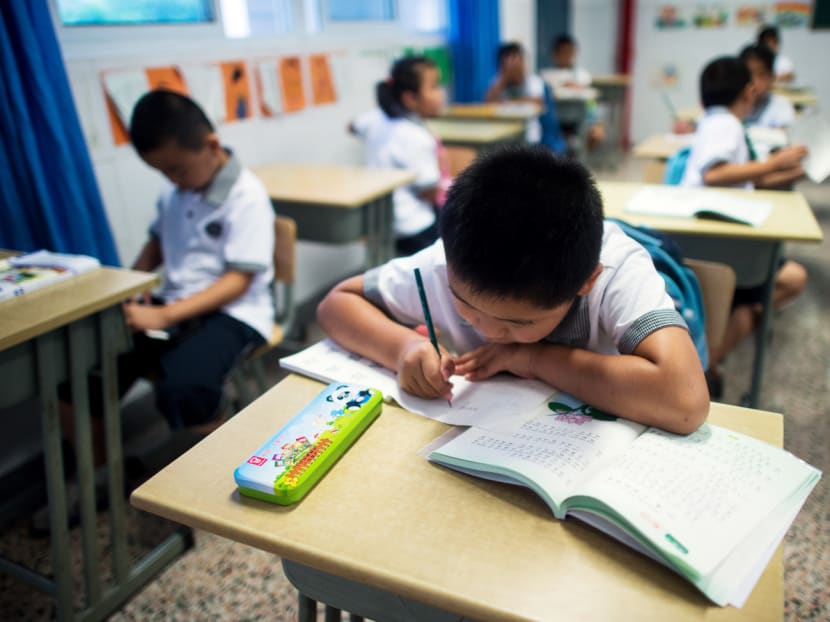
Seven year old Wei Yueran (left), who also has the English name Harney, attends a Chinese class at the Jinqao Center Primary School in Shanghai on Sept 1, 2014. Photo: AFP
BEIJING — Over 10 million children in elementary schools across China have dyslexia, researchers have found, and they do not get timely support because their troubles are ignored or misunderstood.
Children with dyslexia have problems recognising and understanding words, despite having normal or above-normal levels of intelligence. Some have difficulty coordinating their movements, or suffer from poor motor skills. Therefore, some youngsters might struggle to hold a pen or pencil for too long and have sloppy handwriting.
Dyslexia is a type of learning disability associated with problems with the brain’s language processing areas, shows research, and can be caused by both genetic and environmental factors.
A 2014 study by the Institute of Psychology under the Chinese Academy of Social Sciences (CASS) found that about one in 10 students aged six to 12 in the country are struggling with the condition, and that parents and teachers frequently fail to spot it.
In 2007, an Indian film called Taare Zameen Par, or Like Stars on Earth, attracted global attention by highlighting the problems dyslexic children face.
In the film, Ishaan, 8, is sent to a boarding school as punishment for his poor test scores. He is ridiculed by his peers and punished by his teachers, until an art tutor notices his drawing talent and helps him to overcome his learning difficulties.
Like Ishaan, many dyslexic children have hidden talents, but they struggle with education methods that put too much emphasis on language skills. This causes misunderstandings with teachers who are not aware of their problems, labelling them as having lower levels of intelligence or as being lazy.
Various studies show that one in 10 elementary school students around the world have some form of dyslexia. Despite this, many people are surprised by the fact that dyslexia is so common.
Mr James Redford, a US filmmaker whose son suffers from the learning disability, once said these children are sometimes so smart that they can mask the fact that they have a tough time reading.
Conventional teaching methods that put a priority on reading, writing and memorising things are not suitable for dyslexic children. The CASS study in 2014 showed that dyslexic youngsters are more likely to get low grades on written tests than other students. They are also more prone to emotional or physiological problems, such as depression, because the condition also affects their ability to communicate and make friends.
Dyslexia is not a conventional disease that can be cured with drugs alone, said Mr Bi Hongyan, a psychologist at CASS. It is a lifelong condition that requires specific types of intervention and care.
But there is also an upside to dyslexia, said Yale researchers Sally Shaywitz and Bennett Shaywitz, who argue in their joint research that people with dyslexia tend to be more creative. The pair also say the youngsters’ reading skills can be improved through proper teaching techniques and tools.
Experts believe the best time to intervene is before age 12. Difficulties with learning to identify letters and read can be overcome through special training. Many children miss this window of opportunity to get treated because teachers and parents are unaware of the condition.
If the problem is identified in the first two years of elementary school, almost 90 per cent of the reading and writing problems can be resolved with proper intervention, said Ms Lan Zi, CEO of LangLang Learning Potential Development Centre, a company in Beijing that offers assisted learning programmes for these youngsters. The success rate drops to under 40 per cent if families wait until the children are in fifth to sixth grade, said Ms Lan.
Most dyslexic children who come to her centre are already in the final years of elementary school, when the window is about to close, said Ms Lan.
Schools in the country have not attached enough importance to research into learning disabilities and lack an effective support system to help students cope, said Mr Bi, the CASS psychologist.
The country has only a few special training institutions for dyslexic children and no official textbooks for the reading difficulties of this group in mind. “There are less than five social organisations offering services for dyslexic youngsters across the mainland,” said Mr Bi.
Mr Huang Yongguang, a member of the Chinese People’s Political Consultative Conference, said at a meeting of the government’s top political advisory body last month that officials should draft policies in support of special education services in schools.
Some experts say central and local governments on the mainland should adopt the system used in Hong Kong, which has a well-established network of specialists, charities and government departments to support children with special education needs and their families.
Education authorities in the former British colony have trained teachers in more than 200 schools to identify dyslexic students and provide special support to them, said Ms Li Yiran, head of the mainland charity China Dyslexia Foundation.
Hong Kong also had many social workers and doctors who specialise in working with these children.
Dyslexia does not spell doom for a child’s future, said Mr Bi, highlighting stories of celebrities and business leaders who have overcome the condition.
“Helping dyslexic children is possibly helping future artists, scientists and thinkers,” said Mr Redford. CAIXIN
Stay in the know. Anytime. Anywhere.

Subscribe to our newsletter for the top features, insights and must reads delivered straight to your inbox.
By clicking subscribe, I agree for my personal data to be used to send me TODAY newsletters, promotional offers and for research and analysis.






