
China’s first social-media president
Chinese President Xi Jinping caused quite a stir in April when a “selfie” surfaced on popular microblogging site Sina Weibo and sealed his reputation as China’s first social media president. Since coming to power, Mr Xi has developed a sophisticated media strategy, one prong of which is to carefully cultivate an image of himself as a “man of the people” on social media.
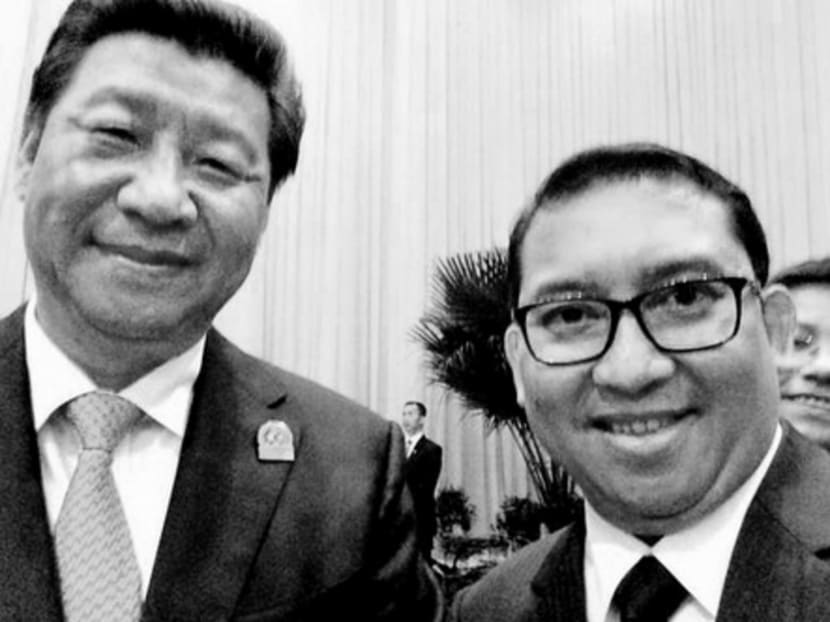
Indonesian House of Representatives Deputy Speaker Fadli Zon (right) taking a ‘selfie’ with Chinese President Xi Jinping in Jakarta in April. Photo: Fadli Zon

Chinese President Xi Jinping caused quite a stir in April when a “selfie” surfaced on popular microblogging site Sina Weibo and sealed his reputation as China’s first social media president. Since coming to power, Mr Xi has developed a sophisticated media strategy, one prong of which is to carefully cultivate an image of himself as a “man of the people” on social media.
His Weibo account contains photos that downplay his political heritage as a “princeling” and show him working as a “sent-down youth” (students who performed hard labour in the countryside during the Cultural Revolution) in the 1970s and a low-ranking party cadre in the 1980s.
He has also used social media to mobilise popular support for his anti-graft campaign, encouraging Chinese citizens to expose corrupt local officials via Weibo.
These efforts have so far drawn enthusiasm, cynicism and detraction alike. One thing is clear, however: Grassroots support will become more important as the Chinese Communist Party tackles daunting challenges ahead, and the leadership considers social media a useful tool to shape a positive public image of the party.
Indeed, the future stability of China and the continued viability of Chinese Communist Party rule may hang on the ability to shape a narrative where effective leadership finally tackles problems that have long threatened to jeopardise China’s future.
Corruption is one of those problems that have received much domestic and international attention. China ranks 100 out of 175 countries in Transparency International’s 2014 Corruption Perceptions Index, with a score of only 36/100. Importantly, Pew Research Center surveys show that members of the Chinese public who say that “corrupt leaders are a very big problem”, have increased from 39 per cent of those surveyed in 2007 to 54 per cent in 2014. Corruption has deep structural roots, however, and tackling it will take time.
Furthermore, other growing concerns are related to corruption. Take environmental degradation and local government debt, for example. Environmental problems have become a grave concern for a cross-section of the Chinese people. Local government debt, totalling about 40 per cent of China’s gross domestic product today, is considered a source of serious drag on the Chinese economy for the future.
Yet, a growing economic pie is important to socio-political stability when income inequality remains high. Considering the systemic nature of China’s problems, we can argue that the outcome of the most genuine efforts to eradicate these problems may even be uncertain.
Using Social media on ‘tigers’ and ‘flies’
Mr Xi’s media strategies must be understood in this light. The use of social media to gain popular support for his leadership serves to bolster his top-down anti-graft campaign. This will be especially helpful as the continued targeting of what Mr Xi calls “tigers” within the party may well result in more intense factional politics and resistance.
Further, public sentiment can be used to discipline the “flies” — local officials whose lavish lifestyles are often the subject of ridicule and resentment on social media. The manipulation of the masses for political ends is not unprecedented in Chinese political history, and social media can create new synergies between bottom-up pressures and top-down initiatives today.
The problem with social media is, of course, that it is a two-edged sword. When Mr Xi first began his social-media campaign, pundits were sceptical that he could successfully use it to mobilise society without raising unrealistic expectations of his administration. Support can turn to criticism if expectations are not met quickly enough.
Thus, what we have seen is an increase in the power of Chinese censors, and a simultaneous campaign against foreign media outlets that have reported on the wealth of key Chinese officials.
Chinese “netizens” have also been required to use their real names on Weibo. This allows the government to implement the so-called “five-strikes-and-out-rule”, in which the accounts of anyone writing “sensitive” posts five times could be suspended for 48 hours.
Not only have “sensitive” posts been deleted, hundreds have been arrested for posting “rumours” online. The ambiguity of what constituted rumours have helped encourage self-censorship.
One other seemingly paradoxical move by the government has been to arrest leaders of the New Citizens Movement, who supported Mr Xi’s anti-corruption campaign. The crackdown on these grassroots activists since July 2013 seems paradoxical only if we fail to understand the need to ensure that social media does its job of buying time for the leadership. The movement posed a threat because they had started organising offline to demand that officials reveal their wealth, making it potentially out of the party’s control.
cat-and-mouse game
Controlling social media is a cat-and-mouse game that does not always tilt in favour of the state, however.
A meme depicting Mr Xi holding a yellow umbrella in various Occupy Central locations in Hong Kong remained uncensored on WeChat for some time and helped propel the spread of the movement’s symbol. The subversive message of the meme is that Mr Xi and the Chinese leadership are ultimately uninterested in being responsive to grassroots demands despite their efforts to present him as a “man of the people”.
This subversive message is only one example of how shaping public opinion is not as easy as it would appear to be. Whether and how the Chinese leadership can lead and shape public discourse via modern communications technologies will therefore be interesting to follow.
ABOUT THE AUTHOR:
Dr Su-Mei Ooi is Assistant Professor of Political Science at Butler University in the United States.
Stay in the know. Anytime. Anywhere.

Subscribe to our newsletter for the top features, insights and must reads delivered straight to your inbox.
By clicking subscribe, I agree for my personal data to be used to send me TODAY newsletters, promotional offers and for research and analysis.