
The Chinese billionaire in exile who stared down China
BEIJING — The biggest political story in China this year is not in Beijing. It is not even in China. It is centred at a US$68 million (S$94 million) apartment overlooking Central Park in Manhattan.
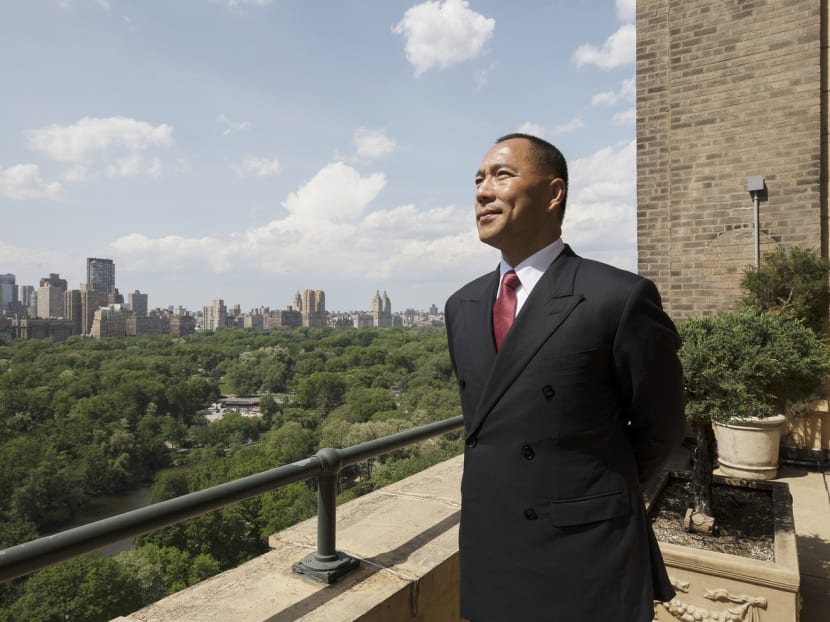
Mr Guo Wengui, a Chinese billionaire, at his Manhattan, New York, apartment, on May 16. Mr Guo, in self-imposed exile, has hurled political grenades at the Chinese Communist Party for months, accusing senior leaders of graft, and using Twitter as his loudspeaker. Photo: The New York Times
BEIJING — The biggest political story in China this year is not in Beijing. It is not even in China. It is centred at a US$68 million (S$94 million) apartment overlooking Central Park in Manhattan.
That is where Mr Guo Wengui, a billionaire in self-imposed exile, has hurled political grenades at the Chinese Communist Party (CCP) for months, accusing senior leaders of graft, using Twitter as his loudspeaker. He escalated his attack by claiming that members of the family of China’s second-most-powerful official, who oversees the country’s anti-corruption effort, secretly own a large stake in a major Chinese conglomerate.
The Chinese government responded by unleashing the state-controlled media to enumerate Mr Guo’s alleged frauds, and asking Interpol to put out a global warrant for his arrest.
But then something unexpected happened. China stood down. The state media campaign against him tapered off. In mid-May, Mr Guo announced on Twitter that his wife and daughter — previously barred from leaving China — had been allowed to visit him in New York.
“We need to root out some of the robbers of this country,” Mr Guo, referring to China, told two New York Times reporters in May at his apartment. To emphasise the point, he wrote it out in Chinese in a notebook. “We are against using corruption to root out corruption.”
Mr Guo’s allegations are unproved, and some of his claims have been outlandish and easily debunked. Yet amid his barrage of charges about China’s powerful and wealthy are claims that have turned out to be accurate. And the government’s treatment of Mr Guo, whose former political patron was one of China’s highest-ranking intelligence officials, suggests that he may be taken seriously, perhaps even supported, by some officials in Beijing.
Mr Guo’s most recent claims have reverberated across China and fed unease on Wall Street about doing business there. The assertions, if substantiated, could upend politics in China, the world’s second-biggest economy, possibly driving a wedge between President Xi Jinping and Mr Wang Qishan, the anti-corruption czar.
Mr Wang, the focus of Mr Guo’s allegations, has close ties to Wall Street, with enormous influence over China’s financial sector. Mr Guo’s assertions come just months before a Communist Party meeting that will decide whether Mr Wang, recently the focus of speculation that he may become China’s next prime minister, will remain on the party’s elite Politburo Standing Committee.
Mr Guo’s Twitter broadsides have continued, and his ability to stare down the world’s most powerful authoritarian nation has underscored the mystery, in China and abroad, about how he acquired his billions, what he knows and who, if anyone, is backing him.
Mr Guo’s ambitions, like his personality, are big and sometimes baffling. He says he has a plan to exorcise graft from the party, bring rule of law to China and put ties with the United States on a stable track, by ending decades of Chinese skulduggery on trade. At other times, he explains his corruption allegations as an act of vengeance for a long-ago death. He could just be a man feeling pressure, his assets frozen in China, and bad investments and lawsuits chipping away at his fortune.
No one better represents the marriage of the party and money than Mr Guo, known as Miles Kwok outside China, who parlayed relationships with some of China’s most powerful officials to help build a global portfolio including hotels, office buildings and securities brokerage firms.
More than a decade ago, the CCP welcomed businessmen into its ranks. In turn, those tycoons helped make the sons and daughters of the revolution rich while helping the country show spectacular growth rates. Now, armed with information, one of them has strayed.
“These people have power and influence and knowledge,” said Dr William C Kirby, a professor at Harvard Business School. “Many of them are easily controlled. But others go off the reservation.”
Mr Guo has gone farther than anyone else. When the party retaliated against him, the state-controlled Beijing News reported that he was suspected of obtaining a “fraudulent loan” worth 3.2 billion yuan (S$649 million) from one state-owned bank. Another publication, Caixin, referring to documents from Mr Wang’s Central Commission for Discipline Inspection, said that Mr Guo had arranged for US$299 million of client funds at a securities firm he controlled to be illegally transferred out of it.
The government’s most potent weapon was the release in April of a videotaped confession by Mr Ma Jian, a former spymaster and political patron to Mr Guo. He said he had accepted more than US$8.7 million in gifts from Mr Guo in exchange for favours, including frequent interventions with officials to short-circuit any obstacles to his property projects. “Guo Wengui, to ingratiate me, to thank me, and to maintain his relationship with me, gave me a huge amount of benefits,” said Mr Ma in the video. Mr Guo did not respond to requests for comment.
Mr Guo’s presence in the US poses a dilemma for the Trump administration, which is seeking China’s cooperation to rein in North Korea’s nuclear ambitions. In recent years Mr Guo provided Washington with insights into Chinese politics through his visits with embassy officials in Beijing, according to one former senior administration official.
Mr Guo, who is a member of Mar-a-Lago, US President Donald Trump’s private Palm Beach club, is eager to get close to the powerful. On Tuesday, he wrote on Twitter that he flew to Washington for meetings at the Trump International Hotel. He contributed to charitable work by the former British prime minister, Mr Tony Blair, who calls him a friend.
His public attacks against the leadership of the country he fled two years ago began in January. Through Twitter, and in a televised interview in April on Voice of America, Mr Guo said a top police official, at the behest of Mr Xi, had asked him several years ago to look into Mr Wang’s family finances.
When the Chinese government eased up on its attacks against Mr Guo, the about-face suggested that the Communist Party’s top leadership may not agree on how to deal with him, according to Dr Victor Shih, a professor at the University of California, San Diego, who studies finance and politics in China. “If the party were unified in opposing Guo Wengui, his family would have had much harsher treatment,” he said.
Mr Guo says the motivation for his corruption allegations is simple: He claims the state shot one of his brothers in 1989 and he has been plotting his revenge ever since. The circumstances of the death are murky, though, like much of Mr Guo’s story.
Mr Guo said that during the 1989 Tiananmen student protests, he was arrested for giving money to the student movement and jailed for two years. But an overseas Chinese website, citing court documents, said that Mr Guo had been arrested in a fraud involving oil sales and that his brother was killed when he and Mr Guo attacked police officers.
After his release in 1991, Mr Guo met a businesswoman who introduced him to wealthy investors. Soon after, he built a hotel in the central Chinese city of Zhengzhou, which became a meeting spot for government officials.
Those contacts and relationships with other officials, including Mr Ma, the spy chief, helped Mr Guo build his empire. He expanded into finance, acquiring a large stake in a securities brokerage firm. In 2014, the Hurun Report, which tracks the fortunes of China’s elite, estimated his wealth at US$2.3 billion. But that same year, Mr Guo’s ambition to take control of one of China’s biggest brokerage firms fell apart and he had a dispute with his business partner, who was later jailed.
Since then, he has lived abroad and his assets in China — he claims 120 billion yuan in all — have been frozen. Mr Guo is facing financial pressures.
One claim Mr Guo made in March regarding the hidden wealth of a prominent Chinese family could be substantiated by company documents, reported The Times in April. Going after Mr Wang, though, is particularly risky.
Mr Wang, 68, has a reputation for being a problem solver who has worked closely with American executives, including Mr Henry M Paulson, the former chief executive of Goldman Sachs and Treasury secretary. His many proteges are in influential positions throughout China’s government.
Mr Wang did not respond to faxed questions sent to the Central Commission for Discipline Inspection in Beijing.
There is no sign that Mr Guo is letting up. Before the Communist Party meets this autumn to pick a slate of top leaders, Mr Guo plans his most dramatic assault of all: A live event, perhaps from Lincoln Center, that will focus on Chinese corruption. “I want it to be carnival-style with a big screen,” he said. “We will sing. We will cry and we will talk about the world.” THE NEW YORK TIMES
Stay in the know. Anytime. Anywhere.

Subscribe to our newsletter for the top features, insights and must reads delivered straight to your inbox.
By clicking subscribe, I agree for my personal data to be used to send me TODAY newsletters, promotional offers and for research and analysis.






