
Great Wall of China too crowded? Visit this replica instead
BEIJING — Tourists hoping to beat the crowds at the Great Wall of China may want to visit a replica wall instead.
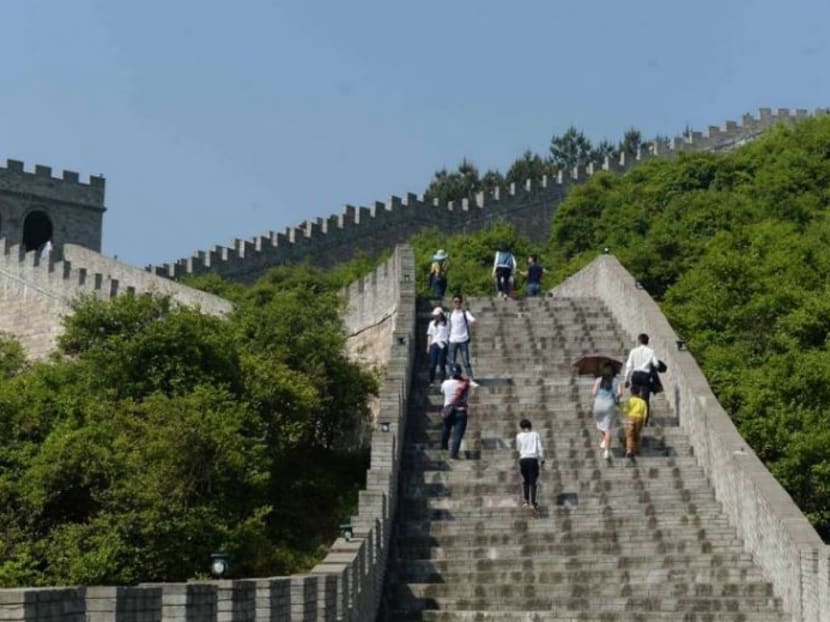
The “fake Great Wall” in Nanchang, Jiangxi province, looks a lot like the real thing. Photo: Visual China Group via South China Morning Post
BEIJING — Tourists hoping to beat the crowds at the Great Wall of China may want to visit a replica wall instead.
Photographs published online show recent visitors at the “fake Great Wall”, a 4km-long replica in Nanchang in eastern Jiangxi province, some 1,500km away from the real structure.
The imitation of the ancient site is built on a range of hills like the original, with sections divided with watchtowers.
Nevertheless, it pales in comparison to the original structure, which stretches for nearly 9,000km.
Parts of the Great Wall, a Unesco World Heritage site, were built during the Qin dynasty (221BC-207BC), but most structures remaining date to the Ming dynasty (1368-1644).
The fortifications, built using stone, brick, wood and other materials, were meant as a line of defence against enemy invasions.
The pictures of the replica in Nanchang were greeted with a mixed response on Chinese social media.
“The Great Wall cannot be copied as its historical meaning cannot be replicated!” one commenter wrote.
Another joked: “This Nanchang ‘Great Wall’ is quite good. There’s no copyright, is there?”
A school in Wuhan in Hubei province showed off a replica stretch of the Great Wall two years ago after spending 4 million yuan (S$809,004) on the structure, according to media reports.
China is notorious for copying famous buildings and structures — imitations of structures including the Eiffel Tower and the Statue of Liberty can be found on the mainland.
Last year, British artist Wendy Taylor accused a Shanghai sundial of being a copy of her iconic sculpture Timepiece, which has been a London landmark next to Tower bridge since 1973.
In 2014, a replica of Egypt’s iconic Sphinx was dismantled in Hebei province after an Egyptian ministry complained about the structure. SOUTH CHINA MORNING POST
Related topics
Great Wall of China replica China JiangxiStay in the know. Anytime. Anywhere.

Subscribe to our newsletter for the top features, insights and must reads delivered straight to your inbox.
By clicking subscribe, I agree for my personal data to be used to send me TODAY newsletters, promotional offers and for research and analysis.