
Xi moves to cement power with ‘New Zhijiang Army’
BEIJING — Chinese President Xi Jinping has in recent weeks promoted a series of political allies, bringing his own power base into the upper ranks of the Communist Party as he seeks to cement his legacy in his second term and beyond.
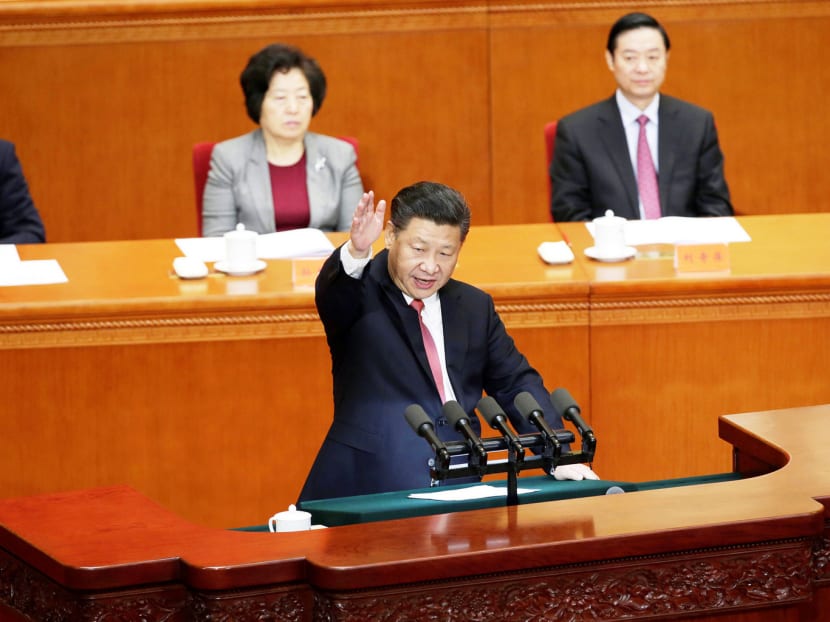
President Xi Jinping commemorating the 150th birth anniversary of Sun Yat-Sen, in the Great Hall of the People on Friday. Mr Xi is moving to strengthen his own power base by promoting his allies. PHOTO: REUTERS
BEIJING — Chinese President Xi Jinping has in recent weeks promoted a series of political allies, bringing his own power base into the upper ranks of the Communist Party as he seeks to cement his legacy in his second term and beyond.
Insiders are now watching the political fortunes of the dozen or so officials known as the New Zhijiang Army who worked under Mr Xi during his rise to the top job.
The name of the group is a play on the name for Zhejiang province, the economic powerhouse just south of Shanghai where Mr Xi served as party secretary from 2002 to 2007.
Interpreting political appointments is a parlour game for diplomats and intellectuals in Beijing. The fate of his allies matters as a gauge of Mr Xi’s strength and because the top appointees hold powerful sway over important portfolios including propaganda, finance, domestic security and industrial policy.
Mr Xi, crowned as “core” of the party last month, has the authority to seed the elite 25-member politburo with his allies.
However, promotion to the Standing Committee, the very top of the hierarchy, is based on consensus reached via horse-trading, precedent and the relative strength of factions vying for influence. Tradition also dictates that Standing Committee members must first serve in the politburo for five years.
“He can try but I think it will be difficult to place his own people in the Standing Committee,” said Professor Bo Zhiyue, an expert in elite Chinese politics at the Victoria University of Wellington. “You don’t see a lot of faces (in the politburo) that have overlapped with Xi in the past.”
One strategy for Mr Xi might be to reduce the size of the Standing Committee, allowing a smaller group of trusted allies to hold sway.
Mr Xi could aim for five members, many political analysts forecast, while a more radical scenario would be to abolish the Standing Committee altogether, a move that would break with party precedent.
The current Standing Committee has seven members, cut from nine under Mr Hu Jintao when it functioned as a constellation of men who were powerful in their own right.
The “first among equals” arrangement bred damaging factionalism, party loyalists believe.
One of the most prominent members of the New Zhijiang Army is Mr Cai Qi, who was appointed as Mayor of Beijing last month. Previously deputy head of Mr Xi’s National Security Council (NSC), established in the first year of his presidency, Mr Cai has occupied one of the most powerful and opaque posts in the administration.
“We asked to see them but couldn’t really interact with them in any substantial way,” one former diplomat said.
The mayoral appointment opens the door for Mr Cai to become party secretary of Beijing, a post that would guarantee him a seat in the politburo.
In the past few months, other allies of Mr Xi and Premier Li Keqiang have also been appointed to posts that traditionally grant entry to the politburo.
Mr Cai’s NSC position during Mr Xi’s first term represented a gathering nexus of power for Mr Xi, who has favoured smaller “working groups” that cross institutional lines to bypass the rigid structures of the civil bureaucracies.
The NSC is believed to include agencies in charge of foreign affairs, external and domestic security, propaganda and the People’s Liberation Army.
“There has been very little public information about the NSC’s members or its role in decision-making,” said China security expert Yanmei Xie. “It’s a big black box that everyone is trying to peer into.”
The Zhijiang group’s rising status could give Mr Xi the political heft to push through economic reforms outlined at a 2013 party meeting, the third plenum of his first term.
Zhejiang and its capital, Hangzhou, are home to some of China’s most innovative private sector companies.
“Xi made it clear that he believed the private sector represented the future of China,” says one former Western official who knew the President when he was Zhejiang party secretary.
Zhijiang Army members have also shown illiberal tendencies consistent with Mr Xi’s consolidation of political power and crackdown on civil society.
Mr Xia Baolong, Zhejiang’s current party secretary who was Mr Xi’s deputy in the province, has presided over the suppression of Christian churches in Wenzhou, which is a hotbed of both private enterprise and evangelical Christianity that is sweeping China.
Other allies recently moved include the new governor of Shanxi, the coal-rich province that was the power base for Ling Jihua, the now disgraced right-hand man to Mr Xi’s predecessor, Mr Hu Jintao.
Political insiders expect appointments soon of the party secretaries of Jilin and Guizhou provinces, also considered to be Zhijiang army members.
Lower-level appointments may not even make it into the politburo for the upcoming term, but would be positioned in the wings for future terms, allowing Mr Xi to extend his influence into later generations — the ultimate strategy for ensuring a legacy. THE FINANCIAL TIMES
Stay in the know. Anytime. Anywhere.

Subscribe to our newsletter for the top features, insights and must reads delivered straight to your inbox.
By clicking subscribe, I agree for my personal data to be used to send me TODAY newsletters, promotional offers and for research and analysis.






