
Japan to supply India with nuclear power equipment, technology
TOKYO — Japan and India signed a civilian nuclear accord yesterday, opening the door for Tokyo to supply New Delhi with fuel, equipment and technology for nuclear power production, as India looks to atomic energy to sustain its rapid economic growth.
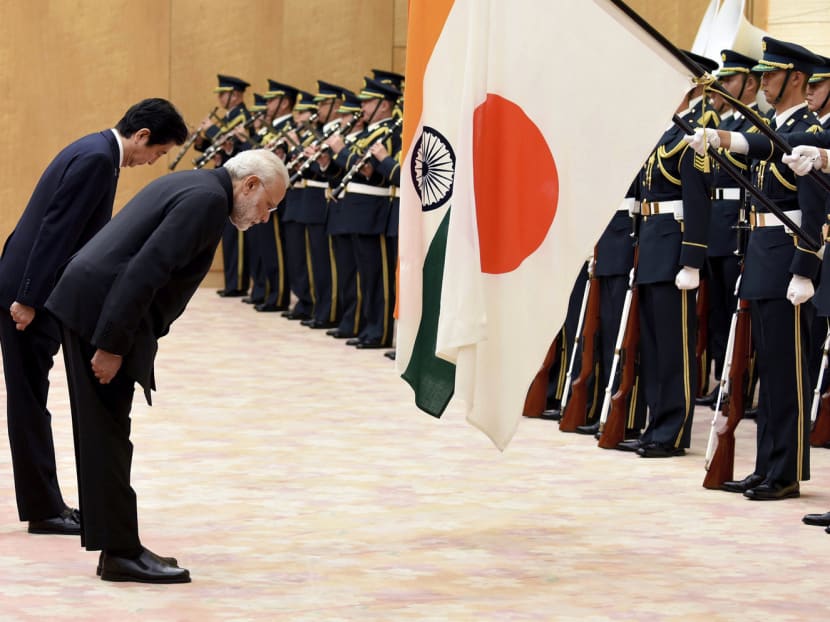
Indian PM Narendra Modi (right) and Japanese PM Shinzo Abe bow to their flags as they review an honour guard in Tokyo yesterday. Mr Modi paid tribute to the ‘growing convergence’ of their views. PHOTO: AFP POOL
TOKYO — Japan and India signed a civilian nuclear accord yesterday, opening the door for Tokyo to supply New Delhi with fuel, equipment and technology for nuclear power production, as India looks to atomic energy to sustain its rapid economic growth.
It was the first time Japan, the only country to have suffered a nuclear attack, has concluded such a pact with a country that is not signatory to the nuclear Nonproliferation Treaty (NPT).
The accord was signed after Prime Minister Shinzo Abe’s meeting with his Indian counterpart Narendra Modi.
“This agreement is a legal framework which will ensure India will take responsible action regarding the peaceful use of nuclear energy. It leads to India virtually taking part in the international regime,” Mr Abe told a joint press conference.
“It matches with our country’s stance to promote nonproliferation and a world without nuclear weapons.”
On his part, Mr Modi said the signing marks “a historic step in our engagement to build a clean energy partnership”, adding that the deal will help his country combat climate change.
India has said the NPT is discriminatory and it has concerns about nuclear-armed China as well as its long-time nuclear-armed rival Pakistan.
The accord stipulates nuclear fuel and equipment provided can only be used for peaceful purposes, and a separate document signed alongside the nuclear agreement has a clause allowing Japan to terminate the pact if India conducts a nuclear test.
The Japanese government is set to seek parliamentary approval for the treaty next year.
The nuclear agreement with Japan follows a similar one with the United States in 2008, which gave India access to nuclear technology after decades of isolation.
Mr Modi’s visit to Japan is part of an effort to forge closer economic and security ties with regional powers in light of China’s rising assertiveness.
Earlier in the day, the Indian leader paid tribute to the “growing convergence” of views between the two nations, saying strong ties will enable them to play a stabilising role in Asia.
Attending a luncheon hosted by Japanese business groups, Mr Modi called for more investment by Japanese companies in India.
He said India will address companies’ concerns, such as transparency of administrative procedures and strict regulations in a “proactive” manner.
“India and Japan will have to continue to play a major role in Asia’s emergence. The growing convergence of views between Japan and India under a special strategic and global partnership has the capacity to drive the region’s economy and development and stimulate global growth,” Mr Modi told Japan’s business leaders.
“(A) strong India, strong Japan will not only enrich our two nations, it will also be a stabilising factor in Asia and the world.”
India is in advanced negotiations with America-based Westinghouse Electric, owned by Japan’s Toshiba Corporation, to build six nuclear reactors in southern India, as part of New Delhi’s plan to ramp up nuclear capacity more than 10 times by 2032.
Mr Abe and Mr Modi also held talks to discuss a 500km-high-speed rail project linking Mumbai and Ahmedabad in western India.
Today, the two leaders will take a Shinkansen train to Kobe in western Japan and visit a factory of Kawasaki Heavy Industries, a maker of Shinkansen cars, according to the Indian government. AGENCIES
Stay in the know. Anytime. Anywhere.

Subscribe to our newsletter for the top features, insights and must reads delivered straight to your inbox.
By clicking subscribe, I agree for my personal data to be used to send me TODAY newsletters, promotional offers and for research and analysis.






