
Dual citizenship: Little to fear, much to gain
In response to Member of Parliament David Ong’s question about 19-year-old Brandon Smith, a New Zealand and Singapore dual citizen who has refused to come back to serve National Service (NS), the Ministry of Foreign Affairs last week reminded all Singaporeans of their NS obligations, adding that exceptions cannot be made for those residing overseas. The case, however, is more than just about avoiding conscription, as it highlights a larger issue with the Singapore Government’s policy on dual citizenship.
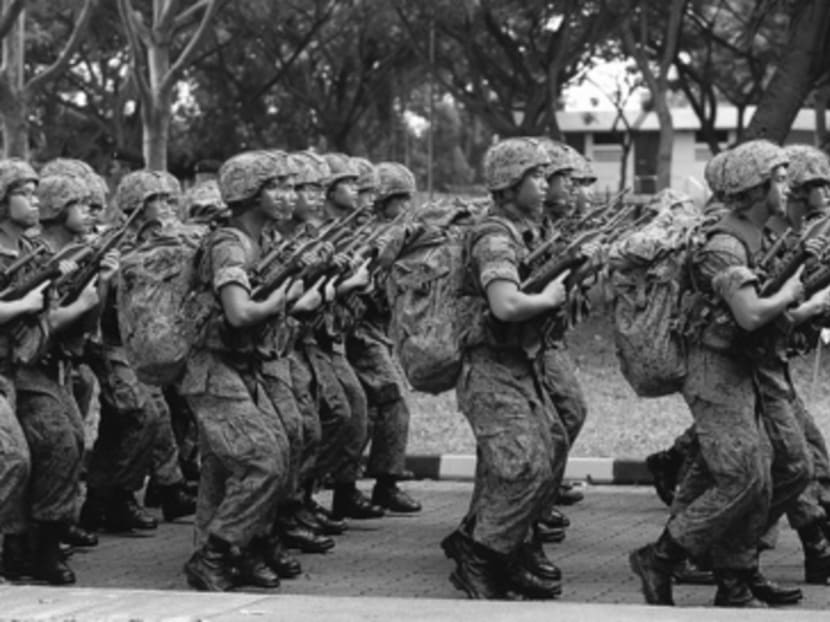
Between 2006 and 2010, just over half the second-generation PRs took up Singapore citizenship after completing their National Service. Why would a young adult today give up two years of his life in defence of a country and not take up its citizenship? Simple: He does not want to give up his original citizenship. TODAY file photo

In response to Member of Parliament David Ong’s question about 19-year-old Brandon Smith, a New Zealand and Singapore dual citizen who has refused to come back to serve National Service (NS), the Ministry of Foreign Affairs last week reminded all Singaporeans of their NS obligations, adding that exceptions cannot be made for those residing overseas. The case, however, is more than just about avoiding conscription, as it highlights a larger issue with the Singapore Government’s policy on dual citizenship.
Singapore will not allow Mr Smith to drop his citizenship before he turns 21 on the grounds that the Republic has provided Mr Smith with protection that comes with being a Singaporean. This makes him an outlaw for not serving NS.
But, more importantly, the Government will also not let him keep both his Singapore and New Zealand citizenship after his 21st birthday. This rule is driven by the unfounded fear that if we all had a choice and things went south in Singapore, we would all run for (or remain on) greener pastures.
We may not have faced a catastrophe in recent history, but Singaporeans have nevertheless time and again demonstrated great resilience. We braved the outbreak of SARS in 2003, rallied to recapture the terrorist Mas Selamat in 2008 and weathered an economic recession in 2009.
To argue that the only reason Singaporeans would defend their country is they have nowhere else to go is sad, to say the least.
THREE BIRDS, ONE STONE
The country could instead benefit in many ways if it embraces dual citizens.
First, transnational marriages are on the rise as Singaporeans meet more people from different cultures and backgrounds. The National Population and Talent Division estimated that they accounted for more than a third of all marriages involving citizens in 2014. If things do not change, there are going to be many more dual citizens like Mr Smith, who will be conflicted about choosing between their Singapore citizenship and their other nationality after the age of 21.
Second, permanent residents (PRs) are more likely to sink their roots here and become citizens if they were not forced to give up the citizenship of their home country. Second-generation PRs here are a case in point. While it may be easier for some of them, especially those born and brought up here, to relinquish the citizenship they acquired from their parents, others might find it a much harder decision.
In the book Immigration In Singapore, Mr Ho Shu Huang and Ms Yolanda Chin from the S Rajaratnam School of International Studies have argued that the conflict of interests inherent to the scheme, where PRs are asked to serve in Singapore’s armed forces as foreigners and are only offered citizenship upon completion, did not manifest in its early years because many PRs back then were stateless and coveted Singapore citizenship. The same cannot be said today.
The Government revealed that between 2006 and 2010 just over half the second-generation male PRs took up Singapore citizenship after completing their NS. This is a drop from 91 per cent who similarly did so between 1973 and 1978.
This statistic raises an important question. Why would a young adult today give up two years of his life in defence of a country and not take up its citizenship? Simple: He does not want to give up his original citizenship. The Government contends dual citizenship dilutes national identity, but what I see here is a loss of a potential citizen because of the absence of dual citizenship.
Third, dual citizenship would benefit the more than 200,000 Singaporeans based overseas, a number set to grow. Much like the PRs in Singapore, overseas Singaporeans are put in a tight corner when offered citizenship by their host country. By some estimates, we lose about 1,000 Singaporeans every year because of this. This may not seem like a big number in absolute terms, but in 2008 then-Minister Mentor Lee Kuan Yew shared during an interview that this group represented the “top end” of the population, making the brain drain a serious problem for Singapore.
Dual citizenship is becoming increasingly accepted around the world, with approximately half of all countries adopting it in some form.
Countries have embraced dual citizenship either to connect with their large diaspora (Philippines, Italy) or integrate their immigrant population into society (Sweden, Australia), or both.
A good example for Singapore to follow would be Denmark, a country that last year allowed dual citizenship after resisting it for years.
Denmark, like Singapore, is a small country of 5.6 million people facing an ageing population and a low total fertility rate.
The Danish political leadership understood the need to find innovative ways to address these issues. Allowing dual citizenship is one way to help its large immigrant population integrate into society as citizens and support its ageing population. It will also benefit the more than 250,000 Danes living abroad, encouraging them to maintain ties with their home country and maybe one day return home.
Then-Danish Justice Minister Karen Hækkerup aptly summed up the reason behind the policy shift when she said: “Many people today choose to settle in foreign countries, but still retain a strong attachment to their country of origin ... We should not force people to choose.”
We can also learn from countries that use blunt immigration policies and are struggling to tackle their demographic challenges. We would not want to end up like Japan, for instance, which has been anti-immigration for far too long and is paying dearly with a population that has been ageing unsustainably, or be on the other extreme like Qatar, which has more foreigners than locals.
BOLD IDEAS NEEDED
An ageing population is simply a reality for any developed country. The Government has tried with limited success to get Singaporeans to have more babies.
One way to build a sustainable population for the future is to embrace bold ideas such as dual citizenship, which would make us rely less on immigrants, PRs included. Dual citizens will not dilute our national identity as long as they do not form our population’s core. They should play only a supporting, albeit important, role in what is now a mature society.
If dual citizenship is adopted, over time, second-generation male dual citizens should be required to serve NS instead of second-generation PRs. While the conflicting loyalty of a dual citizen would still be an issue, it would be better than having complete foreigners serve in our military, especially since many of them have not been taking up citizenship after NS. First-generation dual citizens should, like naturalised citizens, only serve NS if they are below a certain age.
Dual citizenship is by no means a panacea as the issue of integration would only be made harder by this new sub-category of citizenship. Similar to PRs who become new citizens, dual citizens would need to prove their loyalty and make an effort to integrate into the multiracial, multicultural society of Singapore. Meanwhile, the Government would have to keep an eye on the ethnic balance of our citizen population.
Ultimately, dual citizenship could be granted on a case-by-case basis by the authorities and the criteria may come with preferences, exclusions or conditions deemed necessary. The point is that given the challenges facing Singapore on the road to SG100, the concept of dual citizenship can no longer be brushed aside wholesale as it has potential benefits.
Every day we lose genuine, smart and committed individuals who aspire to become the next generation of Singapore citizens and contribute to our country. All they want is to be able to hold citizenship of another country at the same time.
In today’s globalised world, is that really too much to ask?
ABOUT THE AUTHOR:
Chirag Agarwal was born and brought up in Singapore but only became a Singapore citizen eight years ago after completing his National Service as a second-generation PR and an Indian citizen. He has since worked as a civil servant and is currently pursuing a Master of Public Policy and Management degree at The University of Melbourne.
Stay in the know. Anytime. Anywhere.

Subscribe to our newsletter for the top features, insights and must reads delivered straight to your inbox.
By clicking subscribe, I agree for my personal data to be used to send me TODAY newsletters, promotional offers and for research and analysis.






