
Five myths about China that need to be debunked before trade war with US can end
Ahead of the upcoming G20 Osaka summit, where Chinese and American leaders are expected to meet, it is now critical to clear up misconceptions about China that are so popular in the US that they threaten to undermine this precious opportunity for both sides to get back to the negotiating table.
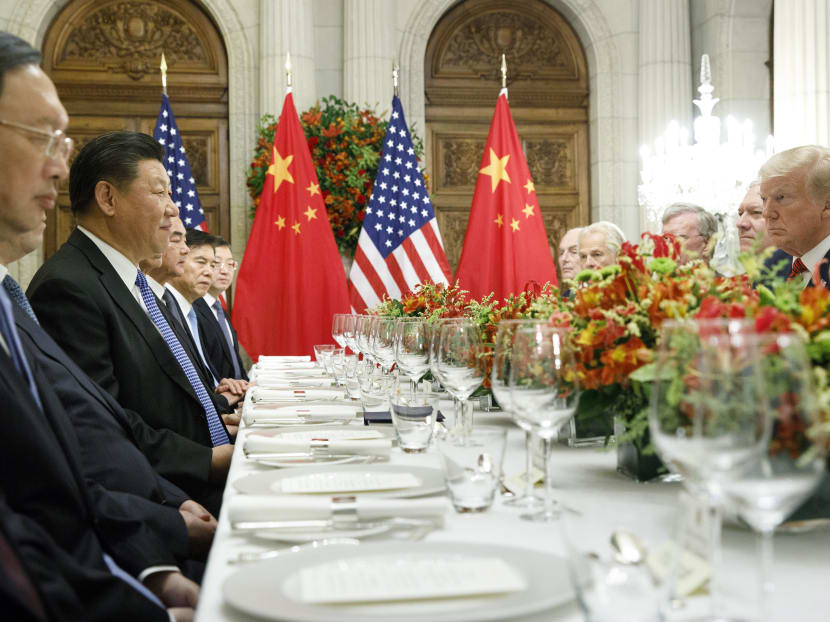
President Donald Trump at a bilateral dinner meeting with President Xi Jinping of China in Buenos Aires in December 2018.

The relationship between China and the United States has hit dangerous turbulence since trade talks ended without agreement in May.
Ahead of the upcoming G20 Osaka summit, where both countries’ leaders are expected to meet, it is now critical to clear up misconceptions about China that are so popular in the US that they threaten to undermine this precious opportunity for both sides to get back to the negotiating table.
The first misconception that needs to be changed — and properly contextualised — is that about China stealing intellectual property from the US.
“To steal a book is an elegant offence,” as a scholar in the Lu Xun short story Kong Yiji pleads. As history has taught us, almost no country can avoid stealing intellectual property from others during its development.
Back in the 19th century, the rise of the US was inseparable from the rampant stealing of technological innovations and intellectual property from Britain, including pilfered plans for textile weaving machinery and pirated copies of Charles Dickens novels.
Now, the US advocates the highest intellectual property standards in the world.
With regard to intellectual property protection, China has followed a similar path, but at a quicker pace over the past 40 years.
The Chinese have built their intellectual property protection system from scratch, and its success is even more extraordinary than that of the Chinese economy, in terms of the stipulations and enforcement of the laws, and the promotion of public awareness through education.
In prioritising science and technology leadership, this developing country will only keep enhancing protection of intellectual property rights, as it increases its social governance capabilities.
The second misconception is that the Chinese government is forcing American companies to transfer technology as a condition of investing in China. Here, the key is to assess whether the contract involving a technology transfer is entered into willingly or forcibly.
If reasonable, well-informed persons on both sides desire to maximise their respective benefits, and negotiate without duress, who is to say the transaction was made under pressure?
Chinese law requires that some foreign investments take the form of joint ventures where Chinese counterparts sometimes hold majority stakes.
The US has cited such requirements in its allegations of forced technology transfers, but has failed to offer concrete evidence of the Chinese government imposing technology transfer requirements during the process of contract negotiation and approval.
Indeed, China has recently passed a landmark foreign investment law that explicitly bars government officials from doing so.
The third misconception concerns China’s status as a developing country.
Sure, China is a superpower when you measure its economy and trade volume in aggregate; in per capita GDP, however, China lags behind more than 80 economies, including Malaysia, Russia and Kazakhstan.
In China, away from bustling metropolises such as Beijing and Shanghai, it is easy to find backward areas everywhere.
China’s still limited social governance capabilities are also a decisive factor in its status as a developing country. There has been a widespread shortage of professionalism and institutional thinking both in government and society.
For example, waste sorting has yet to become a habit even in first-tier cities, let alone in smaller ones and rural areas. Also, when it comes to projecting soft power, China is still catching up with the US.
The fourth misconception concerns the Communist Party’s role in the Chinese economy. Some people imagine that China’s state capitalism enables it to operate as China Inc, and that party members occupy every important position within the system.
This is simply not true. Rather, private firms generate the lion’s share of the Chinese economy, accounting for over 50 per cent of tax revenue, 60 per cent of gross domestic product growth and 70 per cent of technological innovation, as well as providing 80 per cent of jobs.
And what exactly does a party committee do in a company?
Here is an illustrative analogy: the party is to China what God is to Christians, and a party committee is a church. Just as a church calls upon worshippers to love their neighbours, a party committee asks members to be role models with regard to corporate codes of conduct.
In daily operations, Chinese companies run commercially and autonomously, uncontrolled by the party, just as a Christian CEO does business on his own, free from God’s intervention.
The fifth misconception is that Chinese citizens must cooperate with the party and spy for it if so requested.
Such a notion is as much a misinterpretation of China’s 2017 National Intelligence Law, as a reflection of the US’ own intelligence practices, as disclosed by Edward Snowden.
In fact, China’s intelligence apparatus must respect its citizens’ legitimate rights and interests, under Article 8 of the National Intelligence Law.
Thus, if the Chinese government asks Huawei, the telecoms giant, to spy on its European clients, Huawei has the right to refuse; to force Huawei to spy would be to violate the company’s rights under Article 8.
After all, the law is aimed at deterring deliberate attempts to hurt China’s national security, not authorising pre-emptive acts to steal information.
When you think it through from a policy perspective, you should realise it makes no sense for the government to use Huawei as a spy.
China simply cannot afford to undermine a brand like Huawei, with its hard-won global success, when there is more than enough venom and prejudice against both the country and the company. SOUTH CHINA MORNING POST
ABOUT THE AUTHOR:
Gu Bin is an associate law professor at Beijing Foreign Studies University and author of The Law and Governance of the Asian Infrastructure Investment Bank.
Related topics
US China trade war Donald Trump Xi JinpingStay in the know. Anytime. Anywhere.

Subscribe to our newsletter for the top features, insights and must reads delivered straight to your inbox.
By clicking subscribe, I agree for my personal data to be used to send me TODAY newsletters, promotional offers and for research and analysis.






