
Gen Y Speaks: I was fearful of migrant workers, now I speak out for them
I was exposed to prejudice against migrant workers from a young age. This changed after my first interaction with the migrant worker community in 2012 and since then, I have befriended different workers from various countries and even visited some of them or their families in Bangladesh and India
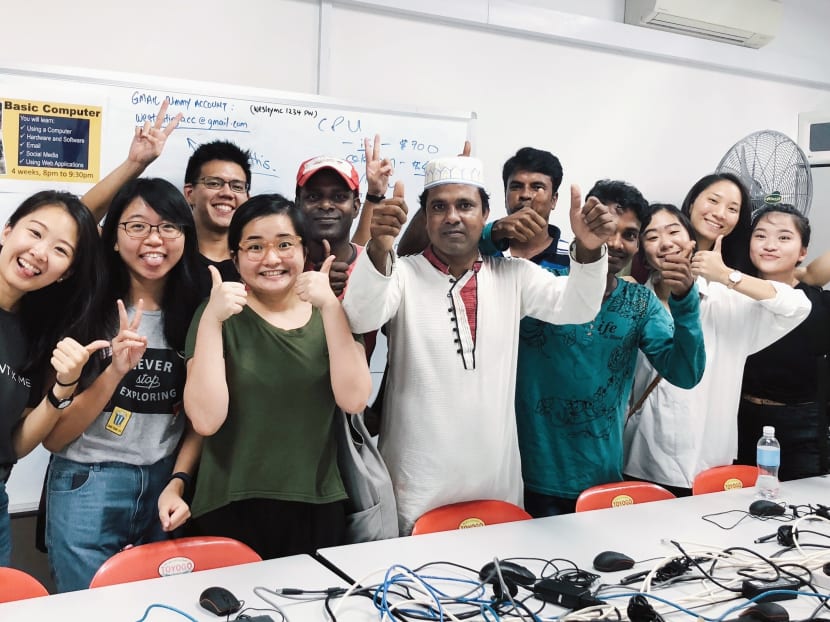
The author (far left) at a monthly Migrant x Me learning journey where members of the public get to interact with migrant workers.

Migrant workers are an important part of the Singapore labour force. In 2018, our population comprised of almost one million unskilled and semi-skilled foreign workers — a sizeable portion of our 5.6 million-strong population.
Unfortunately, prejudices among Singaporeans towards migrant workers — many of whom hail from developing countries like China, India and Bangladesh — still run deep.
I was exposed to this prejudice from a young age, when my elders would warn me that if I was naughty, they’d get foreign workers to come and catch me.
As a result, I learnt to fear them and perceive them as dangerous.
This changed after my first interaction with the migrant worker community in 2012, when I noticed that a few migrant workers were sleeping downstairs at the void deck of my Housing and Development Board flat.
I wanted to find out why and reach out to them, but as I was still wary of them at that point, I decided to bring a group of youths I was leading from church with me. We bought food and water for them and managed to strike up a conversation with them.
READ ALSO:
- Foreign domestic workers in Singapore seek help most for overwork, verbal abuse, pay-related problems: Report
- Gen Y Speaks: Let’s think about how we treat workers
After that first encounter, I wanted to do more but did not know what to do or how to go about doing it. The turning point came two years later, when I attended a workshop on migrant worker issues and heard a veteran in this area shared about the injustices and challenges the workers face on a daily basis.
For example, due to the nature of their work, workplace injuries happen frequently.
However, many employers choose to cancel their work permits and send them home without compensation or medical treatment. Other issues include poor living conditions and non-nutritional diets.
After sharing, he encouraged us to speak up for this marginalised community and to volunteer to serve them.
I knew there and then that I wanted to get involved. That was how my journey of befriending the workers started.
Over the past five years, I have befriended different workers from various countries and even visited some of them or their families in Bangladesh and India.
Initially, my parents were naturally concerned for my safety — but with plenty of reassurances and safety precautions, they have become supportive and even participative.
Do you agree with the author?
YOUR SAY: Tell us what you think
For Christmas 2018 and Chinese New Year 2019, my parents and I happily hosted some of the workers at our home where my father led games and my mother coordinated the food and drinks, and we plan to do it each public holiday.
When I first started reaching out to the migrant workers in 2014, my friends did not understand what I was doing.
I made it a point to share my experiences and also their stories through my personal Instagram page, and as time passed, my friends said that their perceptions of the workers have changed.
But public awareness of the migrant worker community was still low.
I kept thinking: How could we better educate the public about the challenges that these workers face — for example, work injuries and unpaid salaries — and help Singaporeans find out how they can help?
That question inspired me to start Migrant x Me (MxM), a social enterprise, last year.
In short, it aims to provide public education and raise awareness on the challenges migrant workers face, before challenging Singaporeans to give back as volunteers with our partner NGO, SG Accident Help Centre.
The centre provides physiotherapy and traditional Chinese medicine services for injured workers, on top of counselling.
MxM hosts learning journeys at our partner dormitories, during which participants can hear from the migrant workers themselves and get a crash course on their lives.
During our learning journeys, we also engage injured workers who are unable to work and hence often feel bored or lonely.
As a result, they enjoy the companionship of visitors.
The more sociable workers are especially happy to speak to Singaporeans, sharing their stories and perspectives.
Apart from the learning journeys, we also participate in other socially-conscious events where we will invite a few workers to directly engage with Singaporeans outside the MxM team.
This also gives them a voice in speaking up for their own community.
One of the workers who shared his stories was a Chinese worker who was injured in a serious lorry accident.
As a result, he could not work, and this drove him to depression.
He was absolutely distraught that he could not provide for his family during this time. His family did not know he was injured either.
“These burdens are not for them to carry,” he shared.
Thankfully, our partner NGO managed to reach out to him together with a Chinese Christian counsellor.
They sent him to hospital, visited him regularly during his hospitalisation and provided physiotherapy and traditional Chinese medical consultations for his recovery.
We are happy to see him reunited with his family in China now.
We are also glad that many Singaporean participants have shared that after attending our learning journeys, their perceptions have changed drastically.
It is easy to scroll past a news article of a worker dying due to a work safety lapse — but when you have a face and a name and a story attached to the statistic, things change.
Many stereotypes like migrant workers being “dangerous”, “money-faced” and “dirty” have also been debunked.
For MxM, our vision is for Singapore to see our migrant workers beyond a number or a statistic, or a group of people entirely separate from our society — and instead, to see them as fellow humans, with a name, face, families, hopes and dreams.
After all, titles and nationalities aside, they’re people, too.
ABOUT THE AUTHOR:
Isabel Phua, 25, is founder of Migrant x Me, a social enterprise that aims to provide public education and raise awareness on the issues that the migrant worker community in Singapore faces.
Stay in the know. Anytime. Anywhere.

Subscribe to our newsletter for the top features, insights and must reads delivered straight to your inbox.
By clicking subscribe, I agree for my personal data to be used to send me TODAY newsletters, promotional offers and for research and analysis.






