
Gen Y Speaks: This bicentennial, let's remember why financial prudence matters
As Singapore commemorates its bicentennial, it is useful to be reminded of an important principle undergirding Singapore’s success — prudent spending and savings.
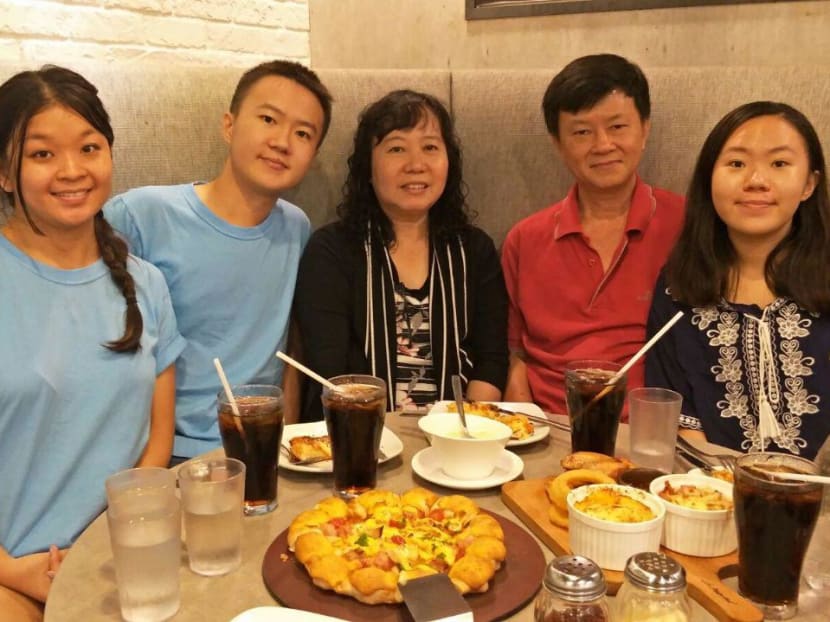
The author (far right), seen here with her parents, brother and his girlfriend, says that distinguishing needs from wants is increasingly pressing for millennials, many of whom have grown up in times of abundance and prosperity and may not think twice about their expenditures.

As Singapore commemorates its bicentennial, it is useful to be reminded of an important principle undergirding Singapore’s success — prudent spending and savings.
This is a value our forefathers and Singapore's pioneers held dear.
Take my grandmother for instance.
I particularly remember a conversation with her during a family gathering some years back.
After hearing my newly-wed cousin’s plans to purchase a Build-to-Order flat, my grandmother shared her account of the difficulties that she had gone through to buy her first flat in the 1970s to provide shelter for her eight children.
Her humble 2-room flat along Cantonment Street cost about S$6,000, which was not an insignificant sum then, and she scrimped and saved for it.
She raised her children by herself as my grandfather passed away when my dad was still a child.
Her determination to squirrel away whatever few pennies left after providing for the family’s needs as a sole breadwinner is an inspiring example of our forebears’ discipline and foresight.
She told us that with her meagre earnings as a fruit monger, she could not have raised her children if she had not constantly looked out for discounts that mama-shops offered for daily groceries, bought household items in bulk for cheaper per-unit costs as well as sought hand-me-down textbooks from neighbours.
Good planning and prudence was key to how our family broke out of poverty.
As cliché as it may sound, it is never too early to start planning for the future, especially in today’s highly digitalised world where information is literally at our fingertips.
It all boils down to having the discipline to plan long term instead of being seized with immediate needs.
Partly because of my grandmother’s habits, my father grew up appreciating the value of delayed gratification.
As a child, he and his siblings often fought off the urge for chilled Coca-Colas after their outdoor games, so that they could save up and buy postage stamps instead.
Why stamps? Because they were collectibles in the 1960s. With each stamp costing 20 cents each, my father and his siblings slowly built up their collection to form S$2, S$10 and then S$50, which was a relatively large sum back then.
I am glad to see the Government relaunch this iconic campaign in 2015 to reinforce the virtue of thrift.
What my father did with his stamps stands in stark contrast to the attitudes of my instant-gratification generation.
When I was in primary school, my friends often used their hongbao money right away to buy the prettiest pencil cases or the most colourful pen sets to show off to their classmates.
I was no different from them at the time.
While my parents bought me a piggy bank to encourage me to save, I often felt that my coins disappeared into a black hole when I dropped them through the tiny slit.
Back then, I had little understanding of savings and hardly gave any thought to preparing for a rainy day.
It was only in my teenage years that I began to appreciate the stories my grandmother and father shared about their thrifty habits.
These days, I set aside 20 per cent of my monthly allowance as savings that cannot be touched and would plan my expenditure around the remaining 80 per cent.
Another rule of thumb that I abide by is to limit the number of cash withdrawals every month and to only withdraw a pre-set amount each week.
This amount would be sufficient for daily necessities, but not enough for any indulgence. For occasional treats at restaurants, I would look out for those with seasonal promotions.
I also discovered a way not to succumb to the temptation of buying something new by sleeping on it for a night.
If I wake up the next morning with the item still vividly in my mind, then it may be something I would consider saving up to buy.
But more often than not, I find that my craving for such things would disappear by the next day.
Distinguishing needs from wants is increasingly pressing for millennials, many of whom have grown up in times of abundance and prosperity and may not think twice about their expenditures.
Although our forefathers and grandparents may not have been the most educated, they helped pave the way for the good lives we enjoy today through their prudence and frugality.
Over the years, the receptacles that Singaporeans used to save their money in has evolved from the old Kong Guan biscuit tins, with a rough-edged slit carved on its covers, to ceramic piggy banks, and later to more durable plastic ones, and eventually to online Child Development Account for every newborn.
However, the importance of savings and careful budgeting has not changed.
In fact, one can argue that it has become more important today given the rapid changes in the world and the uncertainties we face.
Recently, while looking at the statues of Sang Nila Utama, Tan Tock Seng, Munshi Abdullah and Naraina Pillai that have been newly erected along Singapore River in commemoration of Singapore’s bicentennial, I am reminded of how our forefathers’ discipline and sacrifices contributed to the nation’s progress.
I hope that years later, I will also be able to tell my own grandchildren about how my generation help build on these values to keep the Little Red Dot thriving.
ABOUT THE AUTHOR:
Seng Jing Yi is a second-year student at Singapore Management University's School of Accountancy and a student trainer in the Citi-SMU Financial Literacy Programme for Young Adults. Launched in 2012, the programme aims to equip those aged 17 to 30 with essential personal finance knowledge and skills to give them a firm foundation in managing their finances.
Stay in the know. Anytime. Anywhere.

Subscribe to our newsletter for the top features, insights and must reads delivered straight to your inbox.
By clicking subscribe, I agree for my personal data to be used to send me TODAY newsletters, promotional offers and for research and analysis.






