
My wishlist for Singapore education in 2021
Last year, I wrote about my wish list for education in 2020. Then, I advocated for change from the top, suggesting policy changes on examinations, grading as well as teaching and called for more interaction between schools and volunteer activities.
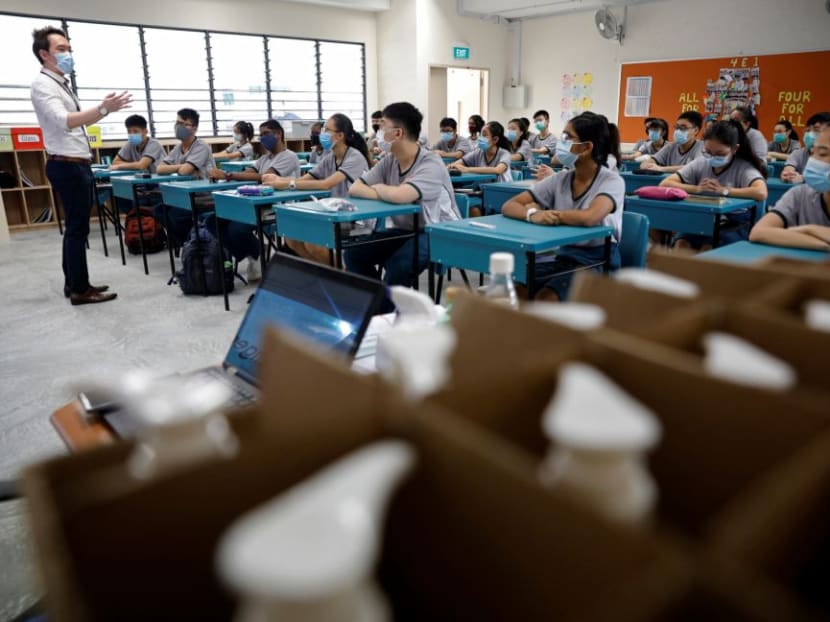
For our education system to improve and for our children to get a better education, we should not be relying on top-down changes; it starts with us — students, parents and educators, says the author.

Last year, I wrote about my wish list for education in 2020. Then, I advocated for change from the top, suggesting policy changes on examinations, grading as well as teaching and called for more interaction between schools and volunteer activities.
Then Covid-19 hit.
That put things in perspective.
2020 was the year everyone, including young students, had to be resilient.
Then it dawned on me — for our education system to improve and for our children to get a better education, we should not be relying on top-down changes.
It starts with us — students, parents and educators. Bottom-up.
Here are my wishes for education in 2021.
1. Students and parents to embrace, not reject technology
We have all struggled and then got used to learning and working with technology. Yet too often, I still hear parents lament their child’s lack of attention in online tuition classes and yearn for a return to physical lessons.
However, in this new normal, it would be foolhardy to revert to life before Covid.
Parents who only want physical classes are missing the benefits of online classes.
These include preparing a child for the adult world as the younger kids learn practical skills, including typing and using the computer for work, while teenagers are given more free rein to be independent learners as more schools turn to flipped learning and there’s a bigger onus on students to learn.
Parents also save time from having to send their children to class with home-based learning.
Plus, most students can actually focus better with less interruption by their peers and also enjoy more direct and frequent interaction with their teacher.
Sure, an ill-disciplined child may be prone to watching YouTube or playing games while taking an online class, but one should tackle that issue of his lack of interest in studies, rather than reject the technology.
Chances are, if your child is dazed in an online class, he is equally dazed in an on-site class. The difference is you don’t see it and hence, don’t blow it out of proportions.
Remember — if we do not keep up with the times, we will be left behind.
2. Students at the same time need to grow up and buck up.
It is the pandemic. Jobs are lost.
If you are just happy you can get away with not handing in homework or not focusing in class via Zoom, then it shows the person that you will become.
In this ultra competitive world, you will only stand out if you can overcome challenges that others can’t through your hunger and drive.
3. A different examination
Last year, I spoke about getting rid of exam questions that focus on the nitty gritty details. With online classes now, all the more we need to revolutionise the exam system.
More questions should be based on application rather than memory work, especially when one is using the computer for most of his studies. There is a famous quote attributed to Albert Einstein “Never memorise something that you can look up”.
This is more relevant than ever now.
Focus more on students’ understanding. I know of a tertiary institution, which has handwritten examinations for its basic journalism class.
This mode of assessment is not just archaic but unrealistic in the real world.
Similarly, for the younger students, adjust the exam format to fit our current needs.
Allow students to use the internet for the examinations, have more open-book exams and factor in their daily school work more in their grades.
Consistent hard work should be rewarded.
4. Make better use of the internet
Educators need to be more creative in 2021 to maximise this gift we have.
Because of Zoom classes last year, I was able to link my students with an American resident who shielded 80 Black Lives Matter activists from the police (he was later named one of CNN’s and Time magazine’s hero of the year), a Syrian refugee, politicians and a student who was accepted by all Ivy League universities, among others.
Teachers are no longer limited by geographical limitations and should think outside the box to make the class more exciting and lively.
There are so many opportunities because classes are online now.
My wish is for adults to pursue more lifelong learning too with the internet. Because of Covid-19, many schools have turned to online teaching.
Previously unattainable courses are now easily accessible.
Multiple Harvard University courses have gone online.
If you are learning a language, you can have Zoom sessions with native speakers to improve your language use.
5. Focus on the means, not the end
Ultimately, I hope for students, parents, educators and the Government to focus on the process and not the end for education.
Recently, a parent asked about the key performance indicators of the child. I explained that education cannot be measured with just so-called KPIs, as we needed to look at the bigger picture.
Instead of focusing on just the grades, look at the intangibles.
Has my child become more interested in the subject? Has he become an independent learner?
Has he learnt skills that can be carried over to real life? Has he learnt resilience? All these are just as important, if not more than grades.
While I have always advocated for this, it is more apparent in this pandemic.
The crisis has shown that no degree would guarantee a livelihood. It’s one’s ingenuity, creativity, drive and hunger that matter more in helping us secure success.
Through this crisis, we should have learnt that there are more important things than showing relatives your son has done well via grades. Don’t set KPIs based on grades.
Look beyond that.
Check to see if your child has developed an interest in learning. Check to see if his daily work has improved. Check to see if he understands.
The grades don’t show these clearly.
6. All students gain access to a laptop and internet
While I had mentioned we should achieve educational goals bottom-up, there’s one item that would require the help of the top.
The latest Household Expenditure Survey 2017/2018 tells us that 81 per cent of resident households have a personal computer, and 87 per cent have internet access.
Schools do try to loan laptops and WiFi dongle to students without one but I understand the process can be arduous.
During the circuit breaker when we could only rely on the internet, I knew of students who did not have laptops and their parents had to borrow an old, cranky one from relatives or companies for their child to catch up with lessons.
Compare their laptop which disconnects every 10 minutes with a more privileged family which has multiple devices.
Senior Minister Tharman Shanmugaratnam had said all secondary school students will receive a personal laptop or tablet for learning this year — seven years ahead of the original target.
This is a fabulous move.
If the policy is implemented successfully, we will be able to narrow the gap between the rich and poor and give the less privileged a more equitable chance at succeeding in life.
This is my simple wish list of 2021.
Simple because the bulk of the list simply requires a change in our mindset. Once done, there could be so much more our children can achieve.
ABOUT THE AUTHOR:
Lim Wei Yi is the co-founder of education centre Study Room. A former journalist, he also teaches at tertiary institutions.
Related topics
Education examination children school Covid-19Stay in the know. Anytime. Anywhere.

Subscribe to our newsletter for the top features, insights and must reads delivered straight to your inbox.
By clicking subscribe, I agree for my personal data to be used to send me TODAY newsletters, promotional offers and for research and analysis.






