
No easy way to deal with N Korea
No country seems able to thumb its nose at the rest of the world better than North Korea.
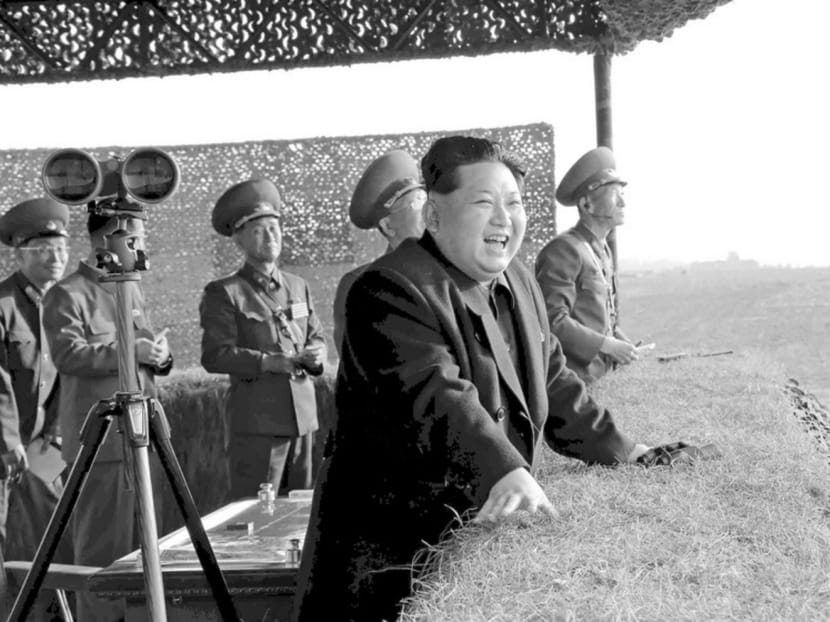
North Korean leader Kim Jong-un watching a rocket-firing drill by anti-aircraft units of the Korean People’s Army. With four nuclear tests since 2006 and various missile launches since the early 1990s, Pyongyang has time and again forced the international community to respond by making vehement ‘condemnations’ in addition to imposing an assortment of sanctions. Photo: Reuters

No country seems able to thumb its nose at the rest of the world better than North Korea.
With this month’s rocket launch, which the international community believes is a prohibited test of its missile technology, North Korea has once again compelled the global powers to search for an answer in managing the new nuclear kid on the block.
With four nuclear tests since 2006 and various missile launches since the early 1990s, Pyongyang has time and again forced the international community to respond by making vehement “condemnations” in addition to imposing an assortment of sanctions.
The optimal outcome is clear — a disarmed and “well-behaved” North Korea connected to the global economy. While no contesting nation, such as the United States, China or even Russia, would be against such a scenario, the overarching question of how to do it at an acceptable price has yet to be finalised.
Despite all the provocations, however, much of the recent responses merely echo previous tactics and strategies used. There is some diplomatic scrambling, followed by no real change in North Korean behaviour. It is safe to say that it is more obvious what will likely not work than what can or should.
Not surprisingly, the United Nations Security Council once again issued a strong statement condemning the latest launch and promised to take punitive steps.
Tragically, the world’s counter-moves, however rational and measured they may be, may no longer amount to anything of substance.
On the one hand, the US, along with its East Asian allies (South Korea and Japan) will most likely push for harder measures in limiting North Korea’s financial and material movements. On the other, Russia, and China in particular, will likely seek a more tempered settlement — effectively diminishing whatever “tough” response can be scrapped together.
Granted that a military response is highly unlikely, this default position of “strategic patience” has led to some side-effects. By now, it is safe to argue that North Korea has conditioned itself to this rhetorical game, which is unlikely to escalate to more concrete action. This may have also emboldened its ambitions to carry on with its nuclear and missile tests, and coming up with predictable, yet unconvincing, excuses such as “peaceful purposes”.
BETTING ON CHINA?
All the same, there is another layer in this predictable scenario that the world has created for itself. Considering that all stakeholders are caught between a rock and a hard place (not wanting to initiate a war, yet unwilling to legitimise North Korea’s actions), many analysts and scholars have pinned their hopes on China, North Korea’s principal supporter and lifeline, taking a more assertive position against North Korean mischief. But we must keep in mind that China has its own interests to serve. An acceptable amount of stability and not well-intended humanitarianism is likely what motivates Beijing.
Disappointingly, and since the beginnings of the Six-Party Talks some 13 years ago, we have seen this movie before. Hopes were raised and were repeatedly dashed since 2003 (when the Six-Party Talks were first initiated) and to date, there has been no clear sign of China’s willingness to step up to the plate.
Even if it did, what guarantees would we really have that Mr Kim Jong-un would succumb to its pressure? It would be too simplistic and even dangerous to presume that Pyongyang was a mere satellite of China’s overall ambitions.
Given that military options are not really viable, and since sanctions have done little in curbing North Korea’s desire for being a nuisance; in the end, much of the world’s hopes are likely to turn again to Beijing, even though we may be all aware that it will probably not go far enough.
Regrettably, the only other viable response, such as the possible deployment of the THAAD (Terminal High Altitude Area Defense) system on South Korean soil, has proven to have its own baggage. With Chinese concerns over THAAD being able to interdict its ballistic missiles, some are worried that Beijing would retaliate with economic pressures of its own on Seoul. Beijing is now South Korea’s top trading partner. This could well hold back any South Korean attempts at “nudging” Beijing.
Additionally, while there may be those who look to Iran’s compliance to put its nuclear ambitions on hold as a possible model for solving the North Korean problem, one must be careful not to compare apples and oranges. Iran is nowhere near as isolated, both economically and culturally.
Sanctions, which have been credited with being “crippling” for the Persian state, could only have been that effective provided you had an economy, not to mention a society, that was already substantially linked to the outside world — something to which North Korea is not.
As a result, North Korea will remain determined in developing its missile and nuclear capabilities in spite of the sanctions and condemnation. After all, North Korea is a country that has little to lose. Unsettling as it may be to admit, there is no easy way to get rid of the Kim Dynasty, nuclear weapons and all.
Bottom line: Provided that the world has yet to come up with a convincing alternative apart from verbal disapprovals, imposing of sanctions, and a persistent yearning for China to commit its political will against its communist neighbour, it looks as though this merry go round of getting nowhere will go on. After all, do we really have a choice at this point?
ABOUT THE AUTHORS:
Lee Il Woo is an Associate Research Fellow with the S.Rajaratnam School of International Studies and Choong Pui Yee is a Ph.D Candidate at Monash University Malaysia.
Stay in the know. Anytime. Anywhere.

Subscribe to our newsletter for the top features, insights and must reads delivered straight to your inbox.
By clicking subscribe, I agree for my personal data to be used to send me TODAY newsletters, promotional offers and for research and analysis.






