
Not 10/10, but pulling off 2018 Asian Games has Jokowi looking for more
While the 2018 Asian Games was an improvement from when Jakarta and Palembang last hosted the South-east Asian Games seven years ago, questions will remain over Indonesia’s ability to pull off a major sporting event of an even larger scale, with President Joko Widodo making a surprise announcement on Saturday (Sept 1) that Indonesia will bid to host the 2032 Olympic Games – a first for South-east Asia if it is successful.
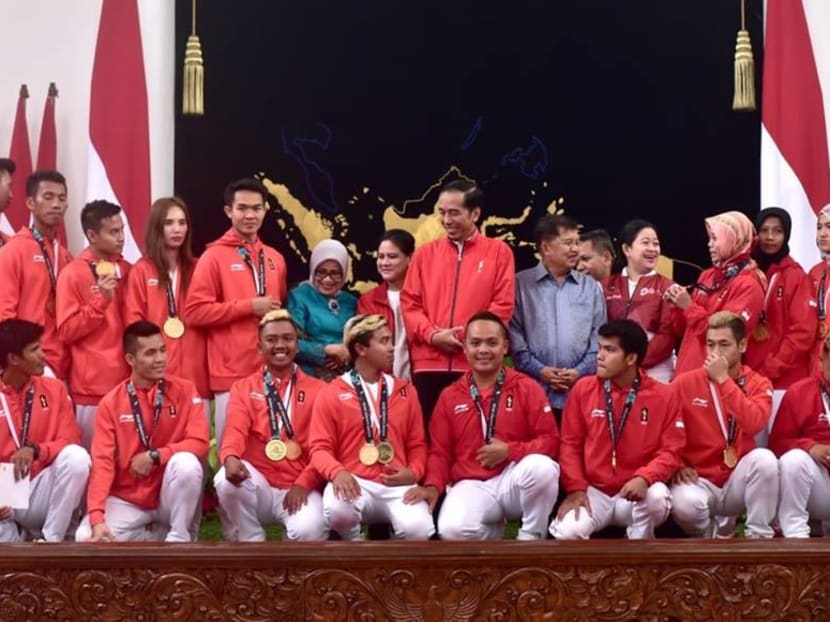
If Mr Widodo’s aim in agreeing to host the 2018 Asian Games was to bolster his appeal among voters – particularly among younger citizens – ahead of next year’s presidential race, he has succeeded to some extent.

The big and black horse carriage stood out on the streets of Jakarta, drawing curious glances.
It prompted my Bluebird van driver to remark, “Jokowi’s!” in a cheeky reference to the Asian Games opening ceremony video featuring Indonesian President Joko Widodo that became a hit among netizens.
The clip showing Mr Widodo riding through Jakarta’s alleys and hurdling over obstacles on a motorbike, before riding into the Gelora Bung Karno Stadium, has drawn over a million views online.
Twitter, a popular social media platform in Indonesia, was also abuzz with the hashtags #proudtobeindonesian and #stuntman trending in the country.
If Mr Widodo’s aim in agreeing to host the 2018 Asian Games was to bolster his appeal among voters – particularly among younger citizens – ahead of next year’s presidential race against rival Prabowo Subianto, he has succeeded to some extent.
Mr Widodo’s appearances at various Asian Games venues in Jakarta were greeted with roars and cheers from the crowds.
Some of his younger voters have already been won over.
My hotel liaison officer who is in his 20s grinned when I asked if Mr Widodo was going to win.
He nodded confidently and said: “Yes, of course!”
Banking on sporting gold medals to bolster popularity is not new in politicians’ playbooks, and Mr Widodo and his administration would have known the power that sport wields when they agreed four years ago to take over the organisation of the Asian Games after initial host Vietnam pulled out due to financial difficulties.
This was the first time that Indonesia had hosted the Asiad in over 50 years, the last being in 1962.
With hosts typically getting at least six years to prepare for an event of such scale and stature, there was much pressure on Indonesia to put together a Games in such a reduced timeline. The Asian Games is the biggest sporting event outside of the Olympics with 10,000 athletes from 45 countries competing in 39 sports.
With over 30 sports held across 40 venues in the cities of Jakarta and Palembang, the task was a daunting one.
Like many previous major Games, there were delays and last-minute curve balls, as seen when riotous fans ripped up seats after a football match at the GBK stadium just days before the Games’ opening day.
NOT HUNKY DORY
Some of the 11th hour rush showed on the ground, as volunteers, security and other staff took time to orientate to their duties, with occasional mix-ups during the Aug 18 to Sep 2 Games.
For example, Chinese swim star Sun Yang’s 200m freestyle victory ceremony was marred by an incident after the hoist holding the countries’ flags malfunctioned during the Chinese national anthem, sending the Chinese and Japanese flags crashing to the ground.
I also had a personal encounter as a miscommunication between the organising committee and its transport department left some members of the media stranded at the bus stop outside the media centre past 11pm one day.
But the evening was saved by a media hotel staff who had stationed himself outside the media centre to help guests with transport.
This jolly employee smiled and shrugged as he said “this happens at the Games”.
Team Singapore was also not spared, with at least one team encountering transportation issues from the athletes’ village to the competition arena.
Security was also a worrying issue.
While armed guards were spotted everywhere in the Senayan area where many sports were contested, and bag scans and detectors were placed outside each venue, the searches often felt perfunctory for Games of such a scale.
There were also occasions when I accidentally walked into training areas that were restricted to only athletes, prompting questions about how tight security really was at the venues.
PRIDE FOR INDONESIANS
This is not to say the hosts got it all wrong.
While its army of volunteers were sometimes unsure about what was going on, they were generally friendly and helpful, with some going out of their way to assist spectators and media with their queries.
Even the locals embraced their role as hosts.
A kind woman even offered her credit card to help me pay for coffee at a Games carnival kiosk outside the stadium as the vendor only accepted debit or credit cards for payment.
The joie de vive of its people was a highlight of the Games, underscored by the raucous cheers that greeted competing Indonesian athletes, even if they did not finish on the podium.
Jakarta’s notorious traffic snares and pollution also gave wearied travellers a breather this Games, as an even-and-odd car licence traffic policy – as well as a declaration of school holiday for 34 schools – imposed for the Asian Games saw traffic reduced significantly to the relief of everyone.
Dr Deasy Simandjuntak, Associate Fellow at research centre Iseas – Yusof Ishak Institute, noted that the Asian Games was “a success for Indonesia”, but she cautioned that this “does not directly bolster Jokowi’s election hopes” as the polls are eight months away.
“Interestingly, Prabowo, Jokowi's rival in 2019, who is also chairman of Indonesian Pencak Silat Association, has also been garnering praises due to the country's successes in winning the pencak silat final,” she added.
“There was a rare moment which happened during the final: President Jokowi and Prabowo shared a group hug with the champion. People are reacting very positively to this moment of unity.”
While the 2018 Asian Games was an improvement from when Jakarta and Palembang last hosted the South-east Asian Games seven years ago, questions will remain over the country’s ability to pull off a major sporting event of an even larger scale, with Mr Widodo making a surprise announcement last Saturday (Sept 1) that Indonesia will bid to host the 2032 Olympic Games – a first for South-east Asia if it is successful.
Its sporting ambitions do not end there, as Indonesia is also reportedly mulling a joint bid with Asean neighbours Thailand and Vietnam to host the 2034 Fifa World Cup.
But take a leaf from the Indonesians, and those among Jakarta’s population of over 10 million who navigate the city’s chaos every day, shrug and just say “Santai aja, semua bakal ok”, which means “Just relax, everything will be ok” in Bahasa Indonesia.
ABOUT THE AUTHOR:
Low Lin Fhoong is an editor with TODAY who has covered many sporting events across the world, including the Asian Games in Indonesia from Aug 18 to Sep 2.
Stay in the know. Anytime. Anywhere.

Subscribe to our newsletter for the top features, insights and must reads delivered straight to your inbox.
By clicking subscribe, I agree for my personal data to be used to send me TODAY newsletters, promotional offers and for research and analysis.






