
Pakatan’s Buku Harapan makes the case for taking a leap of faith
Pakatan Harapan (PH), Malaysia’s federal opposition coalition, launched a sweeping election manifesto on March 8. Many of the manifesto’s items are not new to Pakatan’s rhetoric. This Buku Harapan, however, is more audacious than its predecessors.
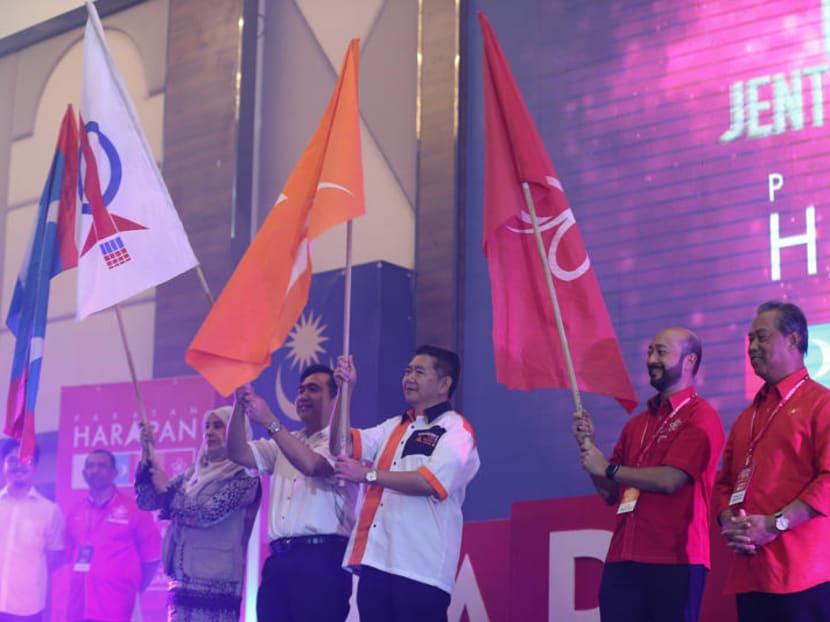
Leaders from the opposition Pakatan Harapan pact wave their party flags during its convention in January 2018. Photo: Malay Mail Online

Pakatan Harapan (PH), Malaysia’s federal opposition coalition, launched a sweeping election manifesto on March 8, exactly 10 years after the shocking political tsunami in the 2008 general election that swept away the Barisan Nasional’s (BN) two-thirds parliamentary majority.
In the 12th general election (GE12) in 2008, the opposition parties did not align their electoral platforms, yet they unwittingly breached the psychological barrier and ushered in a two-coalition system. They subsequently forged Pakatan Rakyat, a three-party pact, and in 2013 jointly declared a 35-page “People’s Manifesto” for GE13. From GE12 to GE13, Pakatan Rakyat increased its parliamentary seats from 82 to 89 (37 per cent and 40 per cent respectively, of 222 seats), and raised its share of the popular vote from 48 to 51 per cent.
With GE14 expected to be held before mid-May, the recently forged four-party coalition of PH is increasingly energised and acutely mindful of the potential benefits of crafting a comprehensive, appealing and resonant manifesto. Thus, Buku Harapan (Book of Hope) is a 194-page booklet presenting 60 promises.
Of course, most people will not read the dense details. But they will hear of the 10 marquee promises, shortlisted from the 60, that PH declares will be delivered in the first 100 days if takes power. The manifesto helps the coalition’s partners, which have yet to settle their respective candidacies, to stay on point on policy matters.
The manifesto studiously covers the bases, with five core elements: lightening the economic burden, reforming administrative and political institutions, spurring fair and equitable economic growth, restoring Sabah’s and Sarawak’s status based on the 1963 Malaysia Agreement, and building an inclusive, moderate and globally distinguished Malaysia. Buku Harapan also packages special commitments for five target groups: Federal Land Development Authority (Felda) settlers, the Indian community, women, youth, and the elderly.
It is significant that PH has also committed to institutional reforms. Notably, it promises to establish independence of the Electoral Commission, Anti-Corruption Commission and other public agencies, safeguard university autonomy and native customary land, repeal repressive laws, and establish an Equal Employment Opportunity Commission.
Many of the manifesto’s items are not new to Pakatan’s rhetoric. The coalition has railed against the Goods and Services Tax since its rollout in 2015, and in elections past, pledged fuel subsidies and free higher education, plus institutional reforms to empower parliament and curb corruption. This Buku Harapan, however, is more audacious than its predecessors.
Arguably, PH has to go to extremes, contending in a political arena slanted against it. Former Pakatan leader Anwar Ibrahim has been incarcerated since 2015, and whistleblower Member of Parliament Rafizi Ramli was recently sentenced to jail. Both cases are widely considered to be politically motivated. In Malaysia’s electoral system, the problem of malapportionment underweights the votes in PH’s urban strongholds, while gerrymandering carves constituency boundaries to Barisan Nasional’s advantage.
Additionally, BN controls the mainstream media and unhesitatingly utilises the civil service and public institutions for partisan gain. On top of all this, widespread multi-cornered contests, involving Pakatan’s ally turned adversary Parti Islam Se-Malaysia (PAS), will split the pro-Opposition, anti-BN vote.
Amid these complexities and the breadth and depth of manifestos, the contest will boil down to the hot button issues: cost of living, corruption, trustworthy government.
GST is a simple, clear target of popular ire. The regressive tax is faulted for burdening folks with higher prices, and further tainted as a bailout for the Najib administration’s improprieties. The latter especially makes for impactful rhetoric, even if the link is tenuous.
PH is clearly counting on GST abolition and economic relief as its rallying call. It also promises to introduce a targeted fuel subsidy and a RM500 (S$168.5) per year claimable healthcare scheme for low-income households, to eliminate highway tolls, and to retain BR1M cash transfer scheme (with unspecified improvements).
This is also where the challenge is steep for the opposition, given the strong advantages of incumbency.
The electorate must take a leap of faith that what BN does, PH can do just as well – or even better. People-friendly policies in PH-governed states, especially Selangor, provide a reference point. But at the federal level, cash handouts and social assistance are BN’s home turf, and it can coax the electorate to vote in gratitude for the extensive social programmes it has implemented, including BR1M, and its track record of service delivery.
PH, in turn, needs to place faith that voters will not be easily swayed by BN’s money politics. PH must strenuously resist playing the same patronage game, which undermines the moral higher ground it seeks to claim.
PH has evidently made a calculation, that for those whom the relief makes a difference the cerebral issues of financial feasibility are not a big deal, and for those who question how it will fund its long list of promises, the pledges to probe scandals – especially those involving 1Malaysia Development Berhad, Felda and Majlis Amanah Rakyat – and to reform institutions and recover international dignity, will help seal the deal.
But it will do well to furnish more details and provide reasonable answers to BN’s dismissal of PH’s plans as unrealistic and detrimental to Malaysia’s debt levels. On Thursday (March 29), Prime Minister Najib Razak told investors that PH’s manifesto would jeopardise the country’s economy.
These issues concern many nonpartisan Malaysians as well.
Ultimately, Pakatan Harapan’s best hope is that Malaysian voters are disaffected enough with the ruling regime to take a leap of faith.
ABOUT THE AUTHOR:
Lee Hwok-Aun is a senior fellow at the Iseas-Yusof Ishak Institute.
Stay in the know. Anytime. Anywhere.

Subscribe to our newsletter for the top features, insights and must reads delivered straight to your inbox.
By clicking subscribe, I agree for my personal data to be used to send me TODAY newsletters, promotional offers and for research and analysis.






