
In this crisis, let's educate our young to think and feel beyond the nation
Despite the global nature of Covid-19, public discourse has typically employed nationalist language, often leading to polarising debates. One common example occurs in the way the media pits one nation against another through ranking tables that tally deaths and infections.
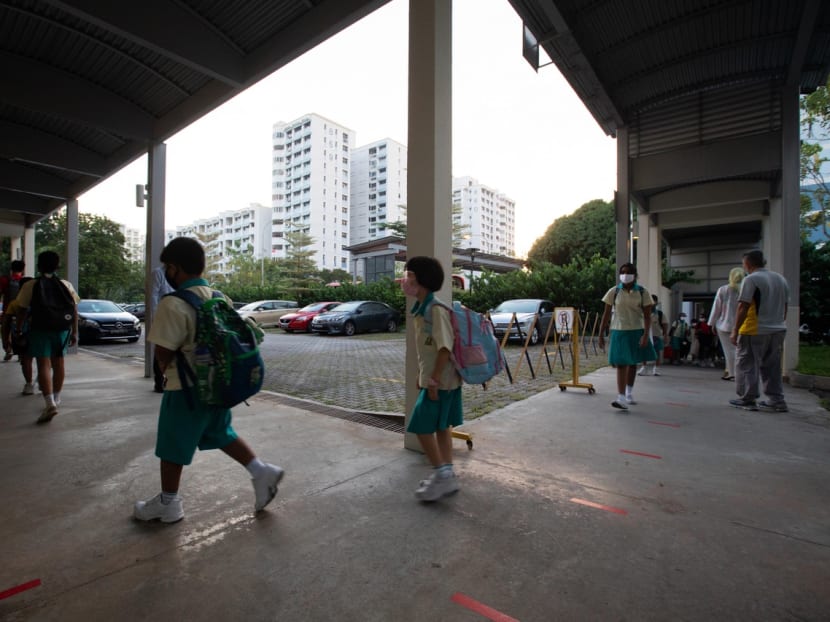
Education can function as a powerful bulwark against intolerance, says the authors, who offers three strategies that teachers as well as parents can apply.

Despite the global nature of Covid-19, public discourse has typically employed nationalist language, often leading to polarising debates.
One common example occurs in the way the media pits one nation against another through ranking tables that tally deaths and infections.
Another example is how nations are measured against the standards of another in tackling the pandemic.
A recent New York Times commentary by an American journalist drew a broad connection between the sudden surge of Covid-19 among Singapore’s migrant worker population with how "freedoms of speech and press are curtailed" and "the tight controls for which Singapore is known — elaborate surveillance, police investigators, the threat of criminal prosecution".
Not surprisingly, this drew sharp responses from Singaporeans.
While the article does present a stereotypical portrayal of Singapore, we should guard against reactions that reinforce an East versus West divide or heighten distrust of anyone deemed un-Singaporean, or un-Asian.
The diversity of the “West” ought to be recognised, and it includes countries such as New Zealand and Sweden.
Likewise, Asia is a varied region, and Singapore is one Covid-19 experience out of many.
How can we better understand the basis of such stereotypes? More importantly, how can we help young learners of all backgrounds make sense of these conversations in a safe space through education?
Perhaps when one reads about the number of infections and deaths on daily news feeds or about countries outbidding others for and banning exports of medical supplies, this leads to the propensity to think first of the safety of one’s community and nation above others.
When this is repeated over and over again, nationalist thinking becomes the default mode of survival in a global crisis.
This can lead to extreme examples of nationalist rhetoric that perpetuate xenophobia such as when United States President Donald Trump employed the term “China virus” or when a White House official described the virus as “kung flu”.
It can also lead to more subtle establishing of boundaries between the “us” versus “them”, citizen versus non-citizen.
Take for instance, while Singaporeans proudly partook in the nationwide singing of “Home”, proposals were made to house foreign workers in floating islands so as to keep them from infecting citizens given recent outbreaks among them.
More recently, the charging in court of individuals who gathered without masks at Robertson Quay during the circuit breaker led to many negative comments about foreigners as a group.
Given increasing ethnocentric, extremist, and nationalistic discourse in the public sphere, we have to pay closer attention to how to educate the young to cultivate transnational empathy and affinities with others.
As students have returned to school this month, teachers may be fixated on ensuring safe social distancing in classrooms and may be concerned about resuming their planned curriculum.
These, however, are exceptional times that necessitate greater attentiveness to the invisible boundaries that demarcate insider and outsider groups.
It is education that can function as a powerful bulwark against intolerance. The following are three strategies that teachers as well as parents can apply.
First, we can teach our young to pay attention to visible and invisible boundaries that separate one community from another or that mark one group as inferior to another.
We can encourage discussions about who has the power to define these boundaries and how these can lead to discriminatory practices.
Second, despite the emphasis on social distancing, we can encourage bridge building activities. For example, even though students have to keep a safe distance from one another in schools, teachers can encourage collaboration through inquiry projects.
More importantly, in these divisive times, there is a greater duty to understand communities that face forms of othering such as ostracism, neglect, or discrimination. For example, children or youths could be introduced to stories and testimonies of migrant workers or be encouraged to appreciate their culture and histories.
Third, at a time when hurtful terms relating to nationality, race and culture are prevalent in the media, teachers as well as parents may want to be proactive in encouraging students to respect their friends, while modelling how cultural differences are opportunities to make room for other perspectives.
Listening critically — and with empathy — means more than sieving out fake news; it also means rejecting xenophobic and racist assumptions.
The way forward may be to think outside false binaries, without denying the inequalities that continue to exist.
Of course, this could be easier said than done. When we encounter perspectives and experiences that are so different from our own, we tend to rely instinctively on generalisations and stereotypes.
Likewise, some viewpoints continue to be unheard in broader conversations, because they are communicated in a different language. Some may not have electronic access to a voice in the media.
There are no easy answers but a first step may be to recognise that we need to make space in our conversation for others, and that we are sometimes too excited in speaking over smaller, less prominent voices.
As cultural scholars Françoise Lionnet and Shu-Mei Shih observe in Minor Transnationalism, we can attend to minor voices even if we tend to be part of the majority. Minor-to-minor networks can also exist across national boundaries.
It’s time to rethink if being nationalist is truly representative of the nation. There are inequalities that continue to exist, which require our empathy and attention.
ABOUT THE AUTHOR:
Ann Ang is a PhD candidate in postcolonial and world literature at Oxford University. Suzanne Choo is Associate Professor in the English Language and Literature Academic Group at the National Institute of Education, Nanyang Technological University.
Related topics
Education Covid-19 coronavirus nationalismStay in the know. Anytime. Anywhere.
Subscribe to our newsletter for the top features, insights and must reads delivered straight to your inbox.
By clicking subscribe, I agree for my personal data to be used to send me TODAY newsletters, promotional offers and for research and analysis.