
PAS' tricky battle for Kelantan and its future
The 14th Malaysian General Elections is the first time in nearly three decades where Parti Islam Se-Malaysia (PAS) seems to be losing grip of its stronghold state of Kelantan.
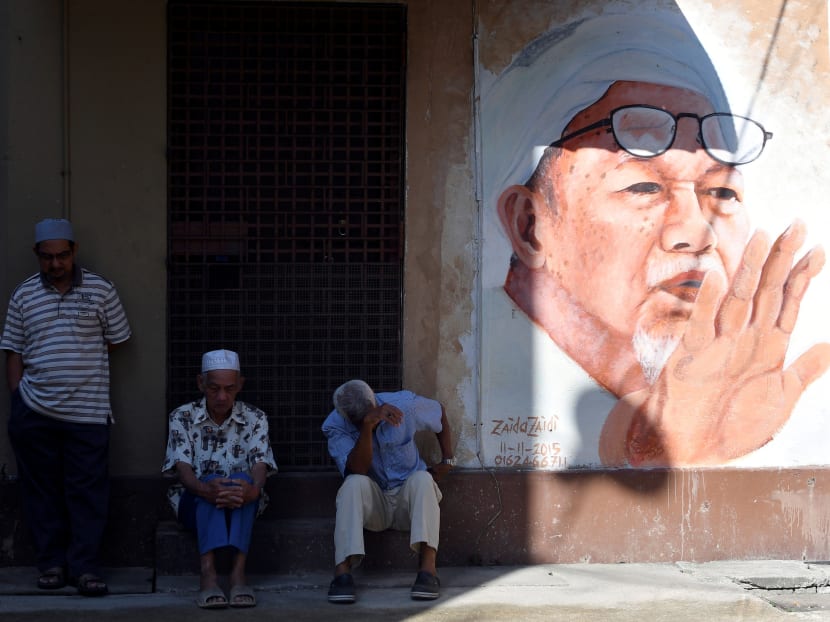
People sit next to a mural of the late former PAS president Nik Abdul Nik Mat at Medan Ilmu in Kota Bharu, Kelantan. The author says that a recent spat between Umno and PAS over the renaming of the Medan Ilmu religious centre to Medan Tok Pa has been cited as an example of it is impossible for the two parties to come together.

The 14th Malaysian General Elections is the first time in nearly three decades where Parti Islam Se-Malaysia (PAS) seems to be losing grip of its stronghold state of Kelantan.
The Barisan Nasional (BN) Kelantan chairman Datuk Seri Mustapa Mohamed has openly declared that the BN has a very good chance of re-capturing the state from PAS especially after the death of the late PAS spiritual leader, Nik Aziz Nik Mat, and the formation of the splinter Parti
Amanah Nasional (Amanah), which PAS’ detractors argued will split the party’s votes.
PAS itself has not taken the threat from BN lightly. The party has launched an election manifesto focusing on the defence of Kelantan.
In fact, the chief minister of Kelantan, Ahmad Yaakob has even declared an electoral jihad (holy struggle) to defend the state and the party’s tagline is Rise to Defend Kelantan (Bangkit Pertahanan Kelantan).
However, a scan of the sentiment of Kelantanese voters indicate that it is likely that Kelantan will remain under PAS’ bastion of influence even if the party might lose several seats especially at the parliamentary level.
There is little doubt that PAS’ grip on Kelantan has weakened. Perhaps the most important factor for the weakened position of PAS is the absence of Nik Aziz, whose passing in February 2015 marked a watershed in PAS’ history.
For many Kelantanese and Malaysians (including many non-Muslims), Nik Aziz, is seen as an example of how a leader can govern in accordance with Islamic values which is humanistic and universal.
The aura and charisma of Nik Aziz is clearly missing in the new leadership of PAS Kelantan. The new chief minister is sorely uncharismatic and seems unable to connect in the same way as Nik Aziz.
Some Kelantanese noted that the new breed of PAS leaders are more distant from the people as compared to the period of Nik Aziz’s leadership.
During an event at the Sultan Muhammad Stadium in Kota Bharu to announce the electoral candidates in Kelantan, the candidates entered the stadium in a convoy of luxury cars, a practice often associated with United Malays National Organisation leaders.
Some Kelantanese also feel that the state government is not doing enough to spur infrastructural development and create employment for the young.
Some Chinese Kelantanese businesses have complained that the new state government is more restrictive, citing its insistence that Kota Baru businesses have to incorporate “Islamic” design elements in newly-constructed commercial buildings and having Jawi text written on shop panels.
Yet, despite some criticisms of PAS, many Kelantanese continue to support the party.
For them, PAS is an integral part of the Kelantanese trait of not relying for help (from the federal government) and their sense of independence.
Despite the constant rhetoric by the BN leadership about the lack of development in the state, many Kelantanese highlight the fact that a number of hyper-marts including Aeon, Tesco and Giant have opened up in Kelantan.
Some have contrasted this with the neighbouring state of Terengganu held by Umno, where there is no shopping mall or hyper-marts.
Hence, the current offer made by the Prime Minister Najib Razak including a new stadium, a bridge in the Ketereh constituency and an Al-Quran University in the state have had little traction amongst many Kelantanese.
As one Kelantanese voter in Pasir Puteh explained, Kelantanese vote for PAS as the party represents Islam and Kelantanese do not wish to change the Islamic character of the state.
Another Kelantanese voter in Machang joked that his parents will disown him if he fails to vote for PAS as they believe that he is transgressing his Islamic obligation.
Many Kelantanese also do not believe that there is a tacit cooperation between Umno and PAS.
Citing the example of the recent spat between Umno and PAS over the renaming of the Medan Ilmu religious centre to Medan Tok Pa, many argued that it is impossible for the two parties to come together.
While many Kelantanese are aware of the split within PAS and Amanah, they consider Amanah as a non-player in Kelantan.
The general sentiment is that even Husam Musa, who is leading Amanah charge in Kelantan, will find it hard to win his current state assembly seat of Salor.
The fact that Amanah is in an alliance with the Democratic Action Party (DAP), a party many in Kelantan considers as chauvinistic Chinese party and with the Parti Pribumi Bersatu (Bersatu) led by Dr Mahathir Mohamed, a figure abhorred by many Kelantanese for depriving the state of its financial allocations, has further weakened the position of Amanah.
Amanah’s position was further complicated when the Sultan of Kelantan revoked the datukship of Amanah vice-president Husam Musa, who has been touted as PH’s chief minister candidate for Kelantan.
PAS vice president Idris Ahmad noted that the chief minister candidate will need to be approved by the Sultan and it is highly unlikely that Mr Husam will receive the support of the Sultan.
Despite the support for PAS in Kelantan, some voters are concerned about the role that PAS can play at the national level.
One voter from Kota Bahru admits that while he continues to support PAS administering Kelantan, he feels that the party’s role at the national level is limited as long as it does not work with the opposition coalition.
As such, he will be voting for the PAS’ candidate for the state seat but will vote for PH for the parliament seat.
While it is likely that PAS will continue to helm Kelantan after the GE14, the party’s leadership will need to reevaluate its future strategy, especially if the party loses a sizable number of parliamentary and state seats in Kelantan.
The argument that PAS will enjoy more support from Malay voters if it stands alone will fall hollow.
A failure on the part of PAS to re-calibrate its political strategy could spell an end to the party’s hold on Kelantan and lead the party becoming obsolete at the national level.
ABOUT THE AUTHOR:
Dr Mohamed Nawab Mohamed Osman is Coordinator of Malaysia Programme at the S Rajaratnam School of International Studies (RSIS). This is part of a series of commentaries by RSIS on the 14th Malaysian General Election.
Stay in the know. Anytime. Anywhere.

Subscribe to our newsletter for the top features, insights and must reads delivered straight to your inbox.
By clicking subscribe, I agree for my personal data to be used to send me TODAY newsletters, promotional offers and for research and analysis.






