
In using telemedicine during this pandemic, let’s not forget its drawbacks
Since the Covid-19 pandemic started, telemedicine has been very much in the news. Little mention has however been made regarding its limitations and the dangers accompanying an unquestioning embrace of such technology seem to have been overlooked.
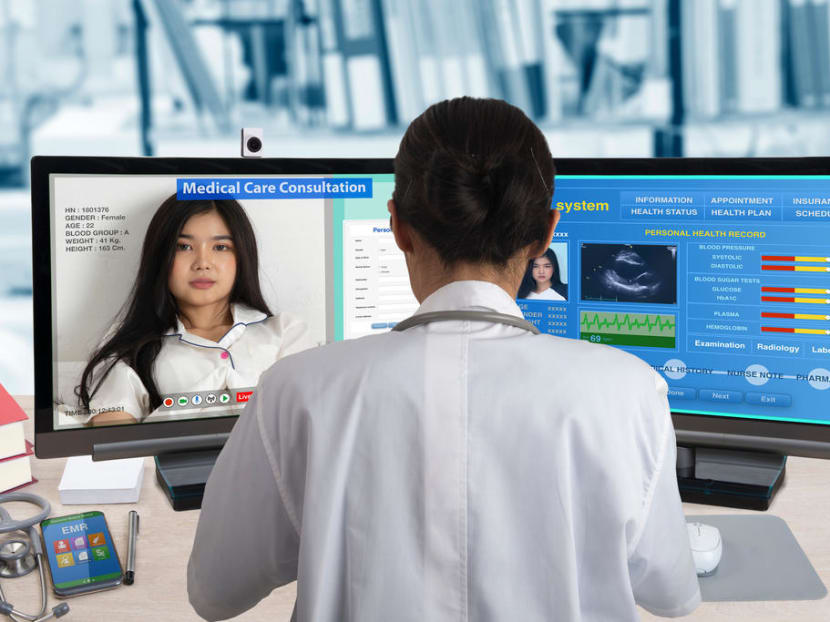
A doctor giving a patient an online consultation.

Since the Covid-19 pandemic started, telemedicine has been very much in the news.
On top of straight news reports on how the Ministry of Health (MOH) directed doctors to provide teleconsulting services if feasible and appropriate during and after the circuit breaker, the media have also highlighted how telemedicine has or has not been adopted in other countries such as India and South Korea.
The media reports largely underscored the usefulness of telemedicine and the convenience it confers.
Little mention has however been made regarding the limitations of telemedicine, and the dangers accompanying an unquestioning embrace of such technology seem to have been overlooked.
WHAT EXACTLY IS TELEMEDICINE?
One common definition says it is the “use of information and communications technology to provide healthcare services to individuals who are some distance from the healthcare provider”.
Besides teleconsultations between a doctor and a patient, telemedicine can encompass a whole range of services such as the remote reading of radiology images and the dispensing of advice via teleconferencing by pharmacists on medication dosages and side-effects.
While there is clearly a place for telemedicine in countries with vast geographical territories where individuals living in remote areas may otherwise lack access to quality medical care, the utility of telemedicine in an urbanised city-state such as Singapore deserves closer scrutiny, especially in a post-Covid-19 world.
WHEN IS TELEMEDICINE APPROPRIATE AND SAFE?
The experience in India suggests that it can be useful for the follow-up of chronic patients whose diagnoses are known, but cannot replace the first physical consultation and examination.
This is indeed the case for a telemedicine service that the Singapore National Eye Centre recently announced.
It is restricted to follow-up patients with a known diagnosis of glaucoma, which even then combines teleconsultation with assessments done by trained personnel on-site at a satellite setting.
In other words, safe conduct of teleconsultation requires pre-conditions such as stable patients with known diagnosis, or the presence of trained healthcare personnel who can supplant teleconsultation with reliable and appropriate examination or investigation findings.
Without either of these conditions, telemedicine has been shown to be fraught with the risks of both misdiagnosis and missed diagnoses.
A study published in 2016 regarding the use of teleconsultation in the United States for skin conditions — without concurrent physical examination — revealed significant problems.
Among others, 57 per cent of doctors who relied on telemedicine fail to give adequate warnings regarding medication-related pregnancy risks to a female patient, 100 per cent missed a diagnosis of a skin eruption related to syphilis (a sexually transmitted disease), 21 per cent misdiagnosed a skin cancer and 83 per cent misdiagnosed a case of skin infection as acne.
In this day and age, where patient autonomy has a preeminent place in the medico-legal landscape, it may be said that it is the patient’s right to opt for telemedicine, be it for reasons of convenience or otherwise.
In a similar vein, healthcare professionals may exercise their autonomy to embrace telemedicine.
Yet the exercise of such autonomy must be accompanied by the willingness of patients to accept responsibility for their decision to partake in teleconsultations, knowing full well the limitations and risks associated therewith.
Clearly, medical doctors who offer teleconsultation have a responsibility to explain to their patients the limitations of teleconsultation (and reasonable options that are available) and owe no less a duty of care to ensure that their patients do not inadvertently suffer any harm.
To be sure, MOH has established clear guidelines for the introduction of telemedicine in Singapore.
Importantly, MOH has noted that the technology involved in telemedicine is still evolving, and healthcare providers who embrace the provision of such services remain “fully responsible for meeting all legal and ethical requirements and must exercise due diligence when delivering telemedicine services”.
The guidelines also state that a face-to-face consultation should precede teleconsultations if treatment is to be issued. If this is not possible, then a face-to-face consultation should follow shortly after the tele-consultation.
It is useful for doctors and patients alike to remember that telemedicine is not a panacea, particularly during this period of safe distancing and cautious opening up of healthcare services.
Further to this, there is a need to contend with issues pertaining to data security and privacy.
The safety of different telemedicine applications as well as the dangers involved in ensuring patient/doctor identity in the epoch of ever more advanced deep-fake technology remain questions that have not been fully answered.
In pursuing the development and adoption of telemedicine, it is also imperative to consider legal requirements for medical licensing and professional liability across different countries, lest one runs afoul of the law.
This is particularly the case for doctors here who provide teleconsultation services for foreign patients.
In the pall cast by the current Covid-19 pandemic, it may be said that the impetus for adopting telemedicine has become ever more pressing. Yet the need to ensure patient safety has not fallen by the wayside.
It is perhaps because of this that in recent weeks, MOH has instructed medical doctors to use teleconsultations where appropriate and possible, but to also allow for timely face-to-face consultations so as to facilitate physical examination.
In short, teleconsultations do not replace the need for physical consultations.
Telemedicine holds promise in granting access to quality healthcare to those who are unable to access care because of geographical constraints or other reasons, but telemedicine is also not without limitations and risks.
Healthcare professionals who engage in telemedicine without explaining the limitations therewith may well be at risk of abrogating their professional duty of care.
ABOUT THE AUTHOR:
Dr Sitoh Yih Yiow is a geriatrician in private practice.
Related topics
telemedicine MOH Covid-19 coronavirus doctor healthcareStay in the know. Anytime. Anywhere.
Subscribe to our newsletter for the top features, insights and must reads delivered straight to your inbox.
By clicking subscribe, I agree for my personal data to be used to send me TODAY newsletters, promotional offers and for research and analysis.