
Watching my dad regress to infanthood while my three children grow out of it
When my Dad was diagnosed with semantic dementia less than a decade ago, I did not know that I had begun a journey wherein — three times over — I would see my parent and my child meet, and then pass each other, in opposite directions in terms of cognitive performance and semantic memory (world knowledge).
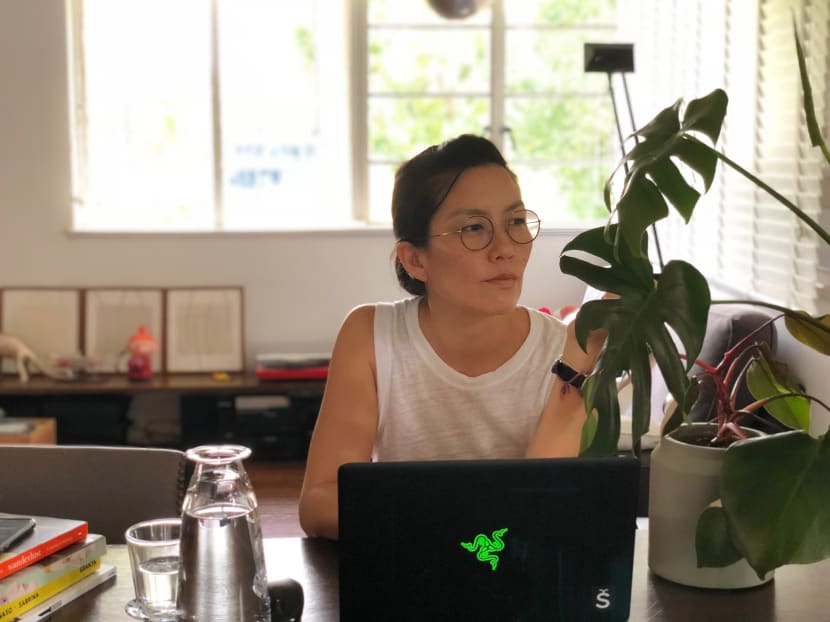
The author (pictured) says that her one-year-old baby has maybe 25 words, an infinity of times more than her father’s zero.

My father has semantic dementia, an uncommon type of fronto-temporal lobe degeneration that systematically, and mercilessly, undoes the learning we accumulate throughout life. It first robbed him of his words, before becoming insatiable and taking everything else.
I have watched my father regress to infanthood whilst my three children emerged from it. Dad was diagnosed less than a decade ago, after I had given birth to Number One.
He was still “normal” then — highly functioning, with few people having any inkling of the shadows gathering in the folds of his brain. He was pleased with his first grandchild.
There was pride in his face as he watched her toddle around. He nodded, and said with a smile, “This one is special.”
I did not know that I had begun a journey wherein — three times over — I would see my parent and my child meet, and then pass each other, in opposite directions. Pass each other in terms of cognitive performance and semantic memory (world knowledge), as well as physical ability and bodily function, social awareness, communication, and development of personhood.
When Number Two was born, we had reached the deadline the neurologist had given us, by which time Dad was supposed to have become “a vegetable.”
In truth, he was nowhere near that; he had even found his way to the hospital to see me in the delivery ward, upon hearing that his first grandson was coming into the world.
But the darkening of his mind was steady and sure. We spoke only in basic terms.
He seemed to understand what gong gong meant, but Christmas trees and hong baos eluded him.
As my son learned to sit up and smile at the faces around him, the two would sit together on the porch grinning, by reflex, at one another, the roads of their lives meeting at a critical junction.
The older still knew, somewhere, the infectious power of a twinkly-eyed smile, while the younger was starting to grasp the gesture as something more effective than crying.
At that time, it seemed impossible to fathom that Dad’s recognition of his grandchild would be something to appreciate.
He understood this relationship, even as other meanings faded: this was his family, his lineage. He would smile at the kids, point at me and urge, “Produce more!”
As it turns out, I did not have any more children until Number Three (Dad’s fifth grandchild) was born, only a year ago.
By that point, my father had no grasp of the significance of this baby — that I had, indeed, produced more. He knew his favourite armchair, and how to open the car door.
But while he still knew to eat when food was served, he no longer knew which objects were not food (and hence not to be eaten).
He had no more words. Both were infants; literally, from the Latin, “ones unable to speak.”
Words that were less vital had been shed first, with one generic term replacing specifics.
He had been an avid golfer, so as instruments lost their names, forks, knives, chopsticks, hammers, racquets and pens became “clubs.”
Perhaps because he was fixated on my having opted for architecture and not his medical profession, anything cooked, sewn, made, or thought up, was “designed.”
Rather like a toddler, for whom everything on wheels is a “car-car.”
What I watched with my older two children became more poignant with the third, because it was suddenly striking how much the beginning and end of life were looking the same.
I saw two human beings who could not exist independently, who needed other people to love and care for them, to look after their daily needs.
Both surrounded by the same things: diapers, wet wipes, bibs, mattress protectors, soft cloths, comfort objects, chew toys, small spoons, mush, day/night confusions, gumming, moans and mantra cries. Watching for choking, for bumping into sharp corners and for putting dangerous things in their mouths.
The separation between sign and meaning, where shouts and moans, a twinkle in the eye, no longer have any emotional valence. Like a baby’s first wry smile, which merely signals the transit of gas through the intestines.
Yet we see in a baby all the possibilities of the future. To put everything into his mouth is sensory exploration, a bid to understand the world that surrounds him. Each misstep, each fall, is a progression towards independence.
Every coo is applauded as a necessary stepping stone towards language acquisition. It is a process of potentials, of becoming.
But in dementia, what we approach is the opposite of expansive. It is the shedding of potentiality, a losing of one’s self, a reduction to “bare life.”
This passage of personhood, symmetrical in detail, is utterly lopsided in implication. Nature has her finger on the scales — the two sides are outrageously imbalanced.
The same sign is wondrous on one side, sinister on the other. The similarity of form can only draw attention to the inequity of content.
One year on from infancy, my toddler has maybe 25 words, an infinity of times more than my father’s zero.
I have likely seen the last of these crossings where for a brief moment, my father and my child stood hand-in-hand, each on the same road.
They say time travels only in one direction, yet I stay standing there, looking both ways.
ABOUT THE AUTHOR:
Ong Ker-Shing is an architect and landscape architect. She works with her husband in their Singapore-based, multi-disciplinary design practice, Lekker Architects. This piece first appeared in The Birthday Book 2018: The Roads We Take, a collection of 53 essays by a range of Singaporeans and Singapore residents reflecting on our individual and collective journeys as the Republic turns 53. This is the last in a series of essays that TODAY has been carrying from the book.
Stay in the know. Anytime. Anywhere.

Subscribe to our newsletter for the top features, insights and must reads delivered straight to your inbox.
By clicking subscribe, I agree for my personal data to be used to send me TODAY newsletters, promotional offers and for research and analysis.






