
Improving inclusivity and expanding pathways in education remain work in progress in 2018
2017 will be remembered as the year the Singapore government made a greater push towards inclusivity in schools, with the Ministry of Education further consolidating earlier policies to expand education pathways for students of different abilities.
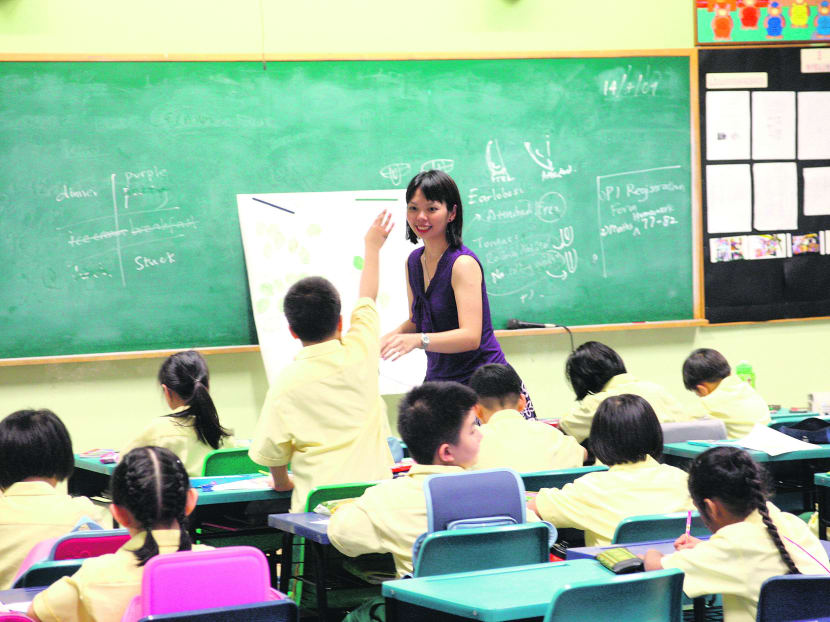
2018 will likely see further policy announcements that send strong signals about the expansion of pathways and greater inclusivity, says the author. TODAY file photo

2017 will be remembered as the year the Singapore government made a greater push towards inclusivity in schools, with the Ministry of Education further consolidating earlier policies to expand education pathways for students of different abilities.
Several key reforms include changes to the admission exercises in secondary school, polytechnics and Institute of Technical Education (ITE), the expansion of subject-based banding in secondary schools, and the amendment of compulsory education legislation to provide for special needs students.
The year also saw the launch of the SkillsFuture series in local institutions of higher learning, in line with the broader SkillsFuture movement, as well as the widening of the Ministry’s role in preschool provision.
Several of these reforms recognised the importance of admissions systems as a key means of signalling changes in official thinking and priorities to parents, students and the general public. For instance, admission criteria send messages about the relative importance of various subjects as well as academic and non-academic attributes.
A few years earlier, in 2014, the Ministry had amended the Primary One admission exercise to allow for a minimum of 40 places in every primary school for students whose parents had no prior connections with the school in question.
This year, it chose to reserve 20 per cent of places in secondary schools with affiliated primary schools for students from non-affiliated primary schools. This change, which will begin in the academic year 2019, predictably drew a mixed response. On the one hand, some parents welcomed the move as providing greater mobility and opportunities in order to prevent these secondary schools from becoming, as Prime Minister Lee Hsien Loong put it in 2013, ‘closed circles.’
On the other hand, other parents worried that their children might not be able to enjoy that desired continuity of experience from primary to secondary school.
In addition to this change, the secondary school Direct School Admission exercise, which has been in place since 2004, was revised.
From next year, the exercise will be extended to all secondary schools, which will be allowed to reserve up to 20 per cent of their Secondary One places for students with non-academic talents.
In addition, schools will not be allowed to use ‘general academic ability’ as an admission criterion. At the post-secondary level, the Ministry announced increases in the percentages of aptitude-based admissions at the polytechnics and ITE level.
These changes in admission systems will further decrease the stranglehold of academic performance on students’ access to various education pathways and help broaden the definition of merit beyond academic performance alone.
Yet another move in the direction of expanding pathways and opportunities for students came when the Ministry announced that all secondary schools offering the Normal (Academic) or Normal (Technical) courses would implement subject-based banding beginning in 2018.
Students in these two streams will now be able to take subjects at a higher level starting from Secondary One if they have performed well in those subjects in the Primary School Leaving Examination.
This would build on the earlier policy of allowing upper secondary Normal (Academic) students to offer subjects at the Ordinary Level examination at the end of four years of secondary schooling. Both of these policies are attempting to blur the earlier rigidity of secondary school streaming and to provide greater flexibility and mobility for students.
A fourth, and long overdue, announcement was the expansion of current compulsory education legislation to encompass special needs students from the year 2019 onwards.
At the same time, the Ministry indicated that full-time students in the polytechnics and Institute of Technical Education with severe physical or sensory impairments would be eligible for a new High-Needs subsidy as part of the Special Educational Needs fund.
This fund was established in 2014 to allow such students to access post-secondary education. Both of these policies indicate further progress in the direction of greater inclusion of special needs students.
Further expansion of pathways was evident in the Ministry’s launch of the SkillsFuture series in local Institutions of Higher Learning. The universities, polytechnics and the ITE will increase the number of short courses in order to support working adults in their quest for lifelong learning.
The Ministry will also review its funding of Masters coursework programmes at the six autonomous universities. These moves provide further consolidation of the three-year-old SkillsFuture initiative.
Finally, the Education Ministry acknowledged the importance of the preschool years in providing all students a firm foundation for primary school. It decided to expand on its pilot group of kindergartens, which were introduced in 2014, and increase the number of such kindergartens to 50 by the year 2023 in order to enrol about 20 per cent of children in the relevant age groups.
All of these kindergartens will be located within existing primary schools. Additional strengthening of the preschool sector was announced with the establishment of a National Institute of Early Childhood Development. The advent of these Ministry-run kindergartens will also lead to changes in the Primary One admission exercise next year.
The Ministry will include students in these kindergartens within the Phase 2A2 stage of the Primary One registration exercise.
The year 2018 will likely see further policy announcements that send strong signals about the expansion of pathways and greater inclusivity.
While undertaking the ongoing task of providing all students greater flexibility and mobility in their educational journeys, the Ministry of Education will continue in its quest to maintain the meritocratic ethos of the schooling system.
Disturbing trends have surfaced in the past decade of the intrusion of ‘parentocratic’ tendencies as some parents attempt to marshal their financial resources and social networks to provide their children that crucial edge in attaining educational success.
These parents are better placed than others to grasp the impact of policy changes and to prepare their children accordingly. Although it is unlikely that the highly competitive nature of schooling in Singapore will change anytime soon, it will still remain vital for the Ministry to minimise the significance of a student’s family background to his or her education and to further level the playing field.
A major area that needs further attention is the efforts of all schools, as well as the Ministry of Education, to educate parents on the numerous ways in which the education landscape has evolved since these parents were themselves students. For instance, there is now a greater diversity of secondary schools providing different curricular emphases and learning experiences.
Such knowledge would then serve as a baseline for parents to make informed choices about educational pathways. In the absence of such choices, many students will continue to fall short of realising their full potential in academic and non-academic areas.
Next, schools will have to intensify efforts to make the difference for students whose home backgrounds do not necessarily allow for their talents to be uncovered and nurtured.
In 2013, PM Lee highlighted the excessive focus on examination performance rather than on learning as a critical area of concern.
Accordingly, the Education Ministry has in the past few years attempted to stress the importance of skills rather than academic qualifications alone.
Therefore, another key priority in 2018 should be further examination of how the high-stakes national examinations exert a powerful backwash effect on classroom teaching and learning, and what changes are necessary in order to increase the intrinsic joys of learning for personal development.
At the same time, parents’, students’ and educators’ conceptions of the relationship between schooling and employment need to be broadened.
As the threat of technological disruption looms large over Singapore, traditional attitudes and beliefs are in urgent need of change. Well-entrenched ways of schooling our students may have served us well over the past five decades but need detailed analysis, even if at times the process proves painful and unwieldy.
ABOUT THE AUTHOR:
Jason Tan Eng Thye is an associate professor of policy and leadership studies at the National Institute of Education.
Stay in the know. Anytime. Anywhere.

Subscribe to our newsletter for the top features, insights and must reads delivered straight to your inbox.
By clicking subscribe, I agree for my personal data to be used to send me TODAY newsletters, promotional offers and for research and analysis.






