
Vice-principals who make a difference
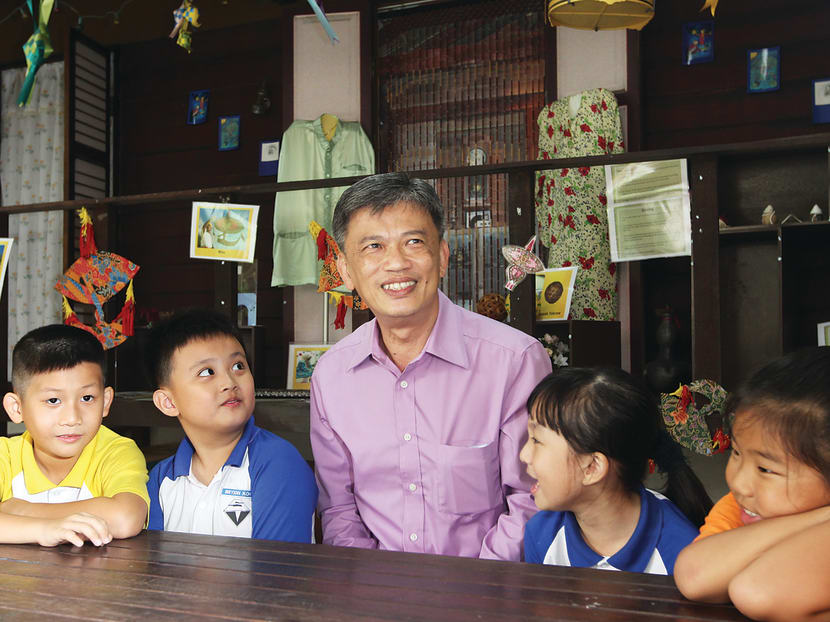
VP (Admin) for South View Primary School Arthur Sow with students from the school. Photo by OOI BOON KEONG
SINGAPORE — A 24-year career in the air force has prepared Mr Arthur Sow well, be it in terms of managing a team of staff or reacting to last-minute contingencies.
But when the former IT and communication specialist in the military made a career switch to the education sector three years ago, it was the long list of acronyms used by the Ministry of Education (MOE) that Mr Sow, 50, found himself having to overcome.
Referring to common terms used among educators such as TLLM (Teach Less Learn More) and PESTA (Physical Education and Sports Teacher Academy), Mr Sow — who is currently the Vice-Principal (Admin) at South View Primary School — said: “I had to quickly get used to and remember all the acronyms as they were frequently used during conversations among the teachers.”
Mr Sow is among a growing number of Vice-Principals (Admin) which have been recruited since the non-teaching position was created in 2005 to relieve the administrative workload of educators.
TODAY understands that there are currently less than a hundred of them.
Their job scope includes leading the relevant staff on administrative and human resource matters, as well as overseeing school operations in areas such as finance and security. “The matching of each VP (Admin) to a school is based on the specific needs of the school, as well as the skills and competencies of the VP (Admin) candidate,” an MOE spokesperson said in response to TODAY’s queries.
She added: “Some recruited VPs (Admin) have had prior work experience in the private sector as general managers or directors, while others were ex-Singapore Armed Forces officers or executive and administrative staff from the MOE who have risen through the ranks.”
Mr Sow retired from the military in 2008. About six months into his retirement, he felt the urge to be meaningfully occupied again. With three school-going children then, there was also a need to supplement the household income, he said.
Through a newspaper recruitment advertisement, he applied for the opening of VP (Admin) — as the job requirements matched his expertise in planning and operations. He took about three to six months to settle into his new role, he said: “I saw it at as a challenge for myself, working with teachers who had 20 to 30 years of experience. I wondered if I was going to be able to gain their acceptance.”
Compared to his last drawn pay, the salary he would get as VP (Admin) was about 25 to 30 per cent lower.
Nevertheless, he relished the chance to directly impact a student’s life. He recalled an instance when, together with his colleagues, they secured boarding and food for two needy homeless children.
“I could see the tangible outcomes in this role and coming to school to see the children smile just keeps me going each day,” he added.
The difference a VP (Admin) can make to a child’s life — even though it is a non-teaching position — was also what motivated a career switch for Mr Samuell Ang.
Mr Ang, who is a VP (Admin) at Temasek Junior College, had worked for 25 years in the private sector, including in regional senior management roles in listed companies such as Cerebos. His elder brother’s death four years ago had prompted him to “relook priorities”, he said.
“Instead of chasing after profits, I wanted to do something different in the second leg of my life,” said Mr Ang, who is in his early 50s.
He said that his skills in organisation and planning, which he had acquired in the private sector, put him in good stead when organising school events and driving its corporate branding, which are part of his current job responsibilities.
“I hope that I will be able to create a conducive school environment for the youths, to raise trailblazers with a heart,” he said.
Stay in the know. Anytime. Anywhere.

Subscribe to our newsletter for the top features, insights and must reads delivered straight to your inbox.
By clicking subscribe, I agree for my personal data to be used to send me TODAY newsletters, promotional offers and for research and analysis.






