
Heartache shapes a doctor’s heart
He came home to find his mother collapsed on the floor, surrounded by a medical team. She had suffered a heart attack and stopped breathing.
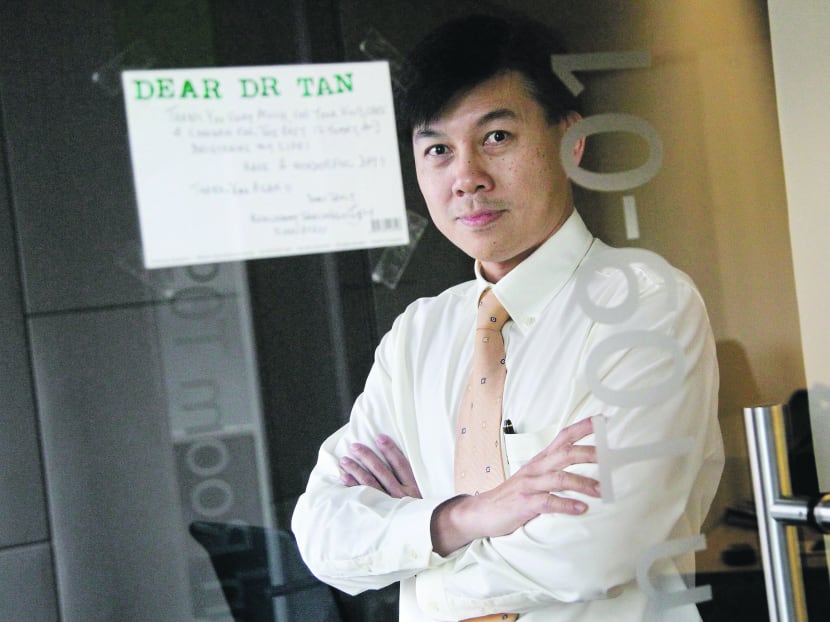
Cardiologist Prof Tan Huay Cheem of NUH. Photo by Don Wong, 20 Feb 2013.
He came home to find his mother collapsed on the floor, surrounded by a medical team. She had suffered a heart attack and stopped breathing.
Refusing to accept that she was dead, Tan Huay Cheem, then a 26-year-old army doctor, insisted on trying to resuscitate her throughout even the ambulance ride to Tan Tock Seng Hospital (TTSH).
“Imagine doing CPR on your own mother … that journey to TTSH was the longest I’d ever made in my life although it was only about 15 minutes,” he said.
“I dared not stop because if you stop, that’s the end ... She was only 55, she hadn’t had a chance to experience the fruits of her labour.”
Now 50, the cardiac specialist can in retrospect recognise the signs of a possible heart attack in his mother all those years ago — the tightness of throat and toothaches which the family had attributed to a dental problem.
At the time, he was a top student in obstetrics and all set to become an obstetrician and gynaecologist. Her unexpected death changed the course of his life.
“I figured … if I can’t save my own mother, surely one day I can save other people. I decided then to do cardiology — specifically, I want to be an interventional cardiologist.” In simple terms, an interventional cardiologist is a “high-class plumber” — “we unchoke blocked arteries,” explained Associate Professor Tan, now the Director of the National University Heart Centre, Singapore (NUHCS) and a Senior Consultant Cardiologist.
95% CHANCE OF LIVING
It was a long training process, which involved a stint in general cardiology before entering Duke University in North Carolina to specialise in interventional methods.
Returning to Singapore, he started the primary Percutaneous Coronary Intervention (PCI) programme at NUHCS in 1997, where emergency heart attack patients are given an immediate angioplasty (a balloon inserted into a blocked artery to allow blood flow) instead of just medication.
This is a literal life-saver — the shorter the time elapsed between a patient entering the A&E and getting a balloon into his artery, the better his chances. The quickest door-to-balloon time at NUHCS was 57 minutes in 2010, compared to the international benchmark of 90 minutes.
Every year, about 450 patients are treated under this service, and the overall mortality rate is “exceedingly low” at 5 per cent, said Assoc Prof Tan. “So if, say, you had a heart attack and you come to this hospital, 95 per cent of the time you’ll walk out alive.”
Ten years ago, he was appointed Director of the NUHCS, which was a milestone opportunity for him.
“You get presented with the responsibility to change the way in which a public service is organised. And you hope you create better, more affordable, accessible care for Singaporeans,” said Assoc Prof Tan, who has introduced a Cardiovascular Research Institute and mentorship schemes, among other things.
STAYING IN THE PUBLIC SECTOR
These days his expertise is in high demand here and abroad; he is a visiting professor at several universities in China and travels at least once a fortnight giving talks and lectures around the world.
But despite the demands of being an administrator and a teacher, he has never forgotten why he became a cardiologist — to stand between life and death for his patients, “for as long as I remain useful”.
One of his patients, for instance, tells of how he called Assoc Prof Tan when he had mild pains. The doctor, who was then in China, immediately put him in touch with an NUHCS colleague and insisted he get checked up at once. Don’t ever take it lightly, he warned the patient.
Assoc Prof Tan cited a Korean patient who, eight years after nearly dying of a heart attack, still flies in every six months for tests and medicine, “just to maintain our relationship. It’s incredible”.
He also continues to supervise operations and personally takes on an operation two mornings a week — the more complicated, the better. “When you hone your skills, you become a better operator over time,” he said.
Being able to take on complex cases is one reason why he remains in public healthcare service. “You do a lot of screening (in the private practice). The patients are not so sick. Most times, they just want to get a check-up, make sure they are healthy. But that’s not what I trained for,” he said.
While he admits that his position means seeing more private and “VIP” patients, he also purposefully makes time for Singaporeans from all walks of life. As one patient testifies, he treats both cleaners and dignitaries.
Assoc Prof Tan said: “By staying in a public institution, I am committed to public care. We must understand that 80 per cent of
Singaporeans still go to a public hospital when they require in-hospital care. A majority are subsidised patients.
“I cannot be personally looking after all, but what I can do is to create a team, to build a system where everyone will be looked after, including the subsidised.”
Stay in the know. Anytime. Anywhere.

Subscribe to our newsletter for the top features, insights and must reads delivered straight to your inbox.
By clicking subscribe, I agree for my personal data to be used to send me TODAY newsletters, promotional offers and for research and analysis.






