
Breathing life into a dying trade
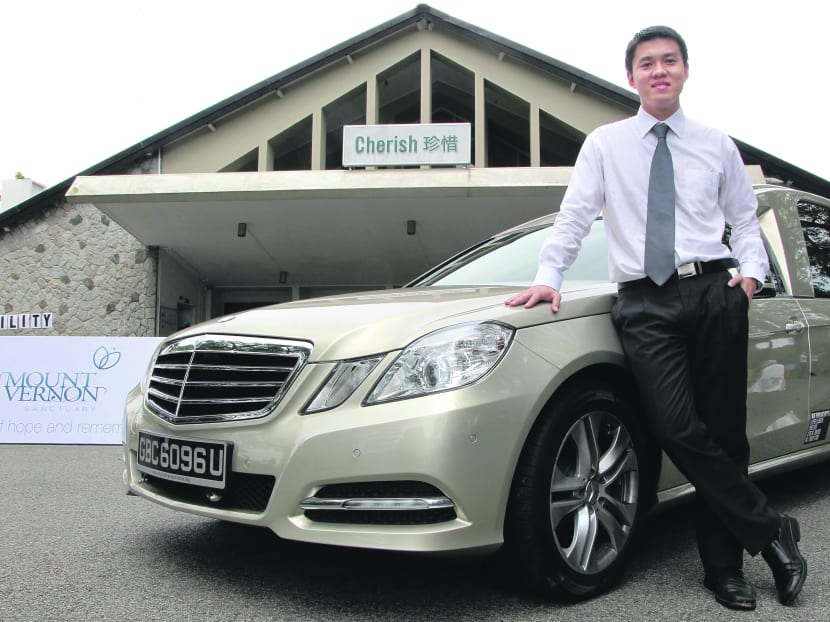
Mr Ang Ziqian, Director of Mount Vernon Sanctuary, with a modified Mercedes hearse. Photo: Don Wong
Upon hearing his father was in the funeral business, some of his schoolmates used to shy away in alarm.
“One had said: ‘My mother said I cannot talk to you or touch you, but we can still be friends’,” Mr Ang Ziqian recalls with a laugh.
His peers might have found the idea hard to grasp, but being around death was nothing unusual for the young Ziqian, whose great-grandfather started Ang Chin Moh Casket in 1902.
What is now one of Singapore’s largest funeral-related businesses began as a small shop in Chinatown, and grew to encompass 13 shops. “In the old days, the wooden coffins were so big that one shop could only hold up to six of them,” says Mr Ang, who at 31 is now Director of the company.
The family business which he presides over has expanded in ways the late patriarch would never have imagined: There is Ang Chin Moh Casket for Buddhist funerals, Ang Chin Ang Huat for Taoist funerals, Western Casket to serve Christians and Catholics, a repatriation service called Flying Home and the Mount Vernon Sanctuary. There is also a partnership with Algordanza, a service that turns cremated remains into memorial diamonds.
Recounting his first encounter with a corpse, Mr Ang says: “I started working as a funeral assistant when I was 13, on weekends and school holidays, to transport the deceased, wash and dress a body. The first time I handled a body, I felt heavy-hearted seeing the family grieve. I thought: ‘If I can do something to help them ease their sadness, it would be a good thing’.”
A SELFLESS DEDICATION
The idea of joining the family business was always on the mind of the eldest of three sons — although he did pursue other interests, such as taking up a diploma (because it looked “interesting”) in mechatronics engineering specialising in wafer fabrication at Nanyang Polytechnic.
He also had fleeting aspirations to continue in his army profession in the investigations branch; or be an air steward and travel the world. But ultimately, the desire to ease his father’s heavy workload proved strongest.
He speaks about his dad — a spry 60-something-year-old — with admiration. Though the business left him little time for the family, the elder Mr Ang’s unflinching dedication to the job made a deep impression on his eldest son.
“It was a tough life. I saw how selfless my father was, always putting the interests of others above his own. He would come home after midnight and leave home even before we went to school.”
In one rare instance when the family went to Sentosa together, Ang senior’s pager went off. It was work. “The whole family left. We didn’t even step into the attraction,” the son says. There is no resentment in the memory, just a matter-of-fact shrug. “For us, it was a way of life. We were brought up to place other family’s sadness above our happiness.”
Joining the family business was not only a way of continuing a tradition but also, he says, “a way to spend time with my father. It has been a way to make up for all the lost time”. Mr Ang, his wife, his younger brother Zisheng and his parents are all involved in different aspects of the business.
TAKING THE PLUNGE
He started officially as Director on Feb 5, 2004, just after completing his National Service. Recalling his initial plunge into the work, Mr Ang shakes his head and laughs quietly. Though he had learnt the ropes as a teenager, running the show was a whole new world to him.
“It was a tough time. I had to learn HR, accounts, logistics, a lot of other things,” he remarks.
Quitting never crossed his mind. “I had a responsibility to my staff and the industry. Already it is facing a lot of challenges and there are no young people joining the business.”
Still, “it was very physically and mentally tiring. It is a 24-7 job … and I had no days off, even during Chinese New Year.”
Each day started at 7am and ended at about 11pm, and his sleep was often interrupted by a pre-dawn call to make funeral arrangements. “In the first few months it felt like I never slept at all, it was worse than (being in the) army, worse than anything!” he laughs.
In addition to the business aspects, Mr Ang, who is fluent in Mandarin and English, also taught himself dialect, knowing how important it was to build rapport with his clients. “I would listen to the news in dialect on the radio and listen to the same news broadcast in Mandarin, and ‘match’ the Mandarin word to its dialect one!”
HELP THE LIVING SAY GOODBYE
The “biggest misconception” about the funeral trade is that it is about the dead, Mr Ang emphasises.
“Though we care for the body with compassion and dignity, our main role is in helping the living. Our job is to comfort, listen, help the family through the grieving process and give them the closure they need at a time of loss.”
Funerals after all, he philosophises, are a way for family members to say goodbye and draw comfort from friends and relatives. This rite of passage has evolved with the times, with more families now choosing not to follow archaic orthodox traditions or costly elaborate ceremonies.
Mr Ang has received requests for specific types or colours of flowers and, in one case, a special song. “One family requested that the brass band” — typically used in Chinese funerals to send off a loved one — “play a theme song from a Taiwanese drama because their ah ma loved the show and would sing along with it,” he says.
The band had never played it before and needed last-minute practice. But “when they played that song, everyone teared. They were very happy that ah ma could hear the song for the last time.” It is moments like this that underscore the meaning of his job.
BREATH OF NEW LIFE
Helping families grieve is just one facet of Mr Ang’s passion for the funeral business. Another is to bring greater innovation into an industry that, with an ageing workforce, dearth of new blood and difficulty in hiring technicians such as embalmers, is facing huge challenges.
“I’ve always been thinking about how to improve,” he says. “The aim is to change the image and the perception of funeral services, and to show what can be done.” His wife of seven years, Nicole Ang, chips in: “If people see there is potential in it, it does not look like a dying trade.”
It was this vision that led Mr Ang to bid for the Mount Vernon Columbarium when the grounds were put up for public tender in 2009. “I happened across the letter by chance and thought it was a great opportunity. Singapore has a shortage of quality funeral parlours. And I wanted to do something to enhance the services.”
The company invested some S$700,000 to renovate the dismal premises — which had dark, termite-infested buildings — into a lush and peaceful site. He spent an intense three months navigating regulatory requirements and working with contractors to create six light-filled, air-conditioned parlour spaces that can be used by all religions.
Other ideas have included offering biodegradable floating shell-shaped urns for sea burials; the creation of memorial diamonds; and most lately, a customised Mercedes E class hearse with ergonomic features.
All of these services, including the Mount Vernon Sanctuary, operate on an “open source” model — they are open to any other funeral business in Singapore to use. “The idea is to give people more choice so that they can relook their perception of funeral services,” he says.
PROFESSIONALISE THE TRADE
Mr Ang also set up the Ang Chin Mo Foundation, a non-profit organisation that aims to preserve the funeral services heritage; continue the business’ tradition of holding free funerals for the destitute; and drive educational partnerships to professionalise the industry.
“The main challenge is that very few people wish to join the industry, and there are no training programmes available for funeral services and no embalming academy to build skills either,” says Mrs Ang.
Mr Ang adds, the idea is to link up with educational institutes, such as ITEs, to offer training and internship programmes leading to professional industry certification for the funeral sector.
But in truth, he says, the skills — similar in many ways to event planning — are not hard to find: “We just need people who are compassionate.”
Stay in the know. Anytime. Anywhere.

Subscribe to our newsletter for the top features, insights and must reads delivered straight to your inbox.
By clicking subscribe, I agree for my personal data to be used to send me TODAY newsletters, promotional offers and for research and analysis.






