
Man enough for the job
Being the only male nursing student among his peers did not bother Mr Yong Keng Kwang, now a nursing director at Tan Tock Seng Hospital (TTSH). Rather, it was coming to grips with the “art” side of nursing — showing patients care, concern and the human touch — that proved a steep learning curve for the former triple-science student.
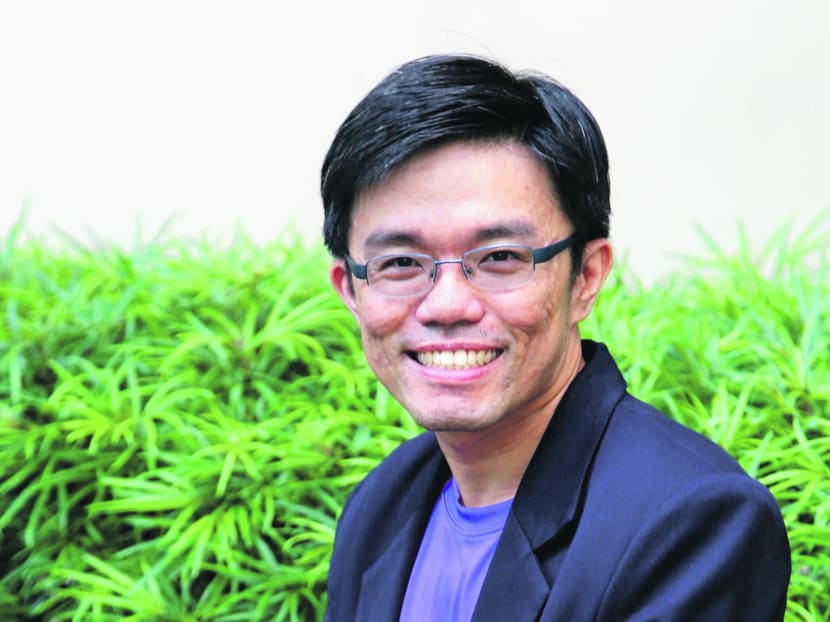
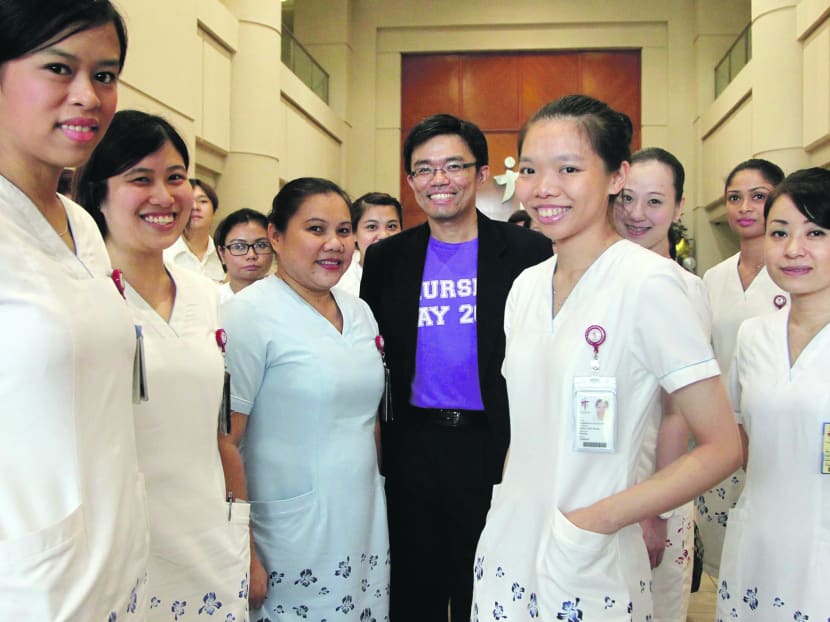
Being the only male nursing student among his peers did not bother Mr Yong Keng Kwang, now a nursing director at Tan Tock Seng Hospital (TTSH). Rather, it was coming to grips with the “art” side of nursing — showing patients care, concern and the human touch — that proved a steep learning curve for the former triple-science student.
Mr Yong, 41, the youngest in a family of three boys, said: “It was not easy because, in all my early days, my mum took good care of us … I didn’t have to worry about caring for others.”
An alumni of River Valley High School and Hwa Chong Junior College, he had “sailed through” the science modules in his nursing course at the University of Manchester in the United Kingdom. As he put it, however: “In nursing, we call it the science and the art — the science part I’d no problem with, the ‘art’ part, I really looked up to my peers.”
He was rather clueless about nursing when he first took it up — notwithstanding school days spent learning first-aid skills with the St John Ambulance Brigade. The Public Service Commission scholar had initially gunned for a career in physiotherapy. But during the scholarship interview, he was told that there were plans to develop people for this sector, and so he opted for a nursing degree.
When he relayed his decision to his parents, “they sort of cringed”, he said. “My dad was, ‘nursing huh? You really want to do that? I thought it was only for women’.”
Still, they did not object. So, armed with his family’s blessings, Mr Yong set out to learn the human art of nursing from scratch.
DOUBTS AND PAINFUL MEMORIES
Mr Yong quickly felt inferior to his all-female classmates in the nursing course at Manchester.
“I saw how passionate they were and how they had chosen nursing out of commitment and dedication,” he said. For himself, taking up nursing had been more a case of “why not”.
Mr Yong conceded that he had doubts about his chosen path in his first year. It was tough, adjusting to a new environment and trying to pick up a British accent so his patients could understand him.
In time, though, he learnt to be more sensitive to their needs. He heard his patients out before formulating care plans and helped their families cope with difficult times. By his final year, when he had to serve a stint in community nursing, making frequent home visits and getting to know his patients, he said: “I was convinced that nursing was for me … I could make a difference to lives.”
Another pivotal point for him came when he returned to work in TTSH over the Chinese New Year period in 1997.
A young man with tattoos was admitted for appendicitis. Attending to him, Mr Yong had to fight off painful memories of being beaten up by a gangster in primary school (a schoolmate he had reported for truancy and who got expelled as a result).
“The only thing wrong with (the patient) was my own labelling that he was a gangster … I had to restrain my fears and treat him with a lot of respect,” he said. The grateful patient, who turned out to be a genial individual, presented him with a hongbao which he had to decline on principle.
“Nursing taught me a few principles — you learn not be judgmental,” he added.
“You learn to look at people as individuals in healthcare … you have to let go of stereotyping mindsets.”
CHANGING MINDSETS ABOUT WHAT NURSES CAN DO
Shifting mindsets is one of his missions now as a nursing leader. After two years of clinical duties, he took on an administrative role so as to “have a wider circle of influence, crafting out policies and correcting system deficiencies”.
One project he took on was to convince nurses to take on tasks that they were in reality well trained for, but were still typically done by doctors.
When the hospital wanted to get two nurses to oversee the process of administering blood to a patient instead of having to schedule a doctor each time, the nurses feared this would increase their workload and worried about safety. It took much persuasion to get their agreement.
Mr Yong was also part of the pioneering team for TTSH’s S$36-million ward redesign last year, which gave nurses a direct line of sight to their patients instead of having only one central station for nurses in each ward.
This meant that not only can nurses see their patients better and respond faster, their direct care of patients has also gone up to 18 per cent of a nurse’s time on a shift, from 10 per cent before the renovation. The eventual target is 50 per cent.
Having his hands full did not stop this nursing director from completing a Master’s in Business Administration by distance learning in 2001. He has his sights set on expanding the role of nurses, encouraging them to go into research and grooming them to become co-leaders alongside doctors.
But after the end of each work day, the father of three children, aged between six and 12, aims to have dinner with them or at least talk to them before their bedtime. Mr Yong bashfully admitted that he has not been very successful so far — though he does strive to keep his weekends work-free.
He and his wife, a physiotherapist, hope that their children will join the healthcare sector and to nudge them along, he takes them to public hospital events to soak up the environment. “We are keeping options open. But we’ll need people in healthcare in the future,” he added with a smile.
Stay in the know. Anytime. Anywhere.

Subscribe to our newsletter for the top features, insights and must reads delivered straight to your inbox.
By clicking subscribe, I agree for my personal data to be used to send me TODAY newsletters, promotional offers and for research and analysis.






