
Staying relevant in a digital age
Like many working parents here, the time spent in the car taking the kids to school is precious bonding time for Mr Shaun Seow and his two teenage boys.

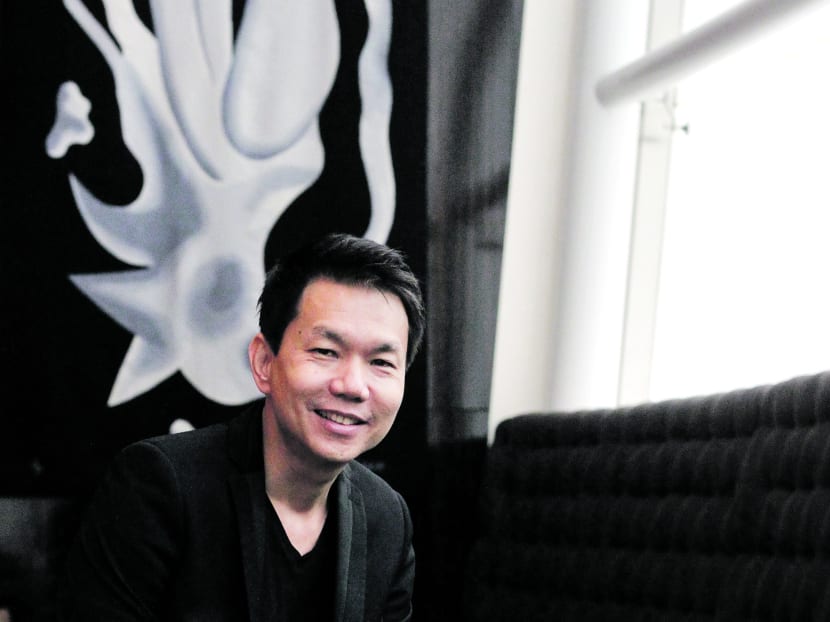


Like many working parents here, the time spent in the car taking the kids to school is precious bonding time for Mr Shaun Seow and his two teenage boys.
But the fact that he runs a media company also means that this short “quality time” every weekday morning has been a window into not only his sons’ world, but also the world of digital natives — for whom television is not only a box in the living room that beams images, and flipping through newspapers need not leave ink stains on the fingers.
“One of the ways that I’ve benefited from having two teenage ‘samples’ at home … they help me to keep in touch with a generation,” the Chief Executive Officer of MediaCorp says.
And their influence on Dad is apparent. He follows on Twitter personalities such as Rihanna, Alicia Keys, and Michael Kors, as well as bands like Coldplay, “to study how they use social media to strengthen their brand”.
“Don’t laugh; it’s not an excuse,” he says. “As a company with many touchpoints, MediaCorp must use social media well in order to create customer and audience stickiness. This way, we continue to be relevant.”
For the record, his favourite mobile apps, Twitter accounts and sites from which he gets updates throughout the day include serious news sites such as The New York Times, The Huffington Post and BBC, as well as his company’s offerings such as TODAY and Channel NewsAsia, of course.
“My Flipboard is an eclectic mix — the usual political, business and tech news alongside style, music and travel,” he adds. “All those so-called ‘fun bits’ are work too, seeing how they’re content that MediaCorp is into.”
WHAT THE CUSTOMER WANTS
This month marks the second year since Mr Seow took over the helm of MediaCorp, and his desire to understand what makes today’s audience tick and create a genuine bond between consumers and the company’s array of entertainment and products is made abundantly clear, over the course of our lunch interview at The St Regis Singapore.
“We must find a way to understand, to establish a one-to-one relationship with the customer. The more I know about our customers individually, the better I’m able to serve them, the better I’m able to get them to make my product better.”
This is where the company’s loyalty programme, MEclub, comes in. He says, “If I know that Mr Tan from Ang Mo Kio reads our TODAY paper and watches an entertainment show on Channel 8, from there I’m beginning to build a profile of Mr Tan… are there any other services and products that might interest him?”
A loyalty programme run by the United Kingdom’s Channel 4 was the inspiration behind MEclub, which has more than 300,000 members to date. In exchange for goodies such as backstage passes, concert tickets, luncheons with television celebrities, MEclub members provide feedback on MediaCorp’s products, information about themselves or take part in surveys.
As part of its customer engagement efforts, the company has also set up new initiatives to crowd-source ideas for TV shows and let consumers choose the ending for drama serials.
NEWS, SPAGHETTI AND DIM SUM
While the entertainment business for most media companies is more lucrative – as it draws more eyeballs – the news product is the standard bearer, Mr Seow says.
“I’ve been told, when I joined the television industry, that the news programme of any TV channel you watch is a litmus test of how good the TV station is,” he says. “It’s like how you go into an Italian restaurant, you order spaghetti bolognese to see how good the Italian chef is. Or how you go to a dim sum restaurant and order har gow (shrimp dumpling).
“It represents how good you are as a media company. If you are a media company serious about its brand, you’ve got to get the news product right. It’s really the mark of excellence.”
Mr Seow, who was instrumental in building up the company’s stable of news offerings, is glad that over the years, these have gotten much better. He notes that TODAY, which was started in November 2000 and has grown to become the second most read newspaper here, is “making impact from the editorial point of view”.
Citing 938Live and Channel NewsAsia, he points out that MediaCorp is one of “the few media companies with entertainment assets as well as a news channel, a newspaper and news radio”.
“We are quite unique in this space, in the world even. The challenge for us is to get it even better, to become world-class, where people will look at us as the arbiter of what’s relevant, accurate and contextual. News and information you need out of Singapore and Asia.”
STAYING TIMELY, RELEVANT
That challenge has been made more daunting by the digital revolution. “There is a huge disintermediation going on… news makers can reach their audiences directly, for example via tweets or blogs, and publishers are popping up on the web as distribution costs, a major entry barrier in the past, are now lower,” he says. “Anyone can shoot a video on his phone, and post it as a citizen journalism piece or on an Internet TV channel.”
So where does that leave the mainstream media? The answer lies in embracing the new environment while holding on to the time-tested values of good journalism, he says.
“We’ve got to do better on speed, not to claim being ‘first’, but to continue staying relevant. Here, I see our newsrooms cooperating with and co-opting social media to stay relevant,” he says. “In addition, our news must always stay true to two hallowed principles -- being accurate and contextual. There’s really far too much information out there, and a timely, accurate and contextual news provider becomes even more desired.”
SHIFTING SANDS OF MEDIA
Over the years, MediaCorp has undergone a few corporate restructuring and name changes: From Singapore Broadcast Corporation to Singapore International Media and finally, to its present incarnation.
For Mr Seow, who has been with the company for 19 years, his career development has intertwined with the company’s growth and the changing media landscape -- or the shifting sands of media, as he likes to call it.
He first joined MediaCorp to head its television financial news desk. He was then heavily involved in the setting up of Channel NewsAsia in 1999 to feed a growing appetite for Asian news round the clock. He ran the news and current affairs production for the news channel – what he calls the “factory” in a television network, as opposed to the “shopfront” of programming and promotion.
“The task then was how to produce, from just one news belt a night on English, Chinese, Malay and Tamil channels, to a full channel,” he recalls.
In mid-2000, he took on the position of Deputy CEO – an appointment he held until July 2011 – in which he oversaw radio and print journalism as well as magazine publishing. “I started experimenting with brand names across platforms, which is that if you are a good print reporter, a brand-name writer, your output should not be just seen in print. If you can come on and comment on trends on Channel NewsAsia, we call on you… Of course today, we see people consuming brands regardless of platforms.”
About five years ago, he started the interactive media division. One of the first outcomes of that effort was XinMSN, an “immensely successful” collaboration between MediaCorp and Microsoft that allows the audience to, among other things, catch up on video content online.
“Those were some of the things that, as I progressed in the company, also mirrors the development of the landscape. Sometimes we lag, sometimes we lead, so it’s been a mixed bag.”
GOING BEYOND BROADCAST
The most fundamental transformation that he has witnessed was how the company moved “beyond broadcast – specifically public sector broadcast”.
“Today, MediaCorp still carries public service obligations -- and we do take them seriously. But it has gone beyond that, to embrace a much wider remit of engaging, entertaining and enriching audiences through a gamut of media -- besides TV and radio, we now have a clutch of magazines, a newspaper, many digital assets, an events arm and investments in e-tailer Reebonz and Cubinet, a games publisher.”
The two recent investments he mentioned created some buzz when news broke. How do they fit into the company’s strategy?
Mr Seow reveals that while MediaCorp had previously been eyeing investment stakes in traditional media companies, it is now looking out for up-and-coming digital media firms whose products transcend geographical boundaries. “There has been a bit of rethink as to what really works for us,” he says.
Under the direction of the board chaired by Teo Ming Kian, who is very at home in the venture capital space, MediaCorp is “quite clear that any acquisition we undertake, has to be relevant to the core business that we are in”. There must be benefits that accrue back to the company and “make a difference”, Mr Seow adds. “It’s not buying a company for the sake of growing the top line. We’ve got to be very clear that there are synergies to be forged.”
With fashion underpinning many parts of MediaCorp’s business – be it its fashion magazines, television shows or “style icons” in the form of its stable of celebrities – the investment in Reebonz, an online luxury retailer, could seed novel forms of collaboration in content. It will also help the Singapore-based e-tailer “stand out in the crowd” as it now boasts greater access to the media mix, Mr Seow says.
Similarly, the investment in Malaysia-based Cubinet will help MediaCorp enhance its offerings while broadening the seven-year-old start-up’s reach. “For example, our drama series may spawn characters which resonate, so why not – the question again is why not – get an online comic version out to engage our audiences better? If an online game is successful… why can’t it become video content on our media channels?”
BREAKING DOWN WALLS
Now, in the hotseat, he wants to break new frontiers – and the company’s upcoming new campus at Mediapolis@one-north, which will be ready in the second half of 2015, will embody the “new MediaCorp”.
“The new campus will help us once and for all break away from the silos of how we’ve operated in the past -- as distinct units overseeing television, or radio, or magazines... ,” he declares. This will enable the company to build on the staff’s strengths, even as it reinvents itself, he adds.
The building, which comprises three basement levels and 12 levels above ground, offers a collaborative physical environment. There are few walls literally between the various departments and open spaces abound. “You can see from one corner to the other. You can walk from one corporate level to another, so you don’t take the lift all the time,” he says.
The idea is to create some serendipity. “A lot of rest areas all over so that there could be the accidental meeting of colleagues and then, sparks can fly ... maybe not in a romantic way, but sparks fly on a concept or a way of doing things,” he quips.
The concept of seeing what one another is doing extends beyond the physical layout. A server-based media management system will allow employees to have access to work in progress. For example, a video can be made available for all 2,600 employees to critique. “Virtual communities of producers providing feedback,” Mr Seow says.
The new campus will also encourage collaboration with external parties who can walk in, discuss ideas and even work in the building. This will dovetail with its recently launched Mediapreneur scheme, which includes an incubator programme where MediaCorp will nurture start ups in technologies relevant to the company by providing mentorship, co-working space and seed funding.
For the general public, daily tours will be also be organised to “demystify what we do”, Mr Seow says. Members of the public could also be invited into the theatres to give feedback on pilot shows.
THE CONSUMPTION REVOLUTION
The change in people’s media consumption habits – driven by the digital revolution and the modern lifestyle - requires media companies to rethink its structures and the way it operates.
“(Viewers) are not tied to a home screen anymore. Technology enables you to bring your content anywhere in the world and to receive content from anywhere around the world. With a VPN line direct to a server in the US, you can actually watch what the Americans are watching,” he says.
“The modern lifestyle of the urban population… is driving a new set of behaviour too. People consuming content in bits and bites, not the entire content at one time but in several instalments over the course of the day or a few days.”
Ultimately, content is still king. “Your content had better stand out from the rest of the world or what’s available out there. It’s got to be relevant. It’s got to be resonating with your target audience,” he says. “If your content is no good, no matter what we do, from a strategy or technology point of view, no one will want to consume our content.”
The revolution is well and truly underway. And the pace of change can only quicken, he points out. “With better connectivity, with more advanced devices that come (onstream), the price points of these devices coming down, it’s just going to accelerate in a big way,” he says. “It flattens the world which can be a scary proposition for most media companies. Because you are fighting not in any space, territory or market anymore… you are fighting worldwide.”
Nevertheless, the upside is the potential reach of quality content. “If (content is) good, it should be able to find ready audiences outside (Singapore). It cuts both ways,” he adds.
To that end, the company is, for instance, also investing more in production and rebuilding capability for local entertainment content such as drama serials and variety shows.
REINVENTING A CULTURE
Mr Seow’s vision for the new MediaCorp encompasses a business approach of harnessing creativity, a questioning culture among its employees and a collaborative environment to produce content that consumers don’t access via one media platform alone.
For consumers, the end product will be a company “very much embedded in the lives of our audiences” and one with “touch points galore”. A company that “you really want to feel close to… that listens to your feedback”, Mr Seow says. A company that engages, entertains and enriches audiences.
For someone who lives life in the fast lane and gets by on six hours of sleep and a runner’s high – he pounds the treadmill Monday to Friday after sending his kids to school -- Mr Seow recognises the virtue of patience, a trait which he hones during the weekends, doing gardening around his house.
“It also takes time to reinvent culture when you have a 24/7 operation to go on,” he says. He’s heard someone likening the challenges of transformational leadership to “performing open heart surgery, where you’ve got to keep a patient alive and yet try to give him a new lease of life at the same time”. Laughing that off, Mr Seow said he’s glad MediaCorp has many strengths to draw on, with a dedicated team that “can do magic” once their potential is unleashed.
Stay in the know. Anytime. Anywhere.

Subscribe to our newsletter for the top features, insights and must reads delivered straight to your inbox.
By clicking subscribe, I agree for my personal data to be used to send me TODAY newsletters, promotional offers and for research and analysis.






