
Breaking foreign-local tension with Singapore Jokes
SINGAPORE — When Singaporean undergraduates Alvin Chia and Lisa Tan embarked on their student exchange programmes in China, they did not expect the culture shock that awaited them.

SINGAPORE — When Singaporean undergraduates Alvin Chia and Lisa Tan embarked on their student exchange programmes in China, they did not expect the culture shock that awaited them.
Stark differences were present everywhere — from the food they ate, to the volume of conversation and how the Chinese celebrated their festivals.
“In Beijing, I could buy red crackers off the street and everyone plays with them freely. My Chinese friend was so amused at how excited I was to set off my own firecrackers. To her, that was the norm. To me, it was a blast,” said Mr Chia, 25.
Recalling his initial discomfort when his Chinese landlady engaged in “shouting matches” over the phone, Mr Chia said he realised later that he had wrongly perceived her casual conversations as arguments.
After spending a semester in China, Mr Chia and Miss Tan felt they could better empathise with what it is like to live as a foreigner. Armed with their experiences, they then set out to “bridge the gap” between Chinese nationals and Singaporeans.
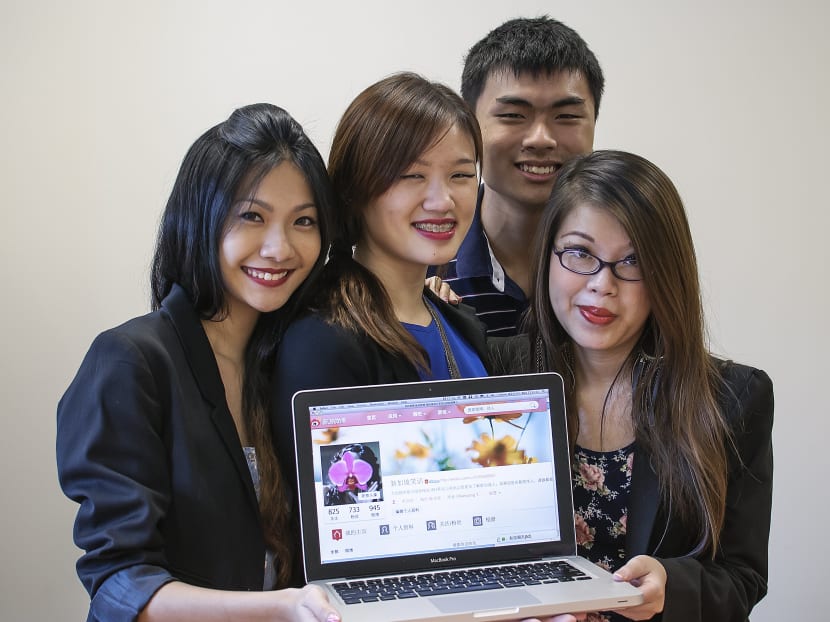
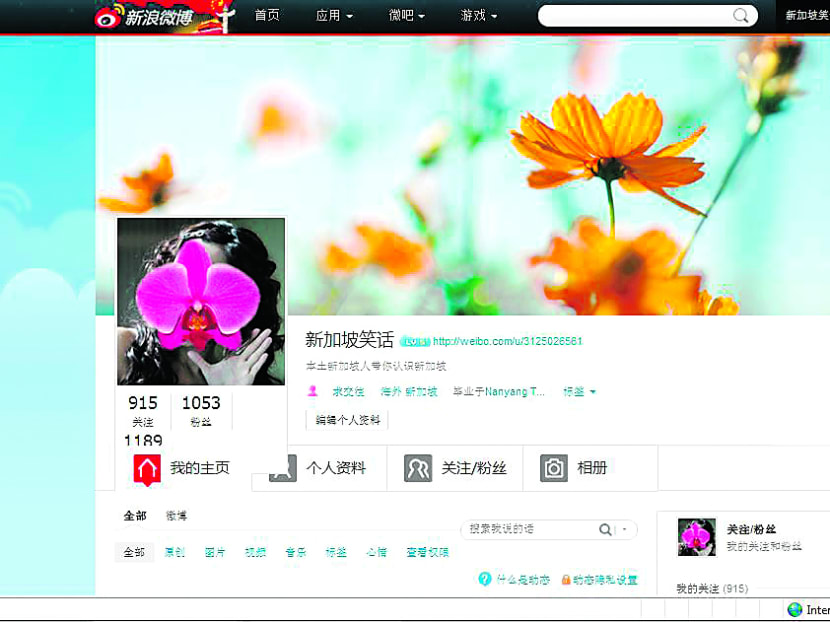
With fellow course-mates — Ms Jaslin Tan and Ms Keline Woo, both 23 — the four started a Weibo account, named Xin Jia Po Xiao Hua (Singapore Jokes), to post jokes, food recommendations, shopping deals and other snippets about living in Singapore.
This was part of their final-year project at the Nanyang Technological University’s Wee Kim Wee School of Communication and Information.
Launched in January, the account has garnered more than 1,000 followers, most of whom are Chinese tertiary students living in Singapore. Tapping on the predominantly Chinese Weibo platform has helped the team reach out to Chinese nationals in Singapore.
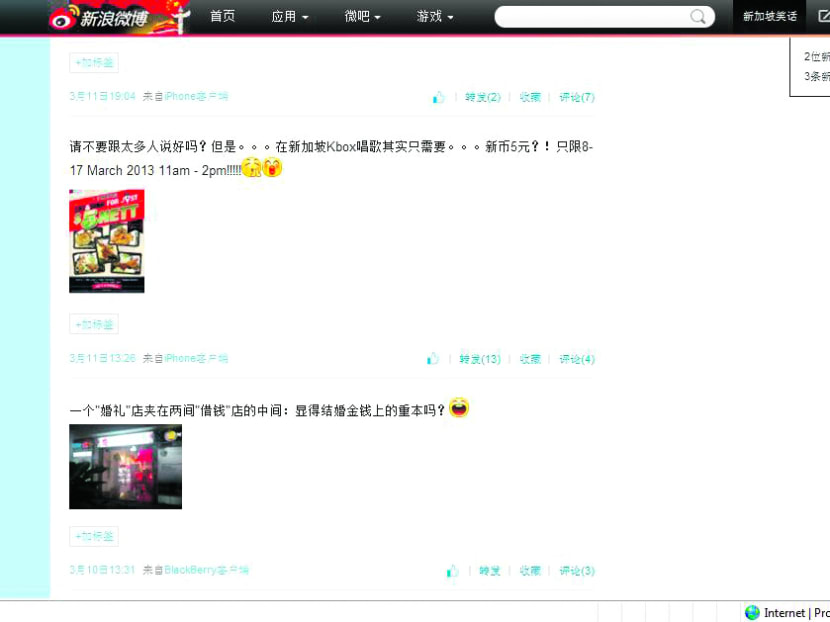
The account is updated about three times a day, with a wide range of content, with posts on entertainment news, local food and even daily Singlish lessons. For instance, a recent post noted that eating in Chinatown can be quite expensive, and recommended Chinatown Complex Food Centre as an option for affordable food at night.
Posts in Singlish are especially popular because the Chinese are eager to learn the lingua franca.
Mr Chia said: “Many followers said that they have understood our culture better now that they understand Singlish. For example, it will come in handy when ordering food in the kopitiam, or understanding what their Singaporean friends are talking about.”
To encourage greater understanding of the multi-cultural landscape in Singapore, some posts also feature interviews with Singaporeans of different races.
Hoping to “connect” to followers on a more “personal” level, the team makes it a point to respond to followers’ comments. Interaction is not limited to the virtual space — they have also met some followers to gather feedback and find out more about them.
Although initiated as a school project, the quartet plans to keep the Weibo account even after they graduate.
Mr Chia said this is a “timely” initiative. “The foreign-local tension is a deep-rooted issue (in Singapore), but our group wants to encourage the Chinese to see the beauty of Singapore and Singaporeans, and make them feel they are welcome here,” he said.
“Few Singaporeans take the initiative to reach out to their foreign friends and, as such, there is a segregation (between the) communities,” said Ms Lisa Tan, 23.
She added that the last three months have taught her more about Chinese culture.
“Stigmatisation only happens between strangers. When you know someone personally, you understand and learn his culture like how he learns and embraces yours.”
Stay in the know. Anytime. Anywhere.

Subscribe to our newsletter for the top features, insights and must reads delivered straight to your inbox.
By clicking subscribe, I agree for my personal data to be used to send me TODAY newsletters, promotional offers and for research and analysis.