
NYP students win prize for X-ray invention
SINGAPORE — Most patients get their chest X-rays done while they are standing up against the machine. The situation becomes tricky, however, when it involves wheelchair-bound patients, as two Nanyang Polytechnic (NYP) students observed during their hospital attachments.
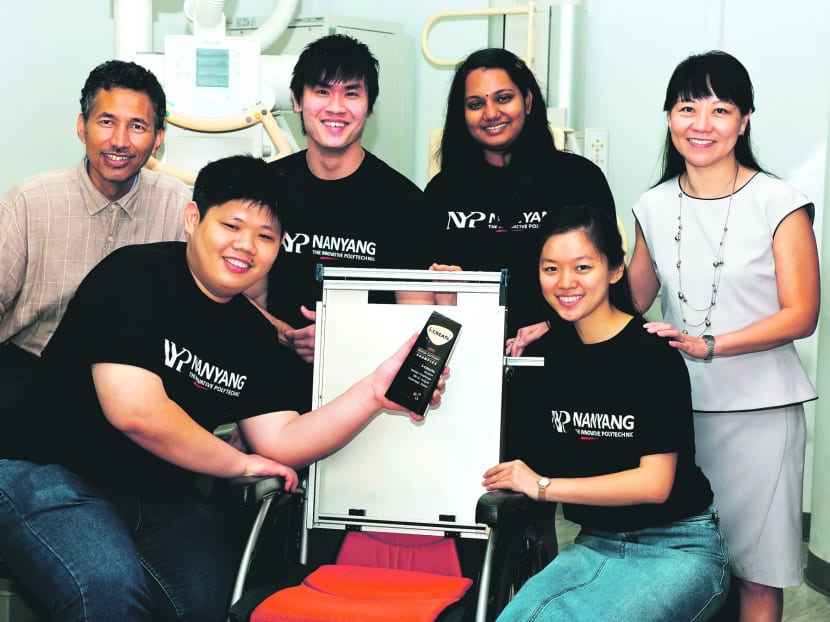
From left: NYP students Meng Xiong, Ren Jun, Kanageswari and Henrietta flanked by their lecturers Mr Kassim Bin Saat from the School of Engineering and Ms Tan Sai Geok from the School of Health Sciences. Photo: NYP
SINGAPORE — Most patients get their chest X-rays done while they are standing up against the machine. The situation becomes tricky, however, when it involves wheelchair-bound patients, as two Nanyang Polytechnic (NYP) students observed during their hospital attachments.
It inspired them to design a simple radiographic cassette holder that enables radiographers to capture better chest X-rays for wheelchair-bound patients — in half the time — with the help of a couple of engineering students. A cassette is a rectangular black board that receives the X-ray image.
Called X-RIGHT, the innovation won the top prize in a global student design competition recently. Its simplicity, as one of the judges commented, was one of the main reasons the students emerged champions from among 51 teams at the 7th International Convention on Rehabilitation Engineering & Assistive Technology (i-CREATe) held in South Korea.
The project is a collaboration between students from the NYP School of Health Sciences and School of Engineering. It is an improvement on a prototype, designed by the students’ seniors in 2011. The junior team made the X-RIGHT more stable and reduced the noise created when adjusting the cassette height.
“There is an increasing number of wheelchair-bound patients due to the ageing population, and these patients tend to be more critically ill, so it is important that the image is taken right for accurate diagnosis,” said Ms Henrietta Goh, 22, a radiology student at the NYP and one of the members on the team. The other three members are Mr Chua Ren Jun, 24; Mr Hui Meng Xiong, 21 (both engineering students); and Ms Kanageswari Muthukumar, 22.
Usually, to achieve an optimal X-ray image, the cassette has to be placed behind the patient’s back — perpendicular to the incoming X-ray beam. On a wheelchair, the cassette is easily tilted if a patient moves or is unable to sit completely straight, producing distorted images. Radiographers will then have to try again, wasting time and effort. For the patients, this will also mean higher-than-usual exposure to radiation. Hospital wheelchairs also have a gap between the seat and the back rest, meaning the cassette may fall through.
A makeshift solution has been to place a thick padded pillow between the patient and the backrest, securing the cassette in place and reducing the chance of tilting.
But such procedures are not foolproof, and pillows may carry infections that can spread to weaker patients.
With X-RIGHT, the cassette is slotted into a holder unit that can be fixed onto the wheelchair, preventing tilts and ensuring the cassette is perpendicular at all times. X-RIGHT also allows radiographers to adjust the cassette up and down to suit the height of the patient.
The result: 93 per cent of the 36 radiographers who participated in the prototype testing agreed that performing the sitting chest X-rays with X-RIGHT will improve current practices. X-ray screening time was also halved: From six minutes to three minutes, hastening the process and minimising radiation exposure for the patient.
“Ultimately, we hope to introduce this in hospitals to help radiographers reduce their workload,“ said Ms Muthukumar, who will graduate and become a certified radiographer herself in a year’s time.
“(The X-RIGHT) is lightweight and user-friendly. Without it, we need to use pillows, sponges or styrofoam boards to help keep the imaging plate in place when the chest X-ray is done on patients who are wheelchair-bound. With the X-RIGHT, the cassette can be held in place firmly and safely,” said Ms Sng Li Hoon, Senior Principal Radiographer at the Singapore General Hospital, who tested the prototype.
Though commercialisation is unlikely to happen by the time they graduate, the project will continue with their juniors, just as they inherited this from their seniors, the students said.
Stay in the know. Anytime. Anywhere.

Subscribe to our newsletter for the top features, insights and must reads delivered straight to your inbox.
By clicking subscribe, I agree for my personal data to be used to send me TODAY newsletters, promotional offers and for research and analysis.






