
China risks an economic art attack
LONDON — It was the sale of Pablo Picasso’s painting Les Femmes d’Alger that broke the record for the highest price paid for any artwork at auction — going, going, gone for $179.4 million (S$237.2 million) at Christie’s in New York on Monday. But we don’t as yet know who bought it.
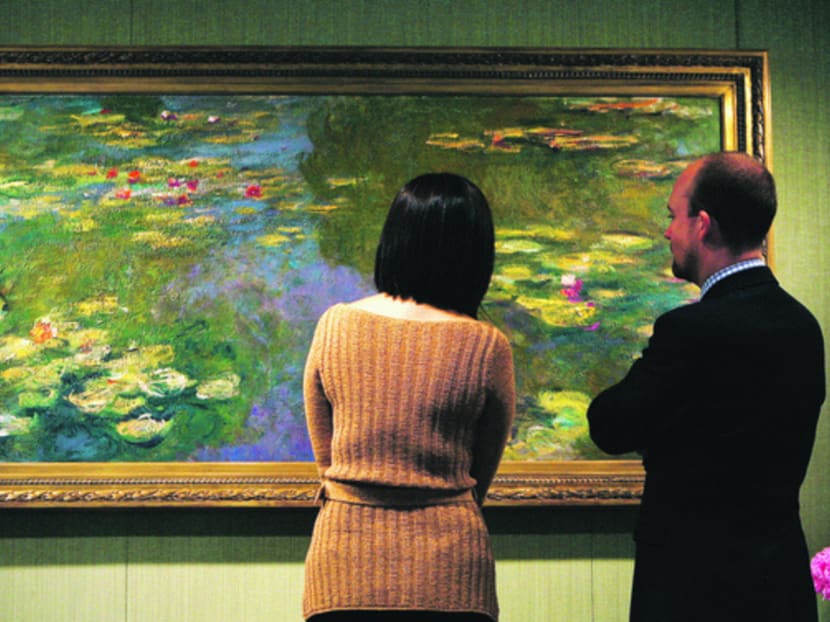
Auction house Christie’s employees examine Claude Monet’s water lily painting
Le Bassin aux Nympheas in New York. Photo: Reuters
LONDON — It was the sale of Pablo Picasso’s painting Les Femmes d’Alger that broke the record for the highest price paid for any artwork at auction — going, going, gone for $179.4 million (S$237.2 million) at Christie’s in New York on Monday. But we don’t as yet know who bought it.
The sale of Claude Monet’s Bassin aux Nympheas, Les Rosiers for $20.4 million by Sotheby’s on May 5 is more instructive. The auction house revealed it had been snapped up by Dalian Wanda Group, one of China’s biggest private property developers and the world’s largest operator of cinema chains.
This was not a one-off for the company, owned by one of China’s wealthiest men, Wang Jianlin. It has been buying up Impressionist and modern art for the past two years. Nor is it alone: Chinese collectors were responsible for around a fifth of all Christie’s international sales last year.
Does this all sound familiar?
In 1987, Yasuda Fire and Marine Insurance, a Japanese firm, bought Vincent van Gogh’s Sunflowers for a record $39.9 million at an auction in London. It sparked a feeding frenzy.
The record only lasted until the following year, when Mitsukoshi Department Store paid $37.6 million for Picasso’s Acrobat and Young Harlequin; the following year Nippon Autopolis paid $52 million for Les Noces de Pierrette (also by Picasso).
Then, in 1990, Ryohei Saito, the chairman of Daishowa Paper Manufacturing, broke the record twice, first by paying $78.1 billion for Bal du Moulin de la Galette by Pierre-Auguste Renoir, then trumping it a few months later by shelling out $86.5 million for Portrait of Dr Gachet by Van Gogh.
Talk about inflation. And why did it all come to an end? Because the Bank of Japan started hiking interest rates — fast. They climbed from 2.5 per cent in 1989 to 6 per cent in 1990. Japan’s stellar economic growth ground to a halt, a huge asset bubble went pop, and the country entered a long period of deflationary malaise from which it is still struggling to emerge.
Art prices aren’t a traditional economic indicator. But they offer yet another excuse for the Chinese central bank to keep letting the air out of the country’s investment bubble. THE DAILY TELEGRAPH
Stay in the know. Anytime. Anywhere.

Subscribe to our newsletter for the top features, insights and must reads delivered straight to your inbox.
By clicking subscribe, I agree for my personal data to be used to send me TODAY newsletters, promotional offers and for research and analysis.






