
For Sia, dance is where the human and weird intersect
NEW YORK — Sia — the enigmatic, soulful singer-songwriter who conceals her face behind wigs while belting out lines like, “there’s a scream inside that we all try to hide” — was “expelled from ballet at age 5”, as she put it in an e-mail interview, “for disrupting the class”.
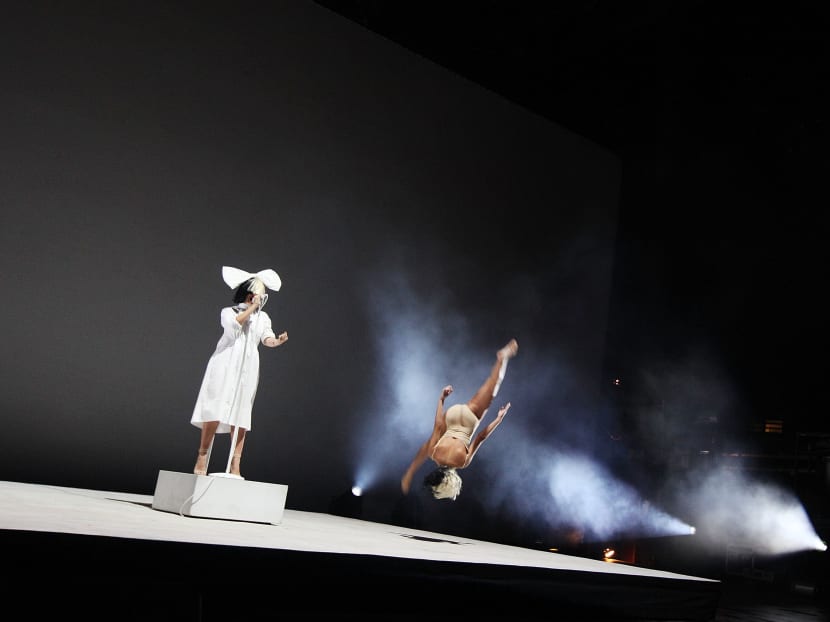
Sia (left) performs with an interpretive dancer at Series Fest: Season Two in Morrison, Colorado. Photo: AFP
NEW YORK — Sia — the enigmatic, soulful singer-songwriter who conceals her face behind wigs while belting out lines like, “there’s a scream inside that we all try to hide” — was “expelled from ballet at age 5”, as she put it in an e-mail interview, “for disrupting the class”.
Happily, the experience didn’t stop her from loving dance.
Over the past few years, Sia, with her choreographer, Ryan Heffington, has done more to raise the standards of dance in pop music than nearly any current artist integrating the forms. For Sia, dance is more than a way to give a music video a splash of pizazz; instead, it is “an expression that crosses all language barriers”, she said. “If people can’t understand the words, they will understand the content.”
The Sia-Heffington approach will be on ample display in Sia’s new show, opening on Sunday (July 24) as part of Panorama at Randalls Island in New York and will tour Europe and the United States through November. Sia calls the concert, choreographed from start to finish, “performance art that is dance driven”.
That is not a bad description of her videos and live performances on programmes like Saturday Night Live. Raw emotion bubbles inside of stringently built movement. And the real difference: She is not afraid of ugly. “I really like to support Ryan’s freak flag,” she said. “The weirder the better for me.”
Maddie Ziegler in Sia’s Chandelier — spinning and hopping madly while wearing a nude leotard — is a far cry from the typical dance in a pop video, where militaristic arrangements of back-up dancers follow the beat like human metronomes or, on the opposite end, sultry, slow-motion movement borders on soft porn.
The look of the touring show, which features five dancers, including Maddie (also formerly of the TV show Dance Moms) is straightforward. As Sia sings her hits and songs from her latest album, This Is Acting, she is joined by dancers on a generally bare, rectangular stage. (The cast also highlights Nick Lanzisera and Wyatt Rocker, who appear in Sia’s Cheap Thrills video.) “There’s not a lot of wild lighting,” Heffington said. “There are these interstitial moments that are either choreography or verbal sounds — breathing, text, mumbling — that kind of are an extension of the piece either prior or post.”
Heffington does not believe that dance is underused in pop music — more that it is abused much of the time by adhering to an easy formula. “We established the artist and back-up dancers, I believe, in the early 1980s,” he said. “There has to be evolution, and there is. We’re doing it.”
He added: “I’m impressed when I go and see Beyonce in concert — I’m absolutely floored by the spectacle. I’m not emotionally charged or engaged at all.”
Heffington calls his approach to choreography human based. “When you do gestures, everyone knows what that feels like,” he said. “It doesn’t become a superhuman exercise onstage, but rather a story that we all know. Even if you haven’t been through it, you understand the emotion.”
His aesthetic, which would not feel out of place in the downtown New York dance scene, is a poetic mix of Yvonne Rainer, the postmodern dance legend who embraced pedestrian movement, and Darcel — or Darcel Leonard Wynne — the glamorous Solid Gold dancer.
Heffington, who has choreographed for many artists, including Arcade Fire (We Exist) and Florence and the Machine (The Odyssey), is increasingly in demand. Recently, he worked on Kenzo’s new perfume campaign, which includes a film directed by Spike Jonze. On July 30, he is to unveil a dance at the Broad Museum in Los Angeles for its Summer Happenings series.
As for Sia, Heffington said he grasped her music visually. “It’s really easy for me to translate,” he said. “It’s almost always instant. I trust; I feel something. Of course, there is a lot of direction from Sia. It’s not a long, painstaking rehearsal process. It comes and, sure, I fine-tune, but I don’t work on something and go, ‘Oh my God it’s not working’. It’s like an inner voice. I can’t nitpick, and I can’t deconstruct. It kills it for me.”
So far, Sia has left the dancing in her videos to others. “I love to dance,” she said. “I have always been the first on the dance floor, but I’m not teachable. I couldn’t learn ‘five, six, seven, eight’ if my life depended on it. Ryan keeps trying to convince me to do a video myself, and I find that so flattering, but I’m too afraid or lazy.”
But Heffington is interested in more than technique: “It’s not about the extreme conditioning that we sometimes think makes the best dancer,” he said. “It’s more about accessing the human story through dance.”
And when he listens to Sia’s voice, he said, it is as if the lyrics are stripped away. “God knows I don’t even know the Chandelier lyrics. Of course, we didn’t do a literal interpretation, so I didn’t really have to listen to them, but it’s not where I draw my inspiration from when I’m hearing the music,” he said. “It’s emotional, expressive, how the voice snakes up and pulls back.” THE NEW YORK TIMES
Stay in the know. Anytime. Anywhere.

Subscribe to our newsletter for the top features, insights and must reads delivered straight to your inbox.
By clicking subscribe, I agree for my personal data to be used to send me TODAY newsletters, promotional offers and for research and analysis.






