
Playing games with your brain
SINGAPORE — Jason Silva wants to trick, befuddle and blow his audience’s mind every week — all in the name of educating people.
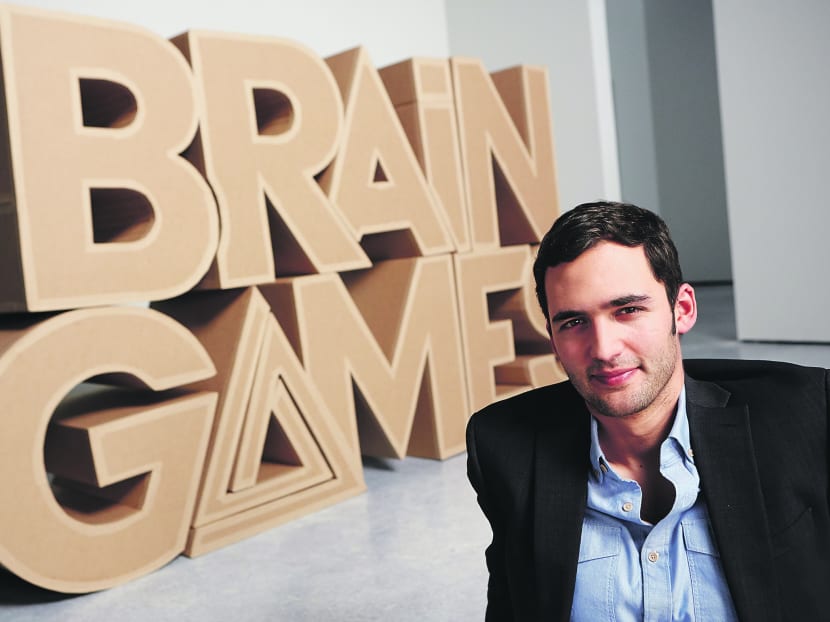
Jason Silva is host of the National Geographic Channel series Brain Games. Photo: NGC


SINGAPORE — Jason Silva wants to trick, befuddle and blow his audience’s mind every week — all in the name of educating people.
Silva is the host of Brain Games, the TV show which explores the way our brains work by poking holes in their workings. Through a series of tricks, illusions and, yes, mind games that he puts the viewers through in every episode, Silva reveals insights into how the brain works. From rabbits that appear to be ducks to a cardboard dragon that appears to turn its head to look at you, each episode confounds viewers and then explains it all to them.
The reason why the human brain is so easily fooled, Silva said, is because it has evolved to deal with excess information from the world in as efficient a way as possible. “I sometimes use the metaphor of compressing video for the Internet,” he said. “Even with high-speed Internet, you still need to come up with an interesting codex to compress high-definition video so that it’s a small enough file that we can send it through the Web.”
“In a way the brain is the same. The brain cannot process the entirety of the world out there. It would be more data than the brain can handle.”
So the brain has to make edits. “And those edits don’t have to be perfect. All they have to be is accurate enough for us to survive.”
One of the things that amazes him, for example, is human vision and how our brain perceives it. We go through a world that seems like it’s in high resolution 3D, he said, but in truth, our eyes only really receive low resolution, 2D images. “Our brain literally takes that signal and up-converts it. It fills in the holes, and completes the information. So that it can create a representation for us.”
One episode of the show tests people’s inputs by seeing if they can tell if a cheerleader in their peripheral vision is a man or a woman. (They can’t.)
“What this shows us is that what we call reality is a co-production,” Silva said, adding that what we perceive as reality is, in actual fact, a co-production between what the senses pick up and what the brain fills in on its own. “The brain does this all the time. We extrapolate conclusions from limited observation.”
And those gaps are where optical illusions and other visual tricks fall.
Still, despite all its shortcomings, Silva is amazed by the way the human mind works. “The brain is the seat of consciousness. The brain that is so easy to trick is the same brain that builds skyscrapers and jet engines and wireless telephones. The brain is responsible for human imagination, for all these technologies that help us transcend all these limitations.”
And what, if anything, can we do to keep our minds sharp enough to overcome these pitfalls? Exercise it, Silva said, just like you would any other muscle. “We encourage people to step out of their comfort zone. Do something radically different, immerse themselves in a new language, learn an instrument, even think of a different route to work every day.
“Anything that you do that is different, that is novel, engages the brain, encourages the brain to create new neural pathways.” June Yang
Brain Games airs every Tuesday at 10pm on the National Geographic Channel (StarHub TV Ch 411 or SingTel MioTV Ch 201).
Stay in the know. Anytime. Anywhere.

Subscribe to our newsletter for the top features, insights and must reads delivered straight to your inbox.
By clicking subscribe, I agree for my personal data to be used to send me TODAY newsletters, promotional offers and for research and analysis.